EAP511S - ENGLISH FOR ACADEMIC PURPOSES - 1ST OPP - NOVEMEBR 2025


EAP511S - ENGLISH FOR ACADEMIC PURPOSES - 1ST OPP - NOVEMEBR 2025


1 Pages 1-10

▲back to top


1.1 Page 1

▲back to top


nAmlBIA UnlVERSITY
OF SCI En CE Ano TECH n OLOGY
FACULTY OF COMMERCE, HUMAN SCIENCES AND EDUCATION
DEPARTMENT OF COMMUNICATION AND LANGUAGES
QUALIFICATION : ALL
QUALIFICATION CODE: VARIOUS
COURSE CODE: EAP5111S
LEVEL: 5
MODE FM, PM, DI
COURSE NAME: ENGLISH FOR ACADEMIC PURPOSES
SESSION: OCTOBER 2025
DURATION: 3 HOURS
PAPER:
MARKS:
THEORY
100
FIRST OPPORTUNITY EXAMINATION QUESTION PAPER
EXAMINER($)
Ms T. Kanime
Mr C. Gwasira
Ms Y. Lyamine
Mr E. Shilemba
Ms R. Ndengu
Ms M . Simon
Ms M. Hashoongo
Dr P. Midzi
Mr V. Enka Ii
Ms E. Limwena
MODERATOR: Dr S. Ashikuti
INSTRUCTIONS
1. Answer ALL the questions.
2. Write clearly and neatly.
3. Number the answers clearly.
4. Check instructions for each question carefully.
THIS QUESTION PAPER CONSISTS OF _13_ PAGES {Including this front page)

1.2 Page 2

▲back to top


QUESTION 1: READING COMPREHENSION
[20 marks)
Read the following research article and answer the question below. The original article has
been adapted for assessment purposes.
The Association between Time Spent in Domestic Work and Mental Health among Women and Men
Anu Molarius and Alexandra Metsini
Abstract
A Unpaid domestic work has been found to be negatively associated with mental health,
especially among women, in previous studies but the measures of domestic work vary. The
aim of this study was to elucidate the association between time spent in domestic work and
mental health in the general population. The study is based on 14,184 women and men aged
30-69 years who responded to a survey questionnaire in Central Sweden in 2017 (overall
response rate: 43%}. Multivariate logistic regression models, adjusting for age group,
educational level, family status, employment status, economic difficulties, and social support,
were used to study the association between hours spent in domestic work and depressive
symptoms and self-reported diagnosed depression, respectively. In total, 26.7% of the
respondents reported depressive symptoms and 8.8% reported diagnosed depression. No
independent associations between hours spent in domestic work and depressive symptoms
were found. Among women, the lowest prevalence of depression was found among those who
spend 11-30 h per week in domestic work. Among men, the prevalence of self-reported
diagnosed depression was highest among those who spend 0-2 h per week in domestic work,
but no other statistically significant associations between time spent in domestic work and
depression were found. In addition, a strong dose-response relationship was found between
experiencing domestic work as burdensome and both depressive symptoms and self-reported
diagnosed depression among women and men. Investigating time spent in unpaid domestic
work may not be sufficient to assess the association between exposure to domestic work and
mental health. Conversely, strain in domestic work may be a more important factor
contributing to the prevalence of poor mental health in the general population.
Introduction
B
In general, women spend a disproportionate amount of their time carrying out three
quarters of the world's unpaid work [1]. In contrast to paid work, fewer studies have
investigated the association between unpaid domestic work and mental health . Recently,
several studies have raised this important but under-researched topic. The COVID-19 pandemic
has made the association between domestic work and mental health more visible, especially
among women, due to the increased burden of unpaid domestic work [2,3]. According to Seedat
and Rondon [4], time spent on care and domestic work increased for both men and women

1.3 Page 3

▲back to top


during the COVID-19 pandemic, but the increase and intensity of this work were far greater
for women. Since unpaid domestic work is associated with poor mental health [5,6], the risk
of poor mental health among women engaged in unpaid work rose during the pandemic, due
to exposure to greater and more stressful workloads [2,3, 7]. Although most of the studies
that have investigated the association between unpaid domestic work and mental health have
been from high-income countries, previous studies have, for instance, shown that unpaid
caregivers are more anxious and depressed than non-caregivers in low- and middle-income
countries [8,9] .
Methods
C
The current study is based on women and men aged 30-69 years who responded to a
. postal survey questionnaire sent to a random population sample during March-May 2017. The
sampling frame was the population register at Statistics Sweden, the statistical administrative
authority in Sweden, covering all inhabitants of the study area. The data collection was
completed after two postal reminders. The aim of the survey was to monitor living conditions,
lifestyle factors, and health in the general population. A total of 14,184 subjects in this age group
answered the questionnaire including questions on domestic work [14]. The overall response
rate was 43%. The area investigated covers 55 municipalities in five counties with more than
one million inhabitants in Central Sweden.
Ethical Considerations
D The individuals in the sample were informed that responded questionnaires would be
linked to the Swedish official registries through personal identification numbers, to achieve
information on gender, age, and educational level. The respondents, thus, accepted the linking
of registry data by informed consent. The personal identification numbers were deleted directly
after the record linkage. Statistics Sweden carried out the sampling, collected the data,
performed the linkage with register data, and delivered de-identified data to the county
councils/regions . All procedures involving human subjects were approved by the Regional Ethics
Board in Uppsala (EPN 2015/417). The data are protected according to the Public and Privacy Act
(2009:400, Chapter 24, Section 8).
Statistical Analyses
E
The analyses were performed separately for men and women. The associations between
hours spent in domestic work and depressive symptoms as well as self-reported diagnosed
depression were analyzed using multivariate logistic regressions. Since there is a U-shaped
association between hours spent in domestic work and burdensome domestic work [16],
spending 3-10 h per week was used as the reference category. Age group, educational level,
family status, employment status, economic difficulties, and social support were treated as
potential confounders and adjusted for in the regression models. In the final model, the odds
ratios were also adjusted for burdensome domestic work. The results are reported as odds ratios
(OR) and 95 percent confidence intervals (95% Cl) for depressive symptoms and self-reported
diagnosed depression, respectively.
2

1.4 Page 4

▲back to top


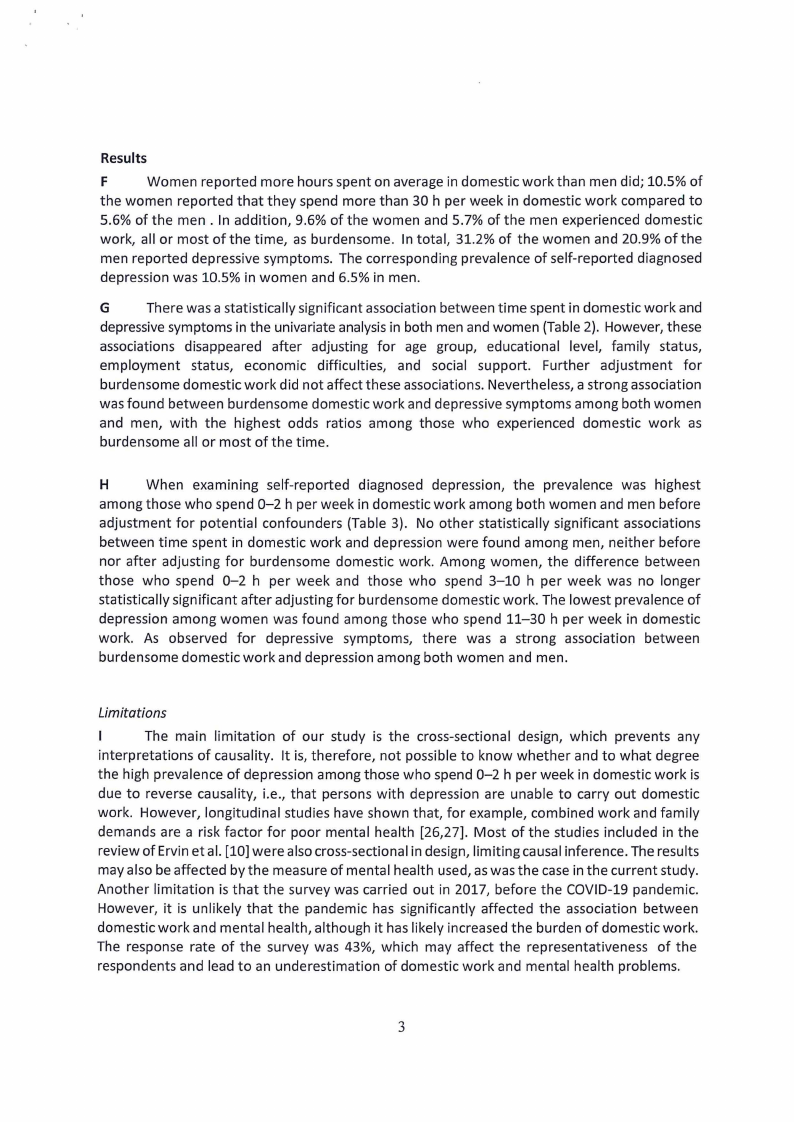
Results
F
Women reported more hours spent on average in domestic work than men did; 10.5% of
the women reported that they spend more than 30 h per week in domestic work compared to
5.6% of the men. In addition, 9.6% of the women and 5.7% of the men experienced domestic
work, all or most of the time, as burdensome. In total, 31.2% of the women and 20.9% of the
men reported depressive symptoms. The corresponding prevalence of self-reported diagnosed
depression was 10.5% in women and 6.5% in men.
G
There was a statistically significant association between time spent in domestic work and
depressive symptoms in the univariate analysis in both men and women {Table 2). However, these
associations disappeared after adjusting for age group, educational level, family status,
employment status, economic difficulties, and social support. Further adjustment for
burdensome domestic work did not affect these associations. Nevertheless, a strong association
was found between burdensome domestic work and depressive symptoms among both women
and men, with the highest odds ratios among those who experienced domestic work as
burdensome all or most of the time.
H
When examining self-reported diagnosed depression, the prevalence was highest
among those who spend 0-2 h per week in domestic work among both women and men before
adjustment for potential confounders (Table 3). No other statistically significant associations
between time spent in domestic work and depression were found among men, neither before
nor after adjusting for burdensome domestic work. Among women, the difference between
those who spend 0-2 h per week and those who spend 3-10 h per week was no longer
statistically significant after adjusting for burdensome domestic work. The lowest prevalence of
depression among women was found among those who spend 11-30 h per week in domestic
work. As observed for depressive symptoms, there was a strong association between
burdensome domestic work and depression among both women and men .
Limitations
The main limitation of our study is the cross-sectional design, which prevents any
interpretations of causality. It is, therefore, not possible to know whether and to what degree
the high prevalence of depression among those who spend 0-2 h per week in domestic work is
due to reverse causality, i.e., that persons with depression are unable to carry out domestic
work. However, longitudinal studies have shown that, for example, combined work and family
demands are a risk factor for poor mental health [26,27] . Most of the studies included in the
review of Ervin et al. [10] were also cross-sectional in design, limiting causal inference. The results
may also be affected by the measure of mental health used, as was the case in the current study.
Another limitation is that the survey was carried out in 2017, before the COVID-19 pandemic.
However, it is unlikely that the pandemic has significantly affected the association between
domestic work and mental health, although it has likely increased the burden of domestic work.
The response rate of the survey was 43%, which may affect the representativeness of the
respondents and lead to an underestimation of domestic work and mental health problems.
3

1.5 Page 5

▲back to top


J
Another limitation regards the validity of the measures of domestic work. There are,
however, no validated measures to examine domestic work due to the lack of research in this
field [10,11,25] . The question on depressive symptoms was identical to the question used in the
national public health survey in Sweden [15]. Diagnosed depression was self-reported, and the
prevalence was somewhat lower {9%} than the proportion using antidepressants {12%} in this
age range in 2017 in Sweden [28]. Previous studies have however found that self-reported
clinician -diagnosed depression is of adequate validity to measure depression [29,30].
K
One of the strengths of the current study is that it is based on a considerable random
sample of the general population. The study population also included a reasonable pro- portion
of both women and men, which is important since many of the studies on this association have
only included women [22-25]. A further strength is that the study was not restricted to
employed persons or parents with children.
Reading comprehension questions
1. Who wrote this research article?
(2)
2. What was the main aim of this study?
(2)
3. In which country and year was the survey conducted?
(2)
4. What percentage of respondents reported depressive symptoms?
(1)
5. What can be inferred about the relationship between domestic work and mental health
in men who do very little domestic work?
(2)
6. What does the term "dose-response relationship" imply in the context of this study? (2)
7. Who approved all the procedures that involved human subjects in the study?
(1)
8. What do each of the balded pronouns in Paragraph B refer to?
(4)
a) the ir
b) this
c) both
d) that
9. The authors use various cohesive devices to indicate the direction of argument between
and within sentences and paragraphs. Identify an example of a cohesive device that
indicates the following:
(4)
a) Exemplification
b) Consequence
c) Addition
d) Contrasting
[Paragraph B]
[Paragraph D]
[Paragraph F]
[Paragraph G]
4

1.6 Page 6

▲back to top


QUESTION 2: LANGUAGE USAGE
[15 marks]
Re-read the extract below from the previous research article and answer the questions that
follow.
Statistical Analyses
The analyses were performed separately for men and women. The associations between hours
spent in domestic work and depressive symptoms as well as self-reported diagnosed depression
were analyzed using multivariate logistic regressions. Since there is a U-shaped association
between hours spent in domestic work and burdensome domestic work [16], spending 3-10 h
per week was used as the reference category. Age group, educational level, family status,
employment status, economic difficulties, and social support were treated as potential
confounders and adjusted for in the regression models. In the final model, the odds ratios were
also adjusted for burdensome domestic work. The results are reported as odds ratios {OR} and
95 percent confidence intervals (95% Cl} for depressive symptoms and self-reported diagnosed
depression, respectively.
1. In the word "analyses" identify the free morpheme and the bound morpheme.
(2)
2. In the word multivariate, what does the prefix "multi-" mean?
(1)
3. In the word "employment", what part of speech does the suffix "-ment" turn the word
into?
(2t
4. What type of word is "depressive" according to its morpheme structure?
(2)
5. State whether the balded suffixes in the following words from the extract are
inflectional or derivational.
(3}
a} Economic
b} difficulties
c) educational
6. Which word formation process is responsible for the formation of each of the
following words from the extract?
(3)
a) self-reported
b} OR
c) respectively
5

1.7 Page 7

▲back to top


7. Indicate whether the underlined adjective in the following sentence is correctly placed
or not?
(1)
In the final model, the odds ratios were also adjusted for burdensome domestic work.
8. Find the adverb in the following sentence.
(1)
The analyses were performed separately for men and women.
QUESTION 3: RESEARCH WRITING
[15 marks]
Reread the article you read for the reading comprehension question, focusing on Paragraphs C-
K, and answer the following questions.
1. What type of sampling method was used in the study?
(1)
2. How many participants did the study have?
(1)
3. Explain how the informed consent of the participants in this study was obtained . (3)
4. Why was it necessary to delete personal identification numbers after record linkage? (1)
5. The study had six limitations. Mention any four.
(4)
6. A student rewrote the title of the research article you have been reading as follows:
Examining the Impact of Domestic Work Duration on Mental Health among Women and Men in
Urban Areas in Sweden
From the above new title, identify:
a) The word specifying the action being done in the study
(1)
b) The phrase specifying the topic of the study
(2)
c) The phrase specifying the scope of the study in terms of geographical location
(2)
QUESTION 4: ACADEMIC WRITING
[20 marks]
Read each of the following scenarios, and answer each question that follows to demonstrate
your knowledge of the characteristics of academic writing conventions.
(6)
1. You are reviewing a friend's academic essay. One sentence reads:
6

1.8 Page 8

▲back to top


Evidence shows that this theory doesn't work in modern classrooms.
Which revision will best improve the formality of this sentence?
a) Evidence shows that this theory doesn't work in modern classrooms.
b) Evidence shows that this theory does not work in modern classrooms.
c) It seems that this theory doesn't work in contemporary educational settings.
d) This theory doesn't work in today's schools.
2. Your lecturer saw the following sentence in your assignment, and told you to revise it to
make it more objective.
I believe that on line learning has benefits for students.
Which of the following revisions demonstrates objectivity?
a) It is my belief that on line learning has benefits for students.
b) Online learning is beneficial, in my opinion.
c) One may suggest that online learning is beneficial for students.
d) I think online learning is beneficial.
3. An environmental science student wrote the sentence below.
This intervention will improve student performance.
During the editing stage, the student remembered tentativeness and revised the above
sentence to make it more tentative. Which revision best reflects tentativeness?
a) This intervention might improve student performance.
b) This intervention will improve student performance.
c) This intervention is guaranteed to work.
d) This intervention is the best way to improve performance.
4. The following paragraph has the following ten errors
a) a run-on sentence
b) a missing-s -s inflectional morpheme for plural
c) two capital letter mistake
d) a missing closing quotation mark
7

1.9 Page 9

▲back to top


e) a subject-verb agreement mistake
f) a missing comma after a cohesive device
g) two incorrect spellings
h) a demonstrative adjective grammatical error
Now that you are aware of the errors, read the paragraph and then rewrite the paragraph to
correct all ten errors. When you are done, underline each of the five corrections you have
made. No marks will be awarded for a correction that has not been underlined.
Agriculture play a vital role in many economies it provides food, employment, and raw
materials for industries. Farmer often rely on seasonal rainfall to grow their crops, but climate
change has made wether patterns more unpredictable. According to the ministry of agriculture,
"sustainable farming practices are essential for long-term productivity. This practices include
crop rotation, organic fertilization and water conservation. In addition farmers must adopt to
new technologies that improve efficiency and reduce environmental impact.
QUESTION 5: TEXT STRUCTURE
[15 marks]
Question 1
There are several different patterns of organisation. The table below lists some patterns of text
organisation that students are expected to know. Study the table and match each pattern to its
most appropriate use. In your answer booklet, write the answers using this format: 1 Cause
and effect =a
(S)
Column A: Patterns of text organization
1. Cause and effect
2. Time order
3. Spatial
Column B: When it is most appropriate to
use
a) If author wants to list, events, or
historical periods in chronological
order
b) If author wants to show that one
thing (or idea) is the result of another.
c) If author wants to examine two or
more things (or ideas) and notes how
hey are different.
8

1.10 Page 10

▲back to top


4. Problem and solution
5. Contrast
d) If author wants to describe objects,
features, or locations as they relate to
each other in a space.
e) If author wants to express a dilemma
or issue followed by a remedy.
Question 2
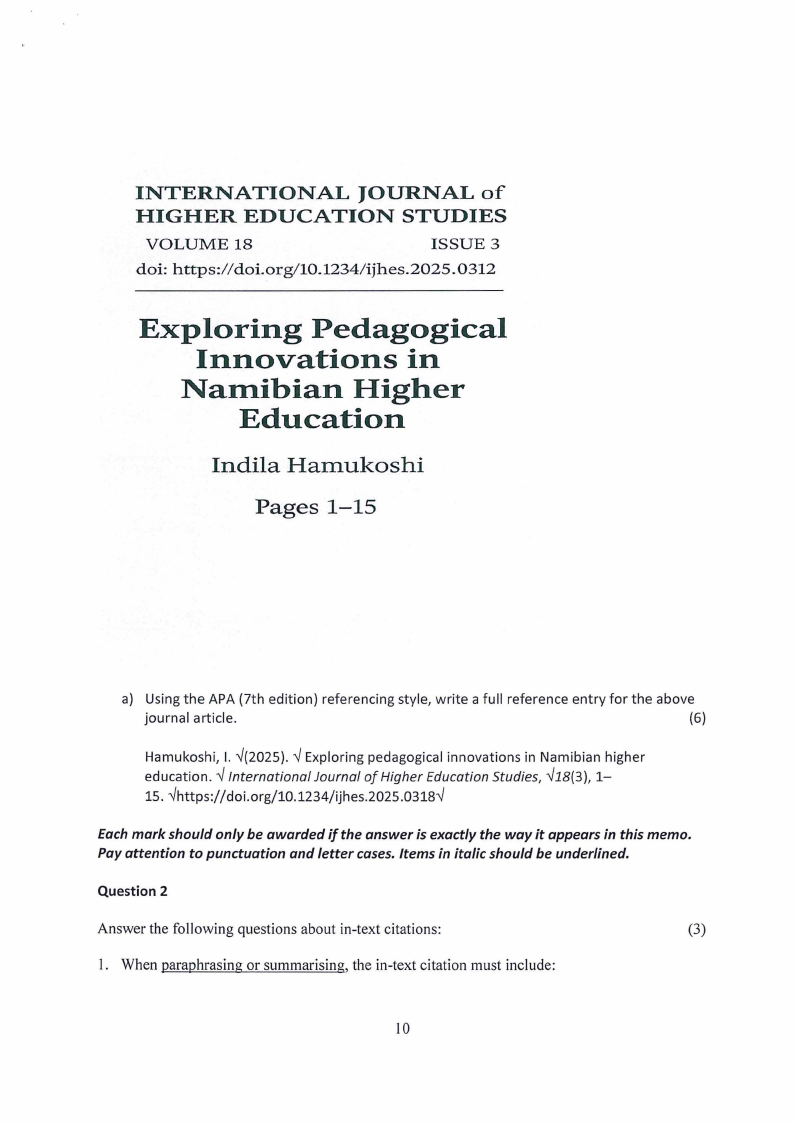
Use the Venn diagram below to write a compare and contrast paragraph on two major
environmental concerns.
(10)
Air
Pollution
Water
Pollution
• Emissions from
vehicles
• Industrial processes
Health
risks
Environmental
impact
• Respiratory problems Pollutant
sources
• Heulth risks
• Environmental impac
• Wastewater d ischarge
• Chemical runoff
• Contaminated drinking
w ater
Commevts
The paragraph should contain:
a) an appropriate topic sentence
b) two sentences providing comparisons
c) two sentences providing contrasts
d) a concluding senten·ce
e) three compare and contrast cohesive devices
QUESTION 6: REFERENCING
Question 1
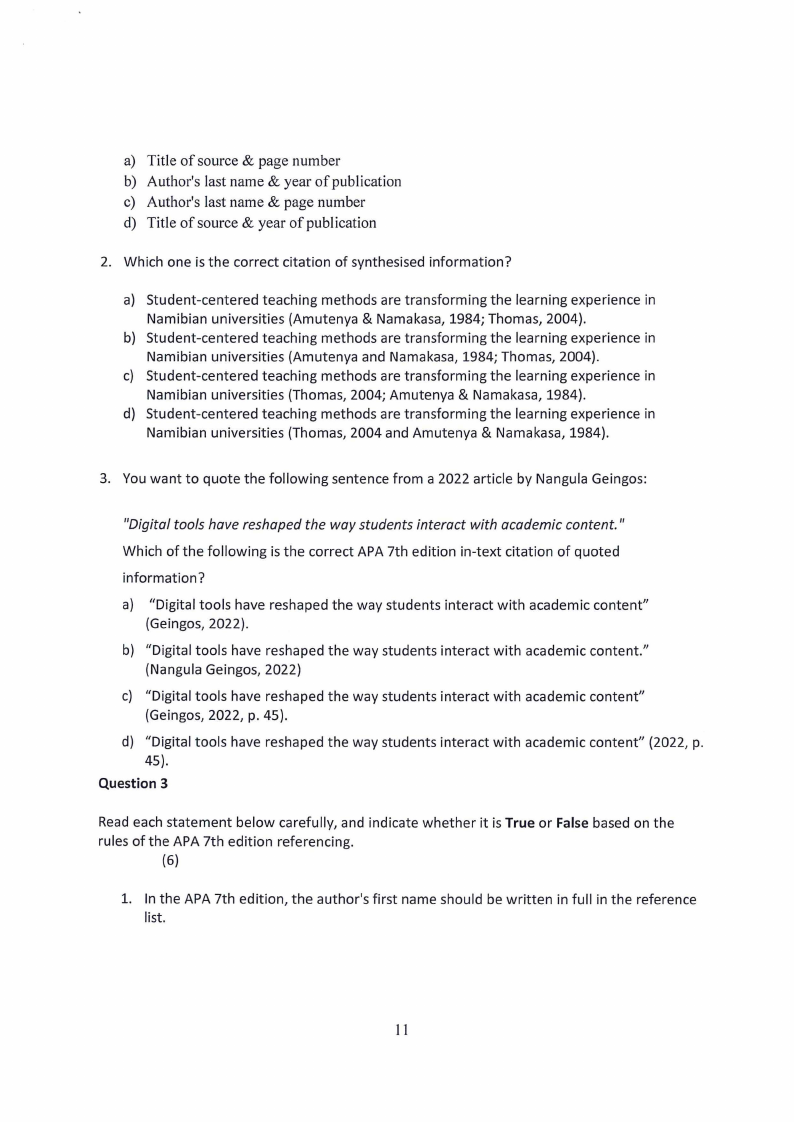
Study the picture below of the first page of a journal article.
[15 marks]
9

2 Pages 11-20

▲back to top


2.1 Page 11

▲back to top


INTERNATIONAL JOURNAL of
HIGHER EDUCATION STUDIES
VOLUME 18
ISSUE 3
doi: https://doi.org/10.1234/ijhes.2025. 0312
Exploring Pedagogical
Innovations in
Namibian Higher
Education
Indila Hamukoshi
Pages 1-15
a) Using the APA (7th edition) referencing style, write a full reference entry for the above
journal article.
(6)
Hamukoshi, I. ✓(2025). ✓ Exploring pedagogical innovations in Namibian higher
education. ✓ International Journal of Higher Education Studies, ✓18(3), 1-
15. ✓https://doi.org/10 . 1234/ijhes.2025.0318 ✓
Each mark should only be awarded if the answer is exactly the way it appears in this memo.
Pay attention to punctuation and letter cases. Items in italic should be underlined.
Question 2
Answer the following questions about in-text citations:
(3)
1. When paraphrasing or summarising, the in-text citation must include:

2.2 Page 12

▲back to top


a) Title of source & page number
b) Author's last name & year of publication
c) Author's last name & page number
d) Title of source & year of publication
2. Which one is the correct citation of synthesised information?
a) Student-centered teaching methods are transforming the learning experience in
Namibian universities (Amutenya & Namakasa, 1984; Thomas, 2004).
b) Student-centered teaching methods are transforming the learning experience in
Namibian universities (Amutenya and Namakasa, 1984; Thomas, 2004).
c) Student-centered teaching methods are transforming the learning experience in
Namibian universities (Thomas, 2004; Amutenya & Namakasa, 1984).
d) Student-centered teaching methods are transforming the learning experience in
Namibian universities (Thomas, 2004 and Amutenya & Namakasa, 1984).
3. You want to quote the following sentence from a 2022 article by Nangula Geingos:
"Digital tools have reshaped the way students interact with academic content."
Which of the following is the correct APA 7th edition in-text citation of quoted
information?
a) "Digital tools have reshaped the way students interact with academic content"
(Geingos, 2022).
b) "Digital tools have reshaped the way students interact with academic content."
(Nangula Geingos, 2022)
c) "Digital tools have reshaped the way students interact with academic content"
(Geingos, 2022, p. 45).
d) "Digital tools have reshaped the way students interact with academic content" (2022, p.
45) .
Question 3
Read each statement below carefully, and indicate whether it is True or False based on the
rules of the APA 7th edition referencing.
(6)
1. In the APA 7th edition, the author's first name should be written in full in the reference
list.
II

2.3 Page 13

▲back to top


2. The APA 7th edition requires the use of italics for journal titles and volume numbers in
the reference list.
3. When quoting directly from a source, the APA 7th edition requires the inclusion of the
page number.
4. In the APA 7th edition, the reference list should be ordered by the date of publication,
starting with the most recent.
5. The APA 7th edition requires the use of "et al." in in-text citations when a source has
three or more authors.
6. The title of a journal article should be written in title case and italicised in the reference
list.
12