


 |
PTS710S-PLANT STUDIES 2-1ST OPP- JUNE 2025 |
|
|
1 Page 1 |
▲back to top |
n Am I BI A u n IVE RS ITV
OF SCIEnCE Ano TECHn0L0GY
FACULTY OF HEALTH, NATURAL RESOURCES AND APPLIED SCIENCES
DEPARTMENT OF NATURAL RESOURCES SCIENCES
QUALIFICATION: BACHELOR OF NATURAL RESOURCE MANAGEMENT
QUALIFICATION CODE: 07BNRS
LEVEL: 7
COURSE CODE: PTS710S
COURSE NAME: PLANT STUDIES 2
SESSION: JUNE 2025
DURATION: 2 HOURS
PAPER: THEORY {PAPER 1)
MARKS: 100
EXAMINER(S)
FIRST OPPORTUNITY EXAMINATION QUESTION PAPER
PROF. JONATHAN MUTAU KAMWI
MODERATOR: PROF. E KWEMBEYA
INSTRUCTIONS
1. Answer ALL the questions.
2. Read all the questions carefully before answering.
3. Number the answers clearly
THIS QUESTION PAPER CONSISTS OF _3_ PAGES (Including this front page)
|
|
2 Page 2 |
▲back to top |
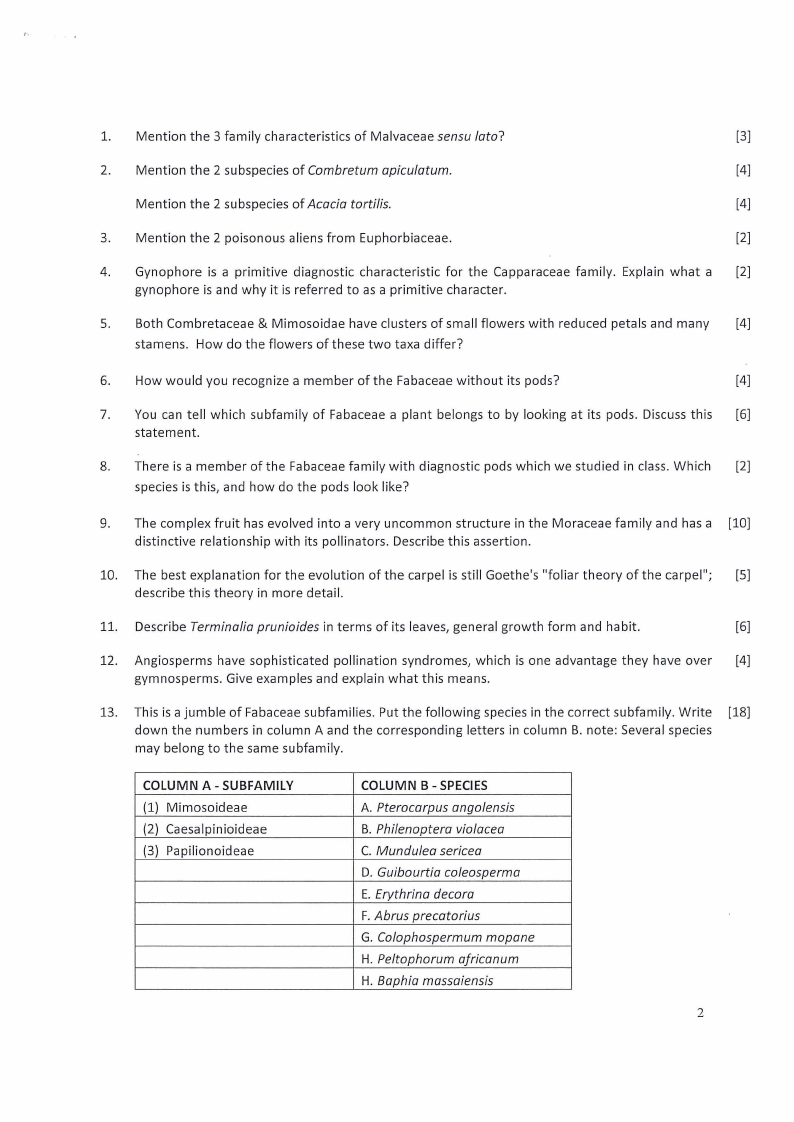
1. Mention the 3 family characteristics of Malvaceae sensu Iota?
(3)
2. Mention the 2 subspecies of Combretum apiculatum.
(4)
Mention the 2 subspecies of Acacia tortilis.
(4)
3. Mention the 2 poisonous aliens from Euphorbiaceae.
(2)
4. Gynophore is a primitive diagnostic characteristic for the Capparaceae family. Explain what a (2)
gynophore is and why it is referred to as a primitive character.
5. Both Combretaceae & Mimosoidae have clusters of small flowers with reduced petals and many (4)
stamens. How do the flowers of these two taxa differ?
6. How would you recognize a member of the Fabaceae without its pods?
(4)
7. You can tell which subfamily of Fabaceae a plant belongs to by looking at its pods. Discuss this (6)
statement.
8. There is a member of the Fabaceae family with diagnostic pods which we studied in class. Which (2)
species is this, and how do the pods look like?
9. The complex fruit has evolved into a very uncommon structure in the Moraceae family and has a [10)
distinctive relationship with its pollinators. Describe this assertion.
10. The best explanation for the evolution of the carpel is still Goethe's "foliar theory of the carpel"; [SJ
describe this theory in more detail.
11. Describe Terminalia prunioides in terms of its leaves, general growth form and habit.
[6)
12. Angiosperms have sophisticated pollination syndromes, which is one advantage they have over [4)
gymnosperms. Give examples and explain what this means.
13. This is a jumble of Fabaceae subfamilies. Put the following species in the correct subfamily. Write [18)
down the numbers in column A and the corresponding letters in column B. note: Several species
may belong to the same subfamily.
COLUMNA- SUBFAMILY
(1) Mimosoideae
(2) Caesalpinioideae
(3) Papilionoideae
COLUMNB - SPECIES
A. Pterocarpus ango/ensis
B. Philenoptera violacea
C. Mundulea sericea
D. Guibourtia co/eosperma
E. Erythrina decora
F. Abrus precatorius
G. Co/ophospermum mopane
H. Peltophorum africanum
H. Baphia massaiensis
2
|
|
3 Page 3 |
▲back to top |

J. Baikiaea p/urijuga
K. Burkea africana
L. Elephantorrhiza suffruticosa
M. Albizia anthelmintica
N. Dichrostachys cinerea
0. Faidherbia albida
P. Acacia reficiens
Q. Acacia luederitzii
R. Erythrophleum africanum
14. What was Darwin's contribution in plant classification during the 19th century?
[6]
15. Those who have never studied plants often mistakenly refer to the flower of a particular plant when [4]
in fact they mean the entire inflorescence. Please explain this statement by explaining the
difference between flowers and inflorescences.
16. Most members of Ebenaceae have persistent calyxes. Discuss this description and name other two (4]
genera in this family which are found in Namibia.
17. Describe the characteristics of a suffrutex plant.
[3]
18. Identify and describe any three problems the industry for Indigenous natural plant products is [9]
facing.
3