


 |
PTP610S - PLANT PHYSIOLOGY - 2ND OPP - JUNE 2025 |
|
|
1 Page 1 |
▲back to top |

n Am I BIA u n IVE Rs ITY
OF SCIEnCE Ano TECHn OLOGY
FACULTY OF HEALTH, NATURAL RESOURCESAND APPLIED SCIENCES
DEPARTMENT OF AGRICULTURAL SCIENCES AND AGRIBUSINESS
QUALIFICATION: BACHELOR OF SCIENCE IN HORTICULTURE
QUALIFICATION CODE: 07BHOR
LEVEL: 7
COURSE CODE: PTP610S
COURSE NAME: PLANT PHYSIOLOGY
DATE: JULY 2025
DURATION: 3 HOURS
MARKS: 100
SECOND OPPORTUNITY /SUPPLEMENTARY EXAMINATION QUESTION PAPER
EXAMINER(S) Dr Grace N. Kangueehi
MODERATOR: Dr Maliata Wanga
INSTRUCTIONS
1. Answer ALL the questions.
2. Write clearly and neatly.
3. Number the answers clearly.
PERMISSIBLE MATERIALS
1. Examination question paper
2. Answering book
THIS QUESTION PAPER CONSISTS OF 1 PAGE (Excluding this front page)
-
1\\Page
|
|
2 Page 2 |
▲back to top |
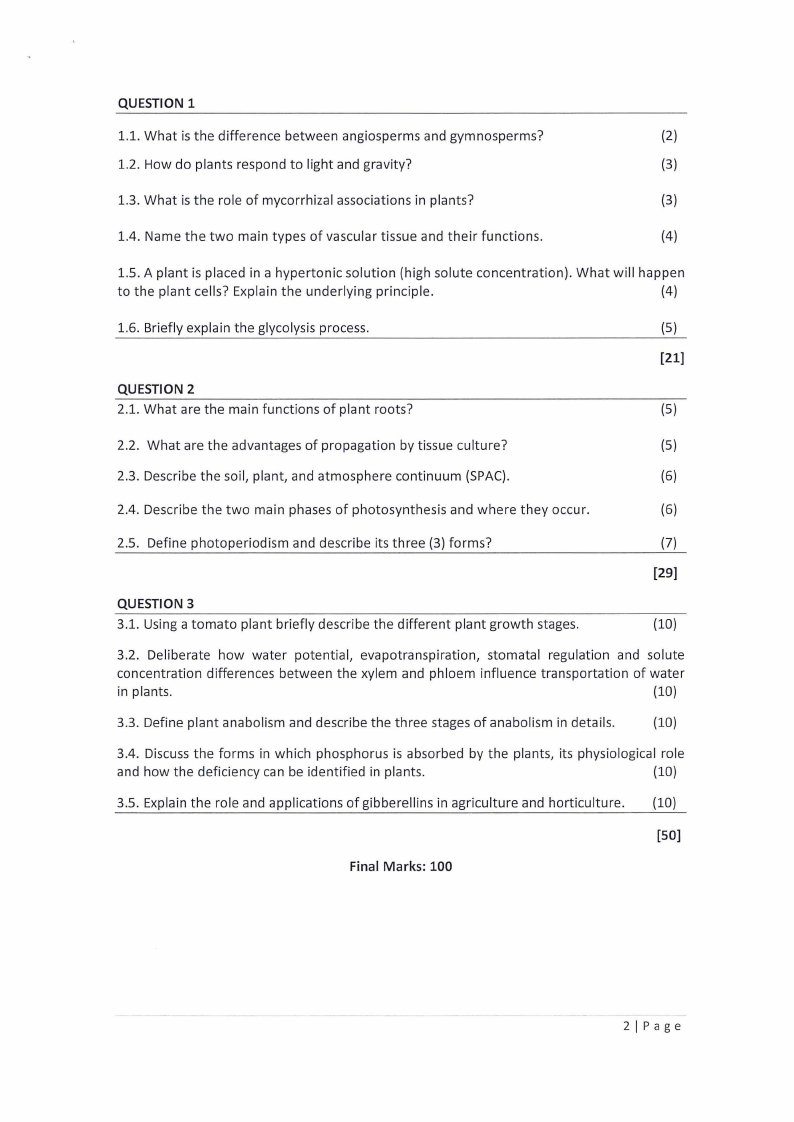
QUESTION 1
1.1. What is the difference between angiosperms and gymnosperms?
(2)
1.2. How do plants respond to light and gravity?
(3)
1.3. What is the role of mycorrhizal associations in plants?
(3)
1.4. Name the two main types of vascular tissue and their functions.
(4)
1.5. A plant is placed in a hypertonic solution (high solute concentration). What will happen
to the plant cells? Explain the underlying principle.
(4)
1.6. Briefly explain the glycolysis process.
(5)
[21]
QUESTION 2
2.1. What are the main functions of plant roots?
(5)
2.2. What are the advantages of propagation by tissue culture?
(5)
2.3. Describe the soil, plant, and atmosphere continuum (SPAC).
(6)
2.4. Describe the two main phases of photosynthesis and where they occur.
(6)
2.5. Define photoperiodism and describe its three (3) forms?
(7)
[29]
QUESTION 3
3.1. Using a tomato plant briefly describe the different plant growth stages.
(10)
3.2. Deliberate how water potential, evapotranspiration, stomata! regulation and solute
concentration differences between the xylem and phloem influence transportation of water
in plants.
(10)
3.3. Define plant anabolism and describe the three stages of anabolism in details.
(10)
3.4. Discuss the forms in which phosphorus is absorbed by the plants, its physiological role
and how the deficiency can be identified in plants.
(10)
3.5. Explain the role and applications of gibberellins in agriculture and horticulture.
(10)
[50]
Final Marks: 100
21Page