LPM521S - Law For Public Managers 1B - 1st Opp - Nov 2025


LPM521S - Law For Public Managers 1B - 1st Opp - Nov 2025


1 Pages 1-10

▲back to top


1.1 Page 1

▲back to top


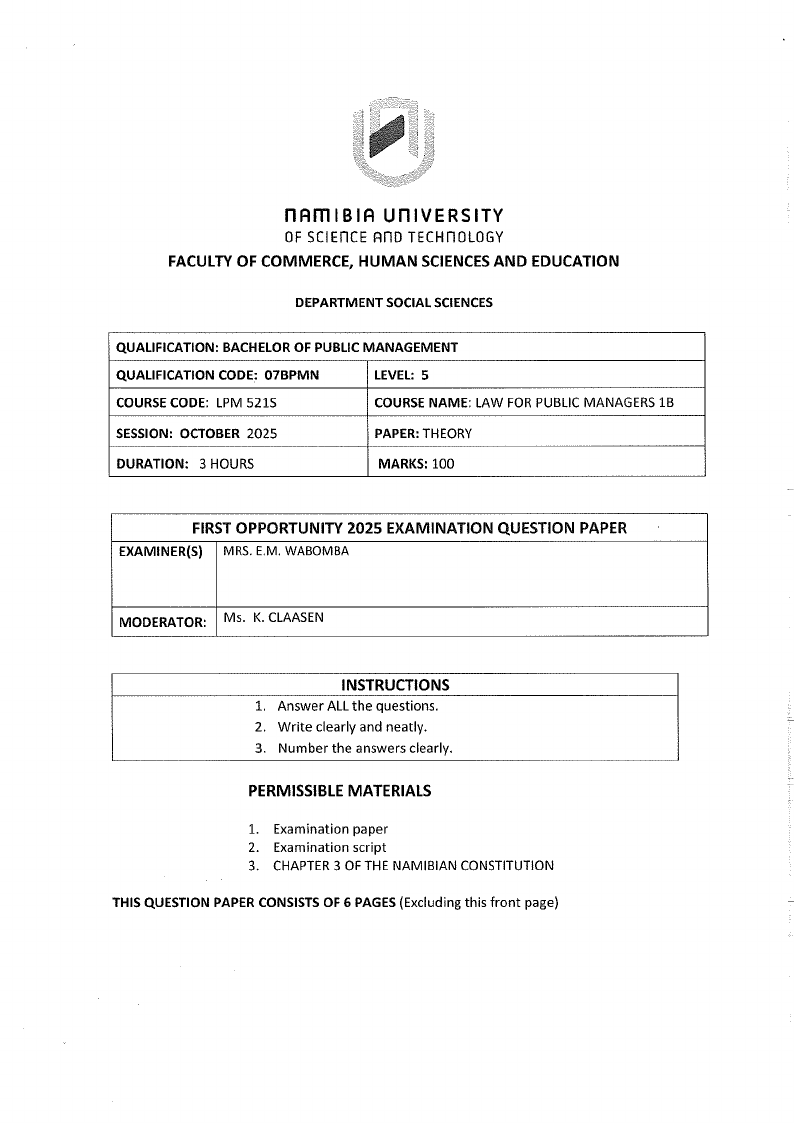
nAmlBIA UnlVERSITY
OF SCIEnCE Ano TECHnOLOGY
FACULTY OF COMMERCE, HUMAN SCIENCES AND EDUCATION
DEPARTMENT SOCIAL SCIENCES
QUALIFICATION: BACHELOR OF PUBLIC MANAGEMENT
QUALIFICATION CODE: 07BPMN
COURSE CODE: LPM 5215
LEVEL: 5
COURSE NAME: LAW FOR PUBLIC MANAGERS lB
SESSION: OCTOBER 2025
PAPER: THEORY
DURATION: 3 HOURS
MARKS: 100
FIRST OPPORTUNITY 2025 EXAMINATION QUESTION PAPER
EXAMINER($) MRS. E.M. WABOMBA
MODERATOR: Ms. K. CLAASEN
INSTRUCTIONS
1. Answer ALL the questions.
2. Write clearly and neatly.
3. Number the answers clearly.
PERMISSIBLE MATERIALS
1. Examination paper
2. Examination script
3. CHAPTER 3 OF THE NAMIBIAN CONSTITUTION
THIS QUESTION PAPER CONSISTS OF 6 PAGES (Excluding this front page)

1.2 Page 2

▲back to top


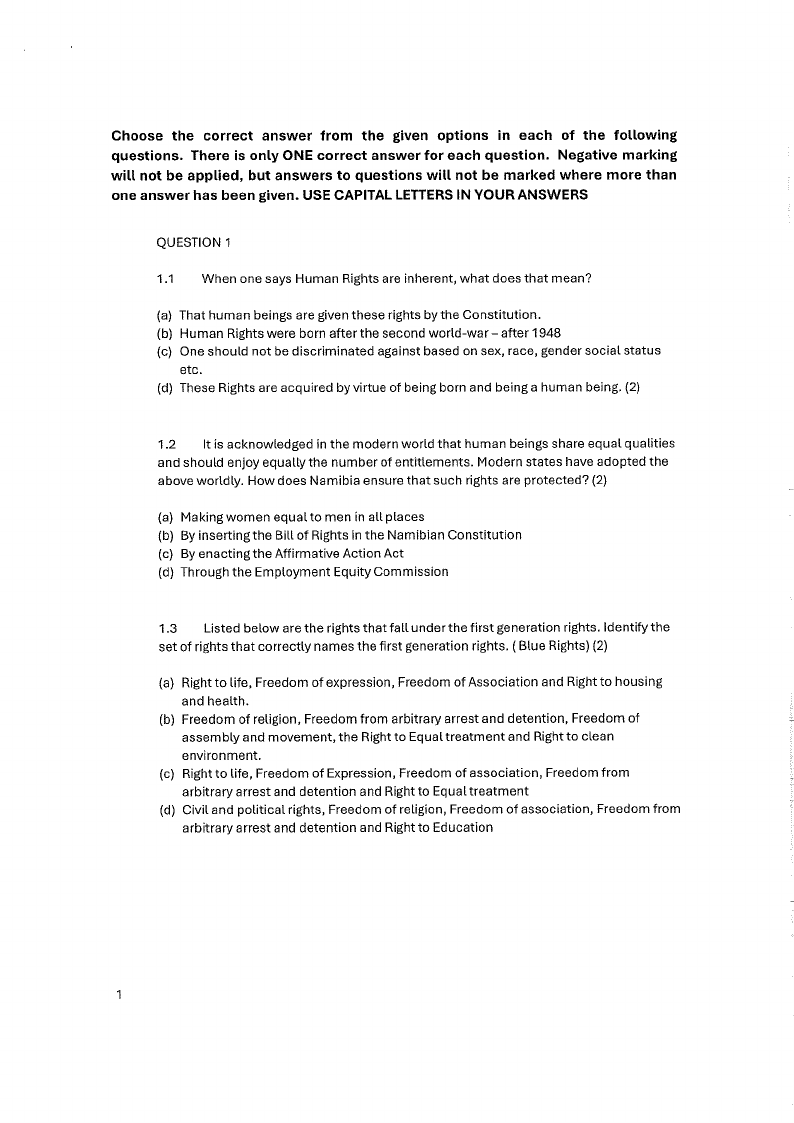
Choose the correct answer from the given options in each of the following
questions. There is only ONE correct answer for each question. Negative marking
will not be applied, but answers to questions will not be marked where more than
one answer has been given. USE CAPITAL LETTERS IN YOUR ANSWERS
QUESTION 1
1.1 When one says Human Rights are inherent, what does that mean?
(a) That human beings are given these rights by the Constitution.
(b) Human Rights were born after the second world-war- after 1948
(c) One should not be discriminated against based on sex, race, gender social status
etc.
(d) These Rights are acquired by virtue of being born and being a human being. (2)
1.2 It is acknowledged in the modern world that human beings share equal qualities
and should enjoy equally the number of entitlements. Modern states have adopted the
above worldly. How does Namibia ensure that such rights are protected? (2)
(a) Making women equal to men in all places
(b) By inserting the Bill of Rights in the Namibian Constitution
(c) By enacting the Affirmative Action Act
(d) Through the Employment Equity Commission
1.3 Listed below are the rights that fall under the first generation rights. ldentify the
set of rights that correctly names the first generation rights. ( Blue Rights) (2)
(a) Right to life, Freedom of expression, Freedom of Association and Right to housing
and health.
(b) Freedom of religion, Freedom from arbitrary arrest and detention, Freedom of
assembly and movement, the Right to Equal treatment and Right to clean
environment.
(c) Right to life, Freedom of Expression, Freedom of association, Freedom from
arbitrary arrest and detention and Right to Equal treatment
(d) Civil and political rights, Freedom of religion, Freedom of association, Freedom from
arbitrary arrest and detention and Right to Education
1

1.3 Page 3

▲back to top


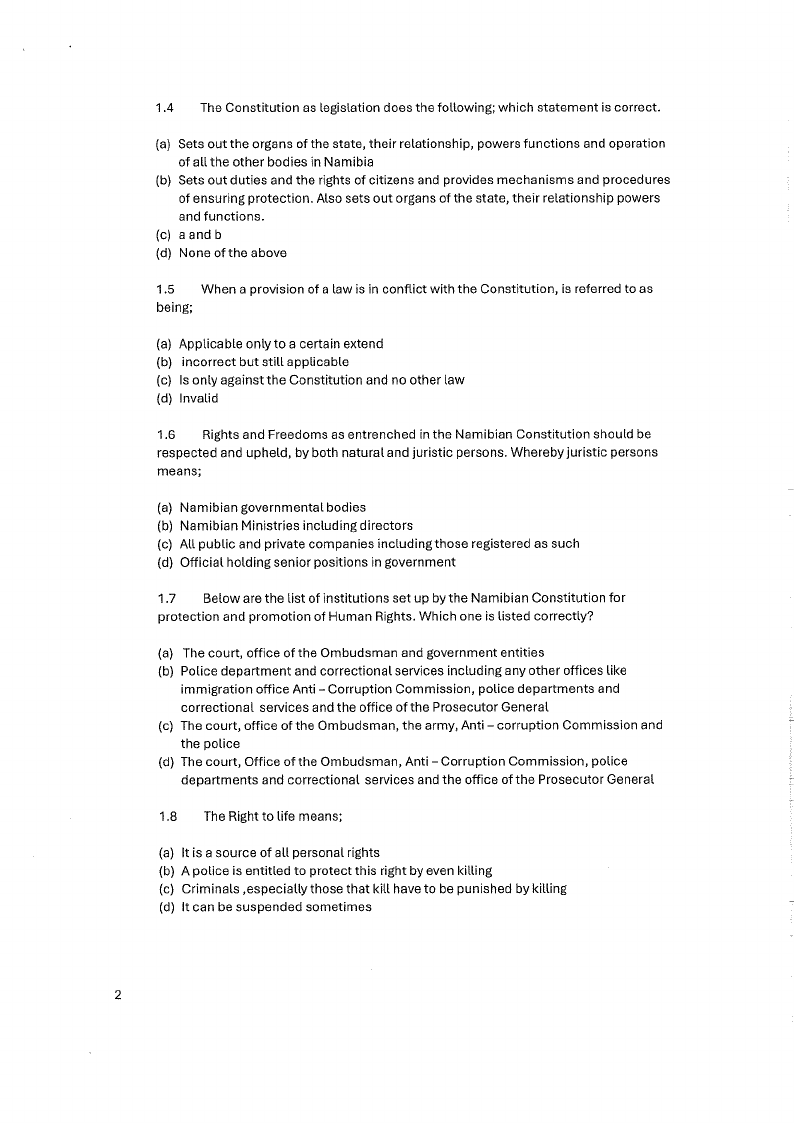
1.4 The Constitution as legislation does the following; which statement is correct.
(a) Sets out the organs of the state, their relationship, powers functions and operation
of all the other bodies in Namibia
(b) Sets out duties and the rights of citizens and provides mechanisms and procedures
of ensuring protection. Also sets out organs of the state, their relationship powers
and functions.
(c) a and b
(d) None of the above
1.5 When a provision of a law is in conflict with the Constitution, is referred to as
being;
(a) Applicable only to a certain extend
(b) incorrect but still applicable
(c) Is only against the Constitution and no other law
(d) Invalid
1.6 Rights and Freedoms as entrenched in the Namibian Constitution should be
respected and upheld, by both natural and juristic persons. Whereby juristic persons
means;
(a) Namibian governmental bodies
(b) Namibian Ministries including directors
(c) All public and private companies including those registered as such
(d) Official holding senior positions in government
1.7 Below are the list of institutions set up by the Namibian Constitution for
protection and promotion of Human Rights. Which one is listed correctly?
(a) The court, office of the Ombudsman and government entities
(b) Police department and correctional services including any other offices like
immigration office Anti - Corruption Commission, police departments and
correctional services and the office of the Prosecutor General
(c) The court, office of the Ombudsman, the army, Anti - corruption Commission and
the police
(d) The court, Office of the Ombudsman, Anti - Corruption Commission, police
departments and correctional services and the office of the Prosecutor General
1.8 The Right to life means;
(a) It is a source of all personal rights
(b) A police is entitled to protect this right by even killing
(c) Criminals ,especially those that kill have to be punished by killing
(d) It can be suspended sometimes
2

1.4 Page 4

▲back to top


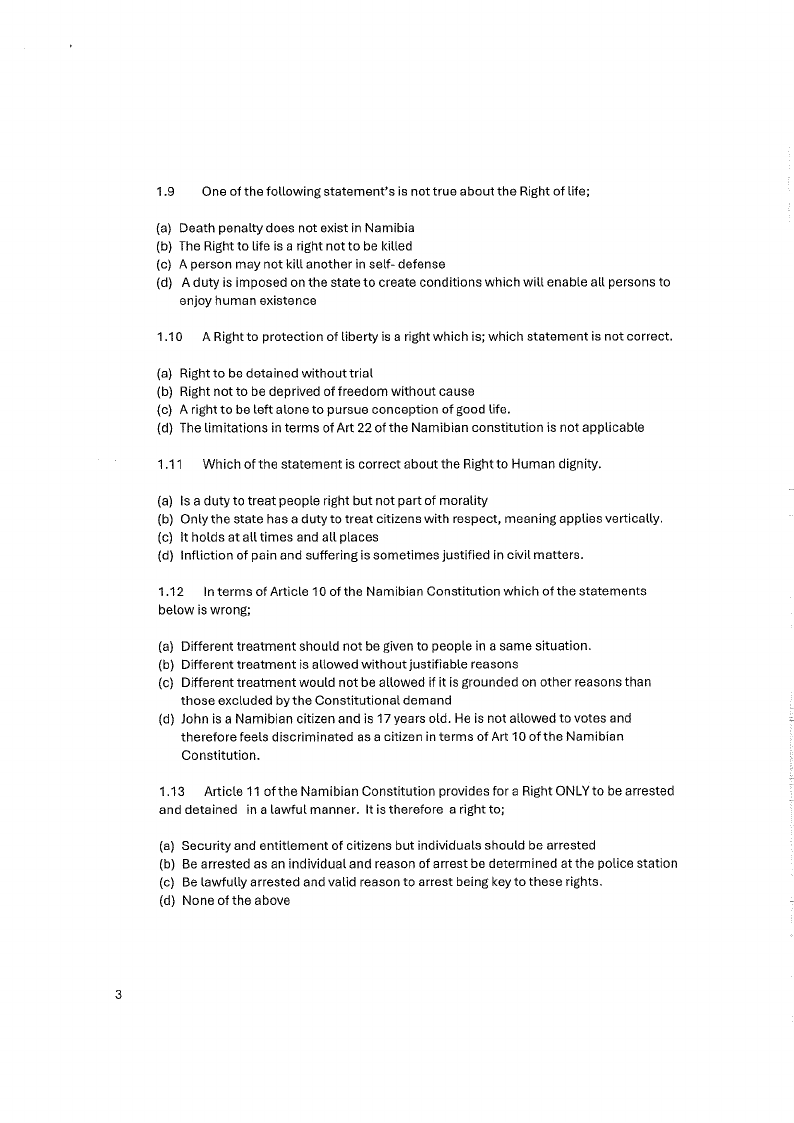
1.9 One of the following statement's is not true about the Right of life;
(a) Death penalty does not exist in Namibia
(b) The Right to life is a right not to be killed
(c) A person may not kill another in self- defense
(d) A duty is imposed on the state to create conditions which will enable all persons to
enjoy human existence
1.1 O A Right to protection of liberty is a right which is; which statement is not correct.
(a) Right to be detained without trial
(b) Right not to be deprived of freedom without cause
(c) A right to be left alone to pursue conception of good life.
(d) The limitations in terms of Art 22 of the Namibian constitution is not applicable
1.11 Which of the statement is correct about the Right to Human dignity.
(a) Is a duty to treat people right but not part of morality
(b) Only the state has a duty to treat citizens with respect, meaning applies vertically.
(c) It holds at all times and all places
(d) Infliction of pain and suffering is sometimes justified in civil matters.
1.12 In terms of Article 10 of the Namibian Constitution which of the statements
below is wrong;
(a) Different treatment should not be given to people in a same situation.
(b) Different treatment is allowed without justifiable reasons
(c) Different treatment would not be allowed if it is grounded on other reasons than
those excluded by the Constitutional demand
(d) John is a Namibian citizen and is 17 years old. He is not allowed to votes and
therefore feels discriminated as a citizen in terms of Art 10 of the Namibian
Constitution.
1.13 Article 11 of the Namibian Constitution provides for a Right ONLY to be arrested
and detained in a lawful manner. It is therefore a right to;
(a) Security and entitlement of citizens but individuals should be arrested
(b) Be arrested as an individual and reason of arrest be determined at the police station
(c) Be lawfully arrested and valid reason to arrest being key to these rights.
(d) None of the above
3

1.5 Page 5

▲back to top


1.14 Although a Right of freedom is guaranteed by the Namibian Constitution, these
rights are sometimes limited by Art 22 of the same Constitution. Which list below has
the correct list of these rights?
(a) Freedom of movement, Right to human dignity and fair trial
(b) Freedoms of movement, right to privacy and freedom of expression.
(c) Arrest, fair trial, right to life and right to property.
(d) a and b
1.15 The following constitute the requirements of a fair trial;
(a) Obtaining evidence, preventing an accused from adequately preparing for the trial,
treating the accused fairly before and during the conduct of the trial
(b) Obtaining evidence, not preventing the accused from adequately preparing for the
trial, treating the accused fairly only before the trial and not during the trail
(c) Obtaining evidence in a constitutional manner, preventing an accused from
adequately preparing for the trial, treating the accused fairly before and during the
trial.
(d) Obtaining evidence in a Constitutional manner, not preventing an accused from
adequately preparing for the trial, treating the accused fairly before court and during
the trial.
1.16 A Right to privacy is a basic Human Right because it is aimed at;
(a) Giving preservation of an individual of the choice as to how much one wants other to
know about them
(b) Allowing people to know one's personal affairs, in case they need to protect
themselves.
(c) It is a right to be left alone but without minimum degree
(d) band C
1.17 A right to a child is also that of nationality. Meaning a child is;
(a) Recognized by the nationality of the parents
(b) Is denied access to many more other rights without a nationality
(c) Entitled to a state even without a nationality
(d) None of the above
4

1.6 Page 6

▲back to top


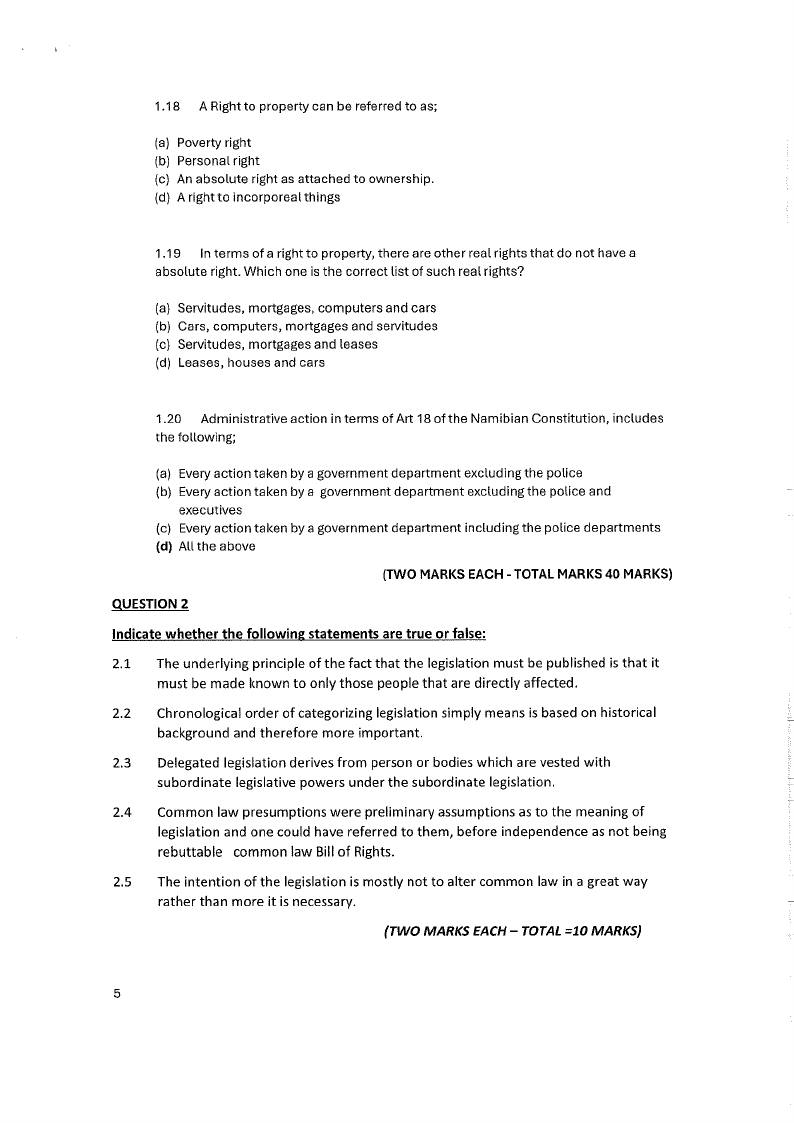
1.18 A Right to property can be referred to as;
(a) Poverty right
(b) Personal right
(c) An absolute right as attached to ownership.
(d) A right to incorporeal things
1.19 In terms of a right to property, there are other real rights that do not have a
absolute right. Which one is the correct list of such real rights?
(a) Servitudes, mortgages, computers and cars
(b) Cars, computers, mortgages and servitudes
(c) Servitudes, mortgages and leases
(d) Leases, houses and cars
1.20 Administrative action in terms of Art 18 of the Namibian Constitution, includes
the following;
(a) Every action taken by a government department excluding the police
(b) Every action taken by a government department excluding the police and
executives
(c) Every action taken by a government department including the police departments
(d) All the above
(TWO MARKS EACH -TOTAL MARKS 40 MARKS)
QUESTION 2
Indicate whether the following statements are true or false:
2.1 The underlying principle of the fact that the legislation must be published is that it
must be made known to only those people that are directly affected.
2.2 Chronological order of categorizing legislation simply means is based on historical
background and therefore more important.
2.3 Delegated legislation derives from person or bodies which are vested with
subordinate legislative powers under the subordinate legislation.
2.4 Common law presumptions were preliminary assumptions as to the meaning of
legislation and one could have referred to them, before independence as not being
rebuttable common law Bill of Rights.
2.5 The intention of the legislation is mostly not to alter common law in a great way
rather than more it is necessary.
(TWO MARKS EACH- TOTAL =10 MARKS)
5

1.7 Page 7

▲back to top


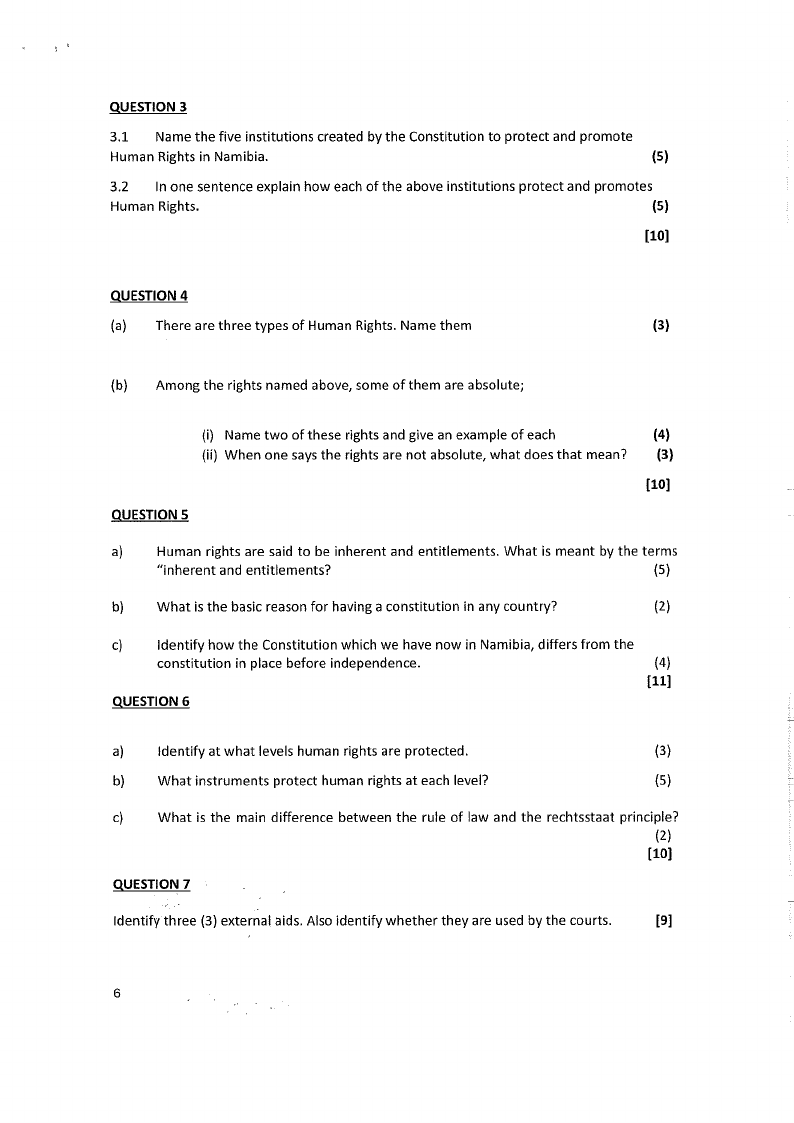
QUESTION 3
3.1 Name the five institutions created by the Constitution to protect and promote
Human Rights in Namibia.
(5)
3.2 In one sentence explain how each of the above institutions protect and promotes
Human Rights.
(5)
(10]
QUESTION 4
(a) There are three types of Human Rights. Name them
(3)
(b) Among the rights named above, some of them are absolute;
(i) Name two of these rights and give an example of each
(4)
(ii) When one says the rights are not absolute, what does that mean? (3)
(10]
QUESTION 5
a)
Human rights are said to be inherent and entitlements. What is meant by the terms
"inherent and entitlements?
(5)
b) What is the basic reason for having a constitution in any country?
(2)
c)
Identify how the Constitution which we have now in Namibia, differs from the
constitution in place before independence.
(4)
(11]
QUESTION 6
a)
Identify at what levels human rights are protected.
(3)
b) What instruments protect human rights at each level?
(5)
c)
What is the main difference between the rule of law and the rechtsstaat principle?
(2)
(10]
QUESTION 7
Identify three (3) external aids. Also identify whether they are used by the courts.
[9]
6

1.8 Page 8

▲back to top


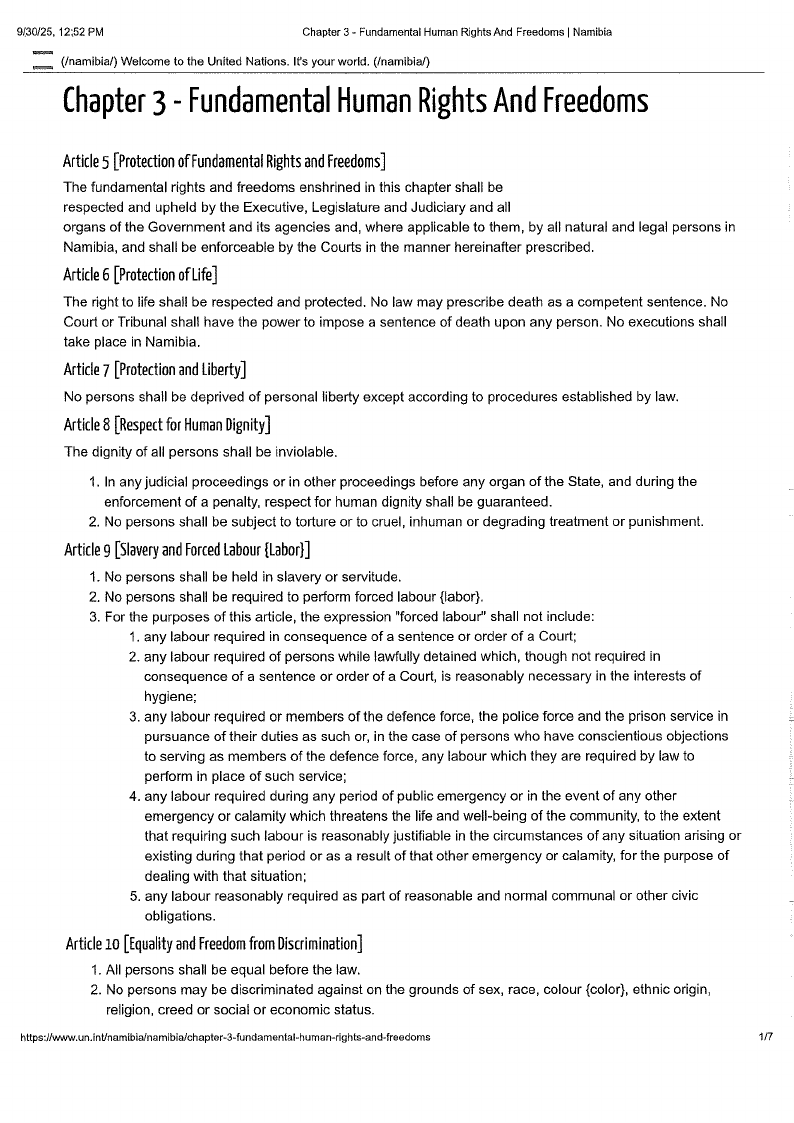
9/30/25, 12;52 PM
Chapter 3 - Fundamental Human Rights And Freedoms I Namibia
(/namibia/) Welcome to the United Nations. It's your world. (/namibia/)
Chapter 3- Fundamental Human Rights And Freedoms
Article 5 [Protection ofFundamental Rights and Freedoms]
The fundamental rights and freedoms enshrined in this chapter shall be
respected and upheld by the Executive, Legislature and Judiciary and all
organs of the Government and its agencies and, where applicable to them, by all natural and legal persons in
Namibia, and shall be enforceable by the Courts in the manner hereinafter prescribed.
Article 6 [Protection of life]
The right to life shall be respected and protected. No law may prescribe death as a competent sentence. No
Court or Tribunal shall have the power to impose a sentence of death upon any person. No executions shall
take place in Namibia.
Article 7 [Protection and Liberty]
No persons shall be deprived of personal liberty except according to procedures established by law.
Article 8 [Respect for Human Dignity]
The dignity of all persons shall be inviolable.
1. In any judicial proceedings or in other proceedings before any organ of the State, and during the
enforcement of a penalty, respect for human dignity shall be guaranteed.
2. No persons shall be subject to torture or to cruel, inhuman or degrading treatment or punishment.
Article 9 [Slavery and Forced Labour (Labor}]
1. No persons shall be held in slavery or servitude.
2. No persons shall be required to perform forced labour {labor}.
3. For the purposes of this article, the expression "forced labour" shall not include:
1. any labour required in consequence of a sentence or order of a Court;
2. any labour required of persons while lawfully detained which, though not required in
consequence of a sentence or order of a Court, is reasonably necessary in the interests of
hygiene;
3. any labour required or members of the defence force, the police force and the prison service in
pursuance of their duties as such or, in the case of persons who have conscientious objections
to serving as members of the defence force, any labour which they are required by law to
perform in place of such service;
4. any labour required during any period of public emergency or in the event of any other
emergency or calamity which threatens the life and well-being of the community, to the extent
that requiring such labour is reasonably justifiable in the circumstances of any situation arising or
existing during that period or as a result of that other emergency or calamity, for the purpose of
dealing with that situation;
5. any labour reasonably required as part of reasonable and normal communal or other civic
obligations.
Article 10 [Equality and Freedom from Discrimination]
1. All persons shall be equal before the law.
2. No persons may be discriminated against on the grounds of sex, race, colour {color}, ethnic origin,
religion, creed or social or economic status.
https://www.un.inVnamibia/namibia/chapter-3-fundamentalHhuman-rights-and-freedoms
1/7

1.9 Page 9

▲back to top


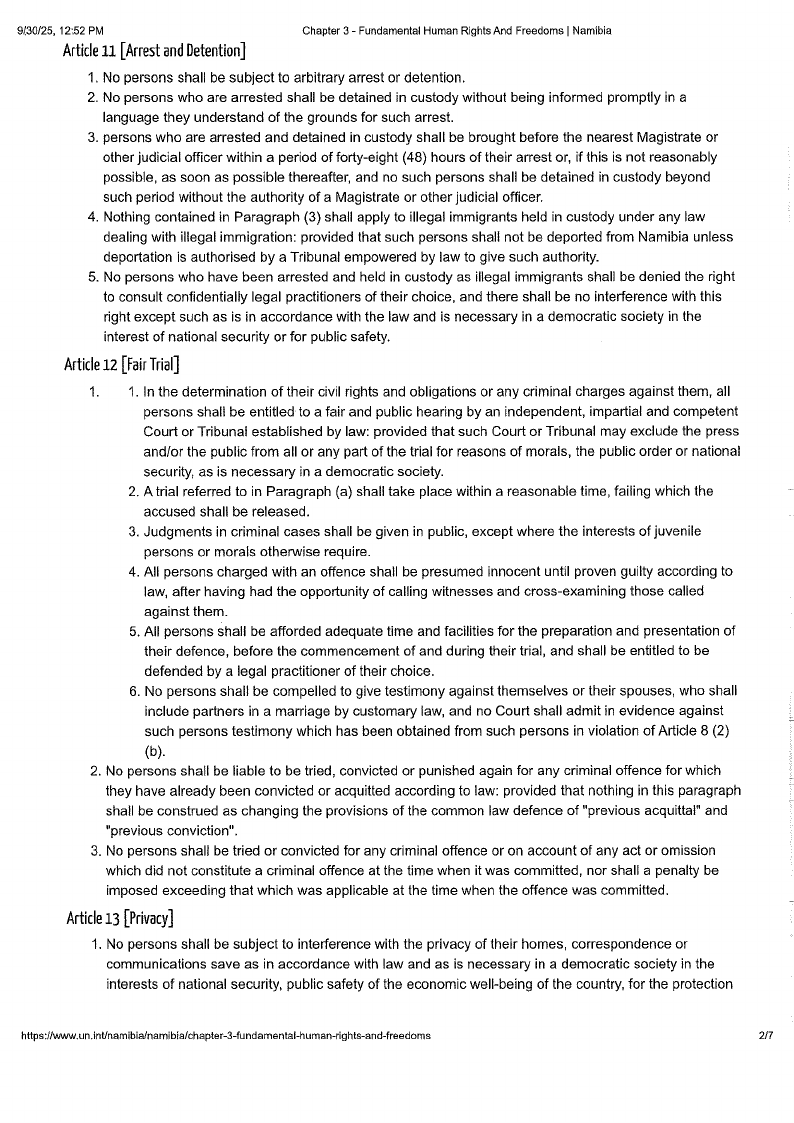
9/30/25, 12·,52 PM
Article 11 [ Arrest and Detention]
Chapter 3 - Fundamental Human Rights And Freedoms I Namibia
1. No persons shall be subject to arbitrary arrest or detention.
2. No persons who are arrested shall be detained in custody without being informed promptly in a
language they understand of the grounds for such arrest.
3. persons who are arrested and detained in custody shall be brought before the nearest Magistrate or
other judicial officer within a period of forty-eight (48) hours of their arrest or, if this is not reasonably
possible, as soon as possible thereafter, and no such persons shall be detained in custody beyond
such period without the authority of a Magistrate or other judicial officer.
4. Nothing contained in Paragraph (3) shall apply to illegal immigrants held in custody under any law
dealing with illegal immigration: provided that such persons shall not be deported from Namibia unless
deportation is authorised by a Tribunal empowered by law to give such authority.
5. No persons who have been arrested and held in custody as illegal immigrants shall be denied the right
to consult confidentially legal practitioners of their choice, and there shall be no interference with this
right except such as is in accordance with the law and is necessary in a democratic society in the
interest of national security or for public safety.
Article 12 [Fair Trial]
1. 1. In the determination of their civil rights and obligations or any criminal charges against them, all
persons shall be entitled to a fair and public hearing by an independent, impartial and competent
Court or Tribunal established by law: provided that such Court or Tribunal may exclude the press
and/or the public from all or any part of the trial for reasons of morals, the public order or national
security, as is necessary in a democratic society.
2. A trial referred to in Paragraph (a) shall take place within a reasonable time, failing which the
accused shall be released.
3. Judgments in criminal cases shall be given in public, except where the interests of juvenile
persons or morals otherwise require.
4. All persons charged with an offence shall be presumed innocent until proven guilty according to
law, after having had the opportunity of calling witnesses and cross-examining those called
against them.
5. All persons shall be afforded adequate time and facilities for the preparation and presentation of
their defence, before the commencement of and during their trial, and shall be entitled to be
defended by a legal practitioner of their choice.
6. No persons shall be compelled to give testimony against themselves or their spouses, who shall
include partners in a marriage by customary law, and no Court shall admit in evidence against
such persons testimony which has been obtained from such persons in violation of Article 8 (2)
(b).
2. No persons shall be liable to be tried, convicted or punished again for any criminal offence for which
they have already been convicted or acquitted according to law: provided that nothing in this paragraph
shall be construed as changing the provisions of the common law defence of "previous acquittal" and
"previous conviction".
3. No persons shall be tried or convicted for any criminal offence or on account of any act or omission
which did not constitute a criminal offence at the time when it was committed, nor shall a penalty be
imposed exceeding that which was applicable at the time when the offence was committed.
Article 13 [PrivacyJ
1. No persons shall be subject to interference with the privacy of their homes, correspondence or
communications save as in accordance with law and as is necessary in a democratic society in the
interests of national security, public safety of the economic well-being of the country, for the protection
https://www.un.inUnamibia/namibia/chapter-3-fundamental-human-rights-and-freedoms
2/7

1.10 Page 10

▲back to top


9/;J0/25, 12:,52 PM
Chapter 3 - Fundamental Human Rights And Freedoms I Namibia
of health or morals, for the prevention of disorder or crime or for the protection of the rights or freedoms
of others.
2. Searchers of the person or the homes of individuals shall only be justified:
1. where these are authorised by a competent judicial officer;
2. in cases where delay in obtaining such judicial authority carries with it the danger or prejudicing
the objects of the search or the public interest, and such procedures as are prescribed by Act of
Parliament to preclude abuse are properly satisfied.
Article 14 [Family]
1. Men and women of full age, without any limitation due to race, colour {color}, ethnic origin, nationality,
religion, creed or social or economic status shall have the right to marry and to found a family. They
shall be entitled to equal rights as to marriage, during marriage and at its dissolution.
2. Marriage shall be entered into only with the free and full consent of the intending.
3. The family is the natural and fundamental group unit of society and is entitled to protection by society
and the State.
Article 15 [Children's Rights]
1. Children shall have the right from birth to a name, the right to acquire a nationality and, subject to
legislation enacted in the best interests of children, as far as possible the right to know and be cared for
by their parents.
2. Children are entitled to be protected from economic exploitation and shall not be employed in or
required to perform work that is likely to be hazardous or to interfere with their education, or to be
harmful to their health or physical, mental, spiritual, moral, or social development. For the purposes of
this paragraph children shall be under the age of sixteen (16) years.
3. No children under the age of fourteen (14) years shall be employed to work in any factory or mine, save
under conditions and circumstances regulated by Act of Parliament. Nothing in this paragraph shall be
construed as derogating in any way from Paragraph (2).
4. Any arrangement or scheme employed on any farm or other undertaking, the object or effect of which is
to compel the minor children of an employee to work for or in the interest of the employer of such
employee, shall for the purposes of Article 9 be deemed to constitute an arrangement or scheme to
compel the performance of forced labour {labor}.
5. No law authorising preventive detention shall permit children under the age of sixteen (16) years to be
detained.
Article 16 [Property]
1. All persons shall have the right in any part on Namibia to acquire, own and dispose of all forms of
immovable and movable property individually or in association with others and to bequeath their
property to their heirs or legatees: provided that Parliament may be legislation prohibit or regulate as it
deems expedient the right to acquire property by persons who are not Namibian citizens.
2. The State or a competent body or organ authorised by law may expropriate property in the public
interest subject to the payment of just compensation, in accordance with requirements and procedures
to be determined by Act of Parliament.
Article 17 {...)
Article 18 [ Administrative Justice]
Administrative bodies and administrative officials shall act fairly and reasonably and comply with the
requirements imposed upon such bodies and officials by common law and any relevant legislation, and
persons aggrieved by the exercise of such acts and decisions shall have the right to seek redress before a
competent Court or Tribunal.
https://www.un.inVnamibia/namibia/chapter-3-fundamental-human-rights-and-freedoms
3/7

2 Pages 11-20

▲back to top


2.1 Page 11

▲back to top


9/~0/25, 12:,52 PM
Article 19 [Culture]
Chapter 3 - Fundamental Human Rights And Freedoms I Namibia
Every person shall be entitled to enjoy, practice, profess, maintain and promote any culture, language,
tradition or religion subject to the terms of this Constitution and further subject to the condition that the rights
protected by this article do not impinge upon the rights of others or the national interest.
Article 20 [Education]
1. All persons shall have the right to education.
2. Primary education shall be compulsory and the State shall provide reasonable facilities to render
effective this right for every resident within Namibia, by establishing and maintaining State schools at
which primary education will be provided free of charge.
3. Children shall not be allowed to leave school until they have completed their primary education or have
attained the age of sixteen (16) years, whichever is the sooner, save in so far as this may be authorised
by Act of Parliament on grounds of health or other considerations pertaining to the public interest.
4. All persons shall have the right, at their own expense, to establish and to maintain private schools, or
colleges or other institutions of tertiary education: provided that:
1. such schools, colleges or institutions of tertiary education are registered with a Government
department in accordance with any law authorising and regulating such registration;
2. the standards maintained by such schools, colleges or institutions of tertiary education are not
inferior to the standards maintained in comparable schools, colleges or institutions of tertiary
education funded by the State;
3. no restrictions of whatever nature are imposed with respect to the admission of pupils based on
race, colour {color} or creed;
4. no restrictions of whatever nature are imposed with respect to the recruitment of staff based on
race or colour {color}.
Article 21 [Fundamental Freedoms]
1. All persons shall have the right to:
1. freedom of speech and expression, which shall include freedom of the press and other media;
2. freedom of thought, conscience and belief, which shall include academic freedom in institutions
of higher learning;
3. freedom to practice any religion and to manifest such practice; d) assemble peaceably and
without arms;
4. freedom of association, which shall include freedom to form and join associations or unions,
including trade unions and political parties;
5. withhold their labour {labor} without being exposed to criminal penalties; g) move freely
throughout Namibia;
6. reside and settle in any part of Namibia;
7. leave and return to Namibia;
8. practice any profession, or carry on any occupation, trade or business.
2. The fundamental freedoms referred to in Paragraph (1) shall be exercised subject to the law of
Namibia, in so far as such law imposes reasonable restrictions on the exercise of the rights and
freedoms conferred by the said Paragraph, which are necessary in a democratic society and are
required in the interests of the sovereignty and integrity of Namibia, national security, public order,
decency or morality, or in relation to contempt of court, defamation or incitement to an offence.
Article 22 [Limitation upon Fundamental Rights and Freedoms]
Whenever or wherever in terms of this Constitution the limitation of any fundamental rights or freedoms
contemplated by this chapter is authorised, any law providing for such limitation shall:
https://www.un.inUnamibia/namibia/chapter-3-fundamental-human-rights-and-freedoms
4/7

2.2 Page 12

▲back to top


9/,30/25, 12;52 PM
1
Chapter 3 - Fundamental Human Rights And Freedoms I Namibia
1. be of general application, shall not negate the essential content, and shall not be aimed at a particular
individual;
2. specify the ascertainable extent of such limitation and identify the article or articles on which authority
to enact such limitation is claimed to rest.
Article 23 [Apartheid and Affirmative Action]
1. The practice of racial discrimination and the practice and ideology of apartheid from which the majority
of the people of Namibia have suffered for so long shall be prohibited and by Act of Parliament such
practices, and the propagation of such practices, may be rendered criminally punishable by the
ordinary Courts by means of such punishment as Parliament deems necessary for the purposes of
expressing the revulsion of the Namibian people at such practices.
2. Nothing contained in Article 10 shall prevent Parliament from enacting legislation providing directly or
indirectly for the advancement of persons within Namibia who have been socially, economically or
educationally disadvantaged by past discriminatory laws or practices, or for the implementation of
policies and programmes aimed at redressing social, economic or educational imbalances in the
Namibian society arising out of past discriminatory laws or practices, or for achieving a balanced
structuring of the public service, the police force, the defence force, and the prison service.
3. In the enactment of legislation and the application of any policies and practices contemplated by
Paragraph (2), it shall be permissible to have regard to the fact that women in Namibia have
traditionally suffered special discrimination and that they need to be encouraged and enabled to play a
full, equal and effective role in the political, social, economic and cultural life of the nation.
Article 24 [Derogation]
1. Nothing contained in or done under the authority of Article 26 shall be held to be inconsistent with or in
contravention of this Constitution lo the extent that ii authorises the taking of measures during any
period when Namibia is in a state of national defence or any period when a declaration of emergency
under this Constitution is in force.
2. Where any persons are detained by virtue of such authorization as is referred to in Paragraph (1), the
following provisions shall apply:
1. they shall, as soon as reasonably practicable and in any case not more than five (5) days after
the commencement of their detention, be furnished with a statement in writing in a language that
they understand specifying in detail the grounds upon which they are detained and, at their
request, this statement shall be read to them;
2. not more than fourteen (14) days after the commencement of their detention, be furnished with a
statement in writing in a language that they understand specifying in detail the grounds upon
which they are detained and, at their request, this statement shall be read to them;
3. not more than one (1) month after the commencement of their detention and thereafter during
their detention at intervals of not more than three (3) months, their cases shall be reviewed by
the Advisory Board referred to in Article 26 (5)(c), which shall order their release from detention if
it is satisfied that it is not reasonably necessary for the purposes of the emergency to continue
the detention of such persons;
4. they shall be afforded such opportunity for the making of representations as may be desirable or
expedient in the circumstances, having regard to the public interest and the interests of the
detained persons.
3. Nothing contained in this article shall permit a derogation from or suspension of the fundamental rights
or freedoms referred to in Articles 5, 6, 8, 9, 10, 12, 14, 15, 18, 19 and 21 (1)(a), (b), (c), and (e), or the
denial of access by any persons to legal practitioners or a Court of law.
Article 25 [Enforcement ofFundamental Rights and Freedoms]
https:!/www.un.int/namibia/namibia/chapter-3-fundamental-human-rights-and-freedoms
5/7

2.3 Page 13

▲back to top


9/30/25, 1I 2;52 PM
Chapter 3 - Fundamental Human Rights And Freedoms I Namibia
1. Save in so far as it may be authorised to do so by this Constitution, Parliament or any subordinate
legislative authority shall not make any law, and the Executive and the agencies of Government shall
not take any action which abolishes or abridges the fundamental rights and freedoms conferred by this
chapter, and any law or action in contravention thereof shall to the extent of the contravention be
invalid; provided that:
1. a competent Court, instead of declaring such law or action to be invalid, shall have the power
and the discretion in an appropriate case to allow Parliament, any subordinate legislative
authority, or the Executive and the agencies of Government, as the case may be, to correct any
defect in the impugned law or action within a specified period, subject to such conditions as may
be specified by it. In such event and until such correction, or until the expiry of the time limit set
by the Court, whichever be the shorter, such impugned law or action shall be deemed to be valid;
2. any law which was in force immediately before the date of Independence shall remain in force
until amended, repealed or declared unconstitutional, it may either set aside the law, or allow
Parliament to correct any defect in such law, in which event the provisions of Paragraph (a) shall
apply.
2. Aggrieved persons who claim that a fundamental right or freedom guaranteed by this Constitution has
been infringed or threatened shall be entitled to approach a competent Court to enforce or protect such
a right or freedom, and may approach the Ombudsman to provide them with such legal assistance or
advice as they require, and the Ombudsman shall have the discretion in response thereto to provide
such legal or other assistance as he or she may consider expedient.
3. Subject to the provisions of this Constitution, the Court referred to in Paragraph (2) shall have the
power to make all such orders as shall be necessary and appropriate to secure such applicants the
enjoyment of the rights of freedoms conferred on them under the provisions of this Constitution, should
the Court come to the conclusion that such rights or freedoms have been unlawfully denied or violated,
or that grounds exist for the protection of such rights or freedoms by interdict.
4. The power of the Court shall include the power to award monetary compensation in respect of any
damage suffered by the aggrieved persons in consequence of such unlawful denial or violation of their
fundamental rights and freedoms, where it considers such an award to be appropriate in the
circumstances of particular cases.
PHOTO ALBUM
https://www.un.int/namibla/namibia/chapter-3-fundamental-human-rights-and-freedoms
6/7