


 |
PDT610S - POLICY DEVELOPMENT - 1ST OPP - JUNE 2025 |
|
|
1 Page 1 |
▲back to top |
n Am I BI A u n IVE RS ITV
OF SCIEnCE Ano TECHnOLOGY
FACULTY OF COMMERCE, HUMAN SCIENCES AND EDUCATION
DEPARTMENT OF TECHNICAL, VOCATIONAL EDUCATION AND TRAINING
QUALIFICATION: DIPLOMA IN TECHNICALAND VOCATIONAL EDUCATION AND TRAINING
QUALIFICATION CODE: 06DTVM LEVEL" 6
COURSE CODE: PDT610S
COURSE NAME: POLICY DEVELOPMENT
SESSION: JUNE 2025
DURATION: 3 HOURS
PAPER:1
MARKS: 100
EXAMINER:
1sr OPPORTUNITY EXAMINATION QUESTION PAPER
Mr. Kamwi Subasubani
MODERATOR: Dr. Nico Sisinyize
INSTRUCTIONS
1. Answer ALL the questions and start each question on a new page.
2. Read all questions carefully before answering.
3. Number answers according to the numbering structure provided in the question
paper.
THIS QUESTION PAPER CONSISTS OF 4 PAGES (Including this front page)
|
|
2 Page 2 |
▲back to top |
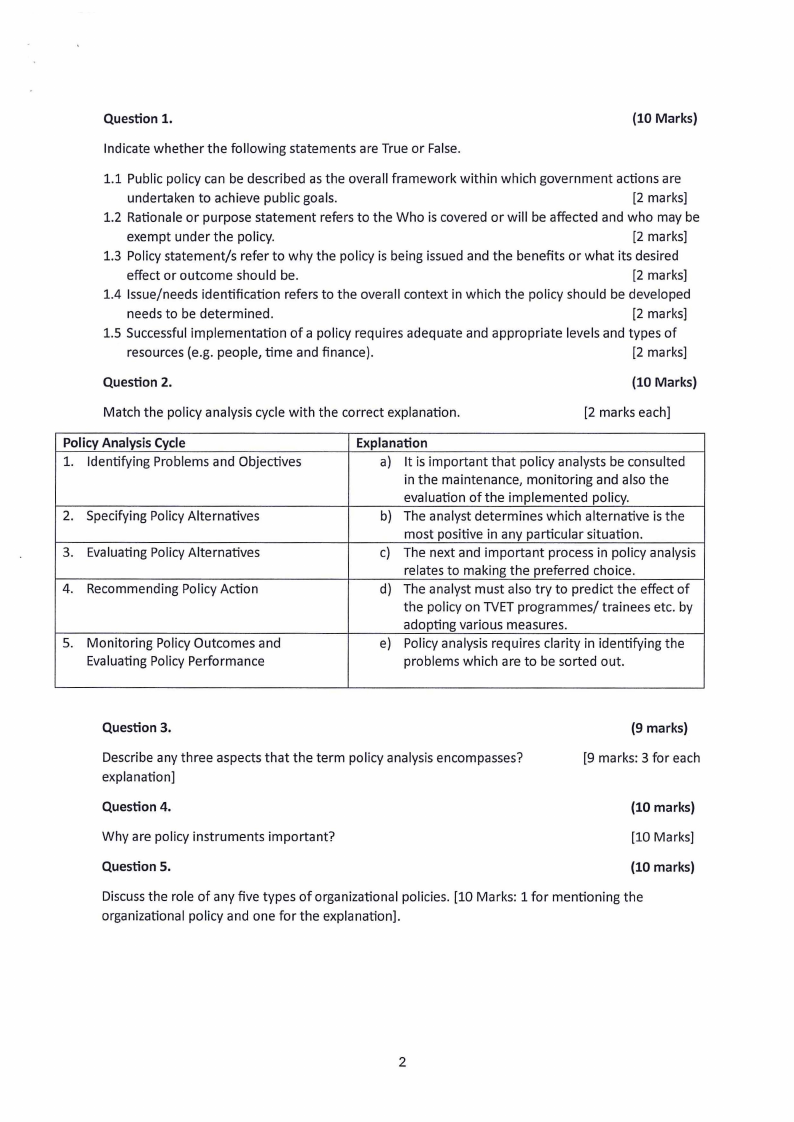
Question 1.
(10 Marks)
Indicate whether the following statements are True or False.
1.1 Public policy can be described as the overall framework within which government actions are
undertaken to achieve public goals.
[2 marks]
1.2 Rationale or purpose statement refers to the Who is covered or will be affected and who may be
exempt under the policy.
[2 marks]
1.3 Policy statement/s refer to why the policy is being issued and the benefits or what its desired
effect or outcome should be.
[2 marks]
1.4 Issue/needs identification refers to the overall context in which the policy should be developed
needs to be determined.
[2 marks]
1.5 Successful implementation of a policy requires adequate and appropriate levels and types of
resources (e.g. people, time and finance).
[2 marks]
Question 2.
(10 Marks}
Match the policy analysis cycle with the correct explanation.
[2 marks each]
Policy Analysis Cycle
1. Identifying Problems and Objectives
2. Specifying Policy Alternatives
3. Evaluating Policy Alternatives
4. Recommending Policy Action
5. Monitoring Policy Outcomes and
Evaluating Policy Performance
Explanation
a) It is important that policy analysts be consulted
in the maintenance, monitoring and also the
evaluation of the implemented policy.
b) The analyst determines which alternative is the
most positive in any particular situation.
c) The next and important process in policy analysis
relates to making the preferred choice.
d) The analyst must also try to predict the effect of
the policy on TVET programmes/ trainees etc. by
adopting various measures.
e) Policy analysis requires clarity in identifying the
problems which are to be sorted out.
Question 3.
(9 marks}
Describe any three aspects that the term policy analysis encompasses?
explanation]
[9 marks: 3 for each
Question 4.
(10 marks)
Why are policy instruments important?
[10 Marks]
Question 5.
(10 marks)
Discuss the role of any five types of organizational policies. [10 Marks: 1 for mentioning the
organizational policy and one for the explanation].
2