


 |
ETD711S - INTRO TO EDUCATION%2C TRAINING AND DEVELOPMENT - 1ST OPP - NOV 2025 |
|
|
1 Page 1 |
▲back to top |
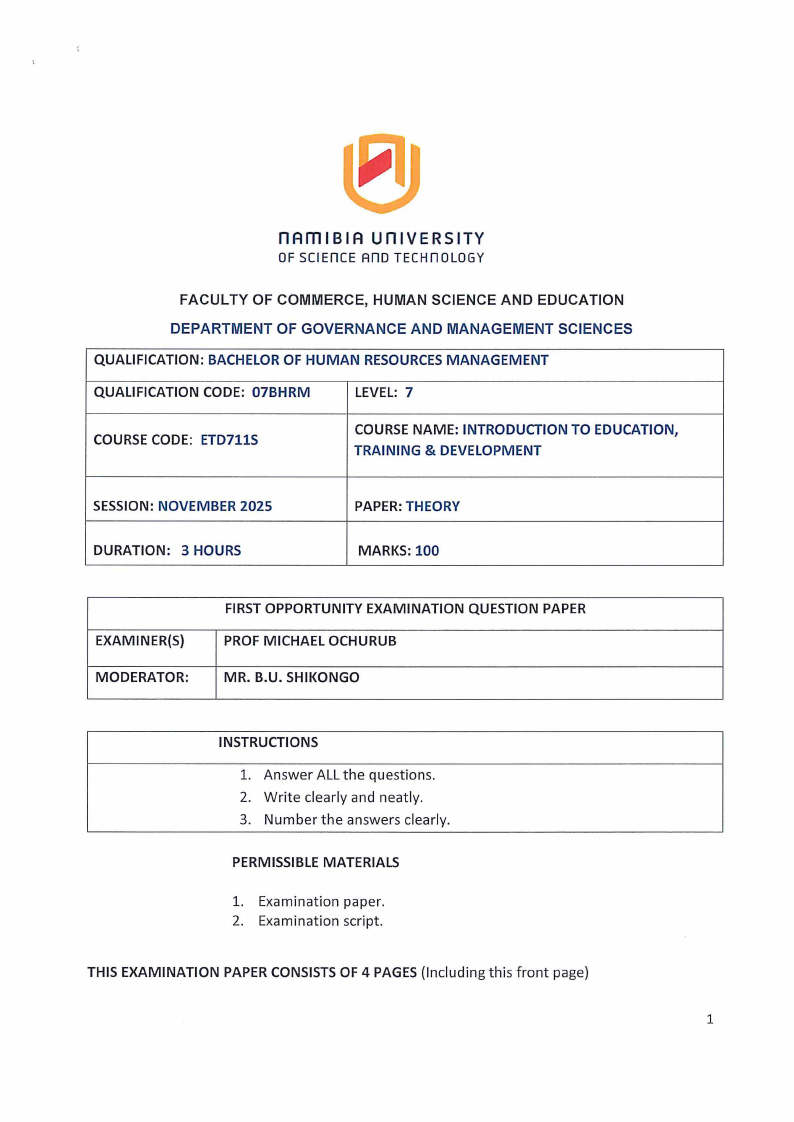
n Am I BI A u n IVER s ITY
OF SC IEn CE Ano TECH n OLOGY
FACULTY OF COMMERCE, HUMAN SCIENCE AND EDUCATION
DEPARTMENT OF GOVERNANCE AND MANAGEMENT SCIENCES
QUALIFICATION: BACHELOR OF HUMAN RESOURCES MANAGEMENT
QUALIFICATION CODE: 07BHRM
LEVEL: 7
COURSE CODE: ETD711S
COURSE NAME: INTRODUCTION TO EDUCATION,
TRAINING & DEVELOPMENT
SESSION: NOVEMBER 2025
DURATION : 3 HOURS
PAPER: THEORY
MARKS: 100
EXAMINER(S)
MODERATOR:
FIRST OPPORTUNITY EXAMINATION QUESTION PAPER
PROF MICHAEL OCHURUB
MR. B.U. SHIKONGO
INSTRUCTIONS
1. Answer ALL the questions.
2. Write clearly and neatly.
3. Number the answers clearly.
PERMISSIBLE MATERIALS
1. Examination paper.
2. Examination script.
THIS EXAMINATION PAPER CONSISTS OF 4 PAGES (Including this front page)
1
|
|
2 Page 2 |
▲back to top |
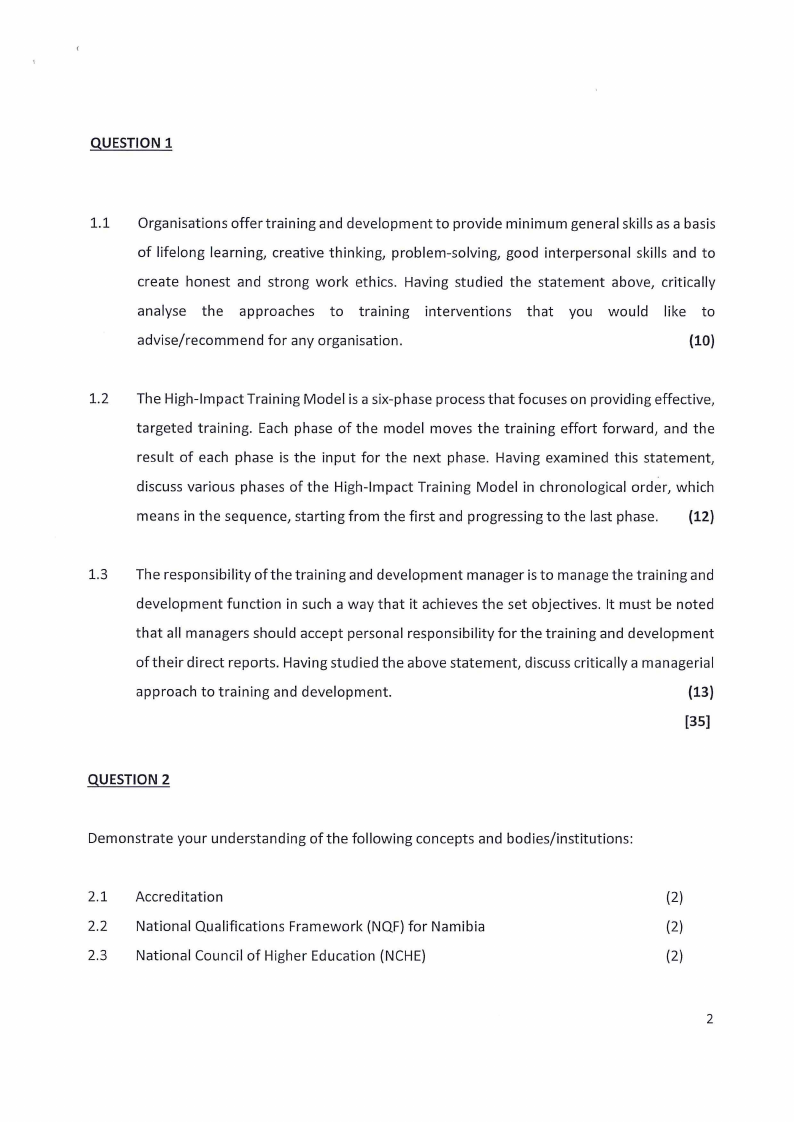
QUESTION 1
1.1 Organisations offer training and development to provide minimum general skills as a basis
of lifelong learning, creative thinking, problem-solving, good interpersonal skills and to
create honest and strong work ethics. Having studied the statement above, critically
analyse the approaches to training interventions that you would like to
advise/recommend for any organisation.
{10)
1.2 The High-Impact Training Model is a six-phase process that focuses on providing effective,
targeted training. Each phase of the model moves the training effort forward, and the
result of each phase is the input for the next phase. Having examined this statement,
discuss various phases of the High-Impact Training Model in chronological order, which
means in the sequence, starting from the first and progressing to the last phase. {12)
1.3 The responsibility of the training and development manager is to manage the training and
development function in such a way that it achieves the set objectives. It must be noted
that all managers should accept personal responsibility for the training and development
of their direct reports. Having studied the above statement, discuss critically a managerial
approach to training and development.
{13)
[35)
QUESTION 2
Demonstrate your understanding ofthe following concepts and bodies/institutions:
2.1 Accreditation
(2)
2.2 National Qualifications Framework (NQF) for Namib ia
(2)
2.3 National Council of Higher Education (NCHE)
(2)
2
|
|
3 Page 3 |
▲back to top |
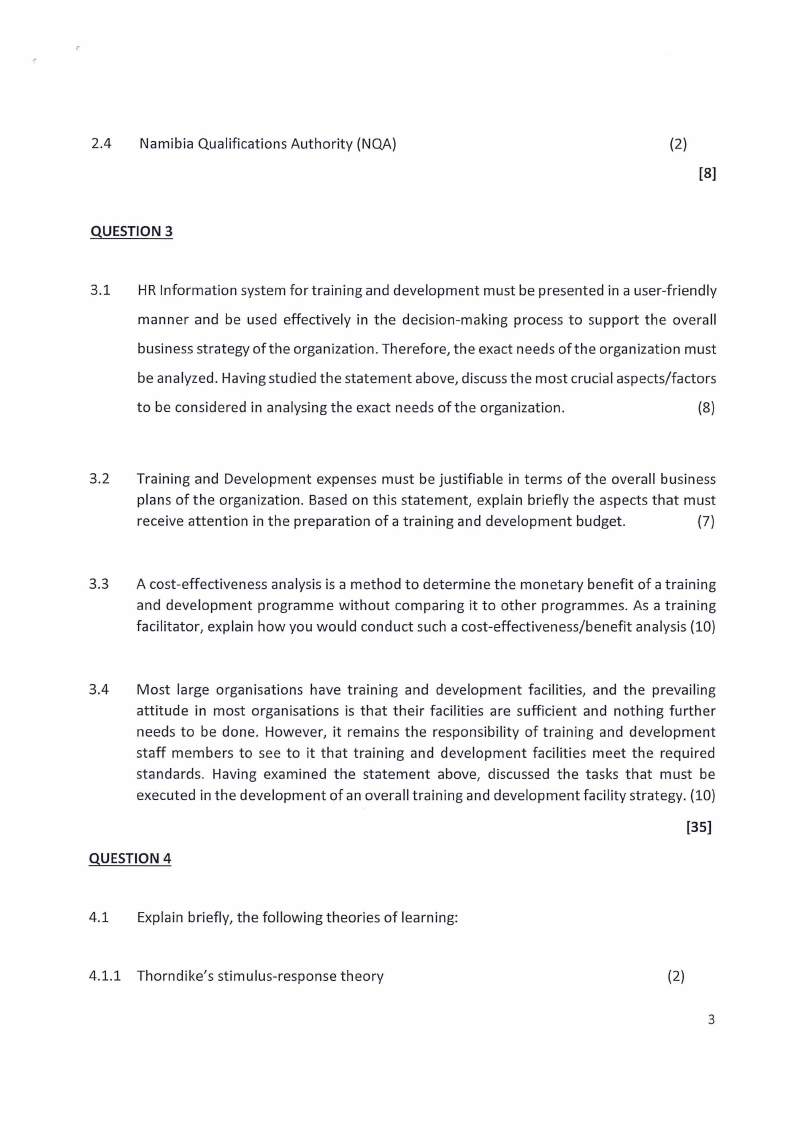
2.4 Namibia Qualifications Authority (NQA)
(2)
[8]
QUESTION 3
3.1 HR Information system for training and development must be presented in a user-friendly
manner and be used effectively in the decision-making process to support the overall
business strategy of the organization. Therefore, the exact needs of the organization must
be analyzed. Having studied the statement above, discuss the most crucial aspects/factors
to be considered in analysing the exact needs of the organization.
(8)
3.2 Training and Development expenses must be justifiable in terms of the overall business
plans of the organization. Based on this statement, explain briefly the aspects that must
receive attention in the preparation of a training and development budget.
(7)
3.3 A cost-effectiveness analysis is a method to determine the monetary benefit of a training
and development programme without comparing it to other programmes. As a training
facilitator, explain how you would conduct such a cost-effectiveness/benefit analysis (10)
3.4 Most large organisations have training and development facilities, and the prevailing
attitude in most organisations is that their facilities are sufficient and nothing furt her
needs to be done. However, it remains the responsibility of training and development
staff members to see to it that training and development facilities meet the requ ired
standards. Having examined the statement above, discussed the tasks that must be
executed in the development of an overall tra ining and development facility strategy. (10)
[35]
QUESTION 4
4.1 Explain briefly, the following theories of learning:
4.1.1 Thorndike' s stimulus-response theory
(2)
3
|
|
4 Page 4 |
▲back to top |
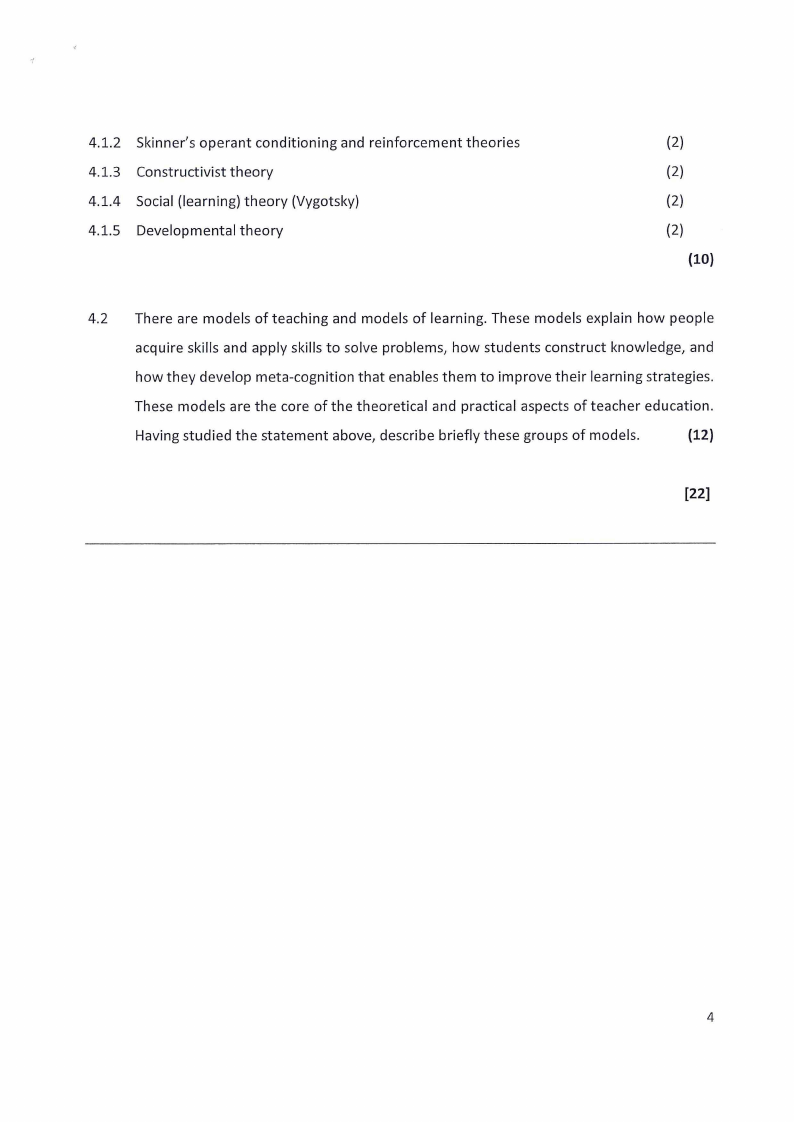
4.1.2 Skinner's operant conditioning and reinforcement theories
4.1.3 Constructivist theory
4.1.4 Social (learning) theory (Vygotsky)
4.1.5 Developmental theory
(2)
(2)
(2)
(2)
(10)
4.2 There are models of teaching and models of learning. These models explain how people
acquire skills and apply skills to solve problems, how students construct knowledge, and
how they develop meta-cognition that enables them to improve their learning strategies.
These models are the core of the theoretical and practical aspects of teacher education.
Having studied the statement above, describe briefly these groups of models.
(12)
[22]
4