


 |
ETD711S - INTRO TO EDUCATION%2C TRAINING AND DEVELOPMENT - 2ND OPP - NOV 2025 |
|
|
1 Page 1 |
▲back to top |

nAm I Bl A un IVERS ITY
OF SCIEnCE Ano TECHnOLOGY
FACULTY OF COMMERCE, HUMAN SCIENCE AND EDUCATION
DEPARTMENT OF GOVERNANCE AND MANAGEMENT SCIENCES
QUALIFICATION: BACHELOR OF HUMAN RESOURCES MANAGEMENT
QUALIFICATION CODE: 07BHRM
LEVEL: 7
COURSE CODE : ETD 711S
COURSE NAME: INTRODUCTION TO EDUCATION,
TRAINING &DEVELOPMENT
SESSION: NOVEMBER 2025
DURATION: 3 HOURS
PAPER: THEORY
MARKS: 100
EXAMINER(S)
SECOND OPPORTUNITY EXAMINATION QUESTION PAPER
PROF MICHAEL OCHURUB
MODERATOR:
MR. B.U. SHIKONGO
INSTRUCTIONS
1. Answer ALL the questions.
2. Write clearly and neatly.
3. Number the answers clearly.
PERMISSIBLE MATERIALS
1. Examination paper.
2. Examination script.
THIS EXAMINATION PAPER CONSISTS OF 3 PAGES (Including this front page)
1
|
|
2 Page 2 |
▲back to top |
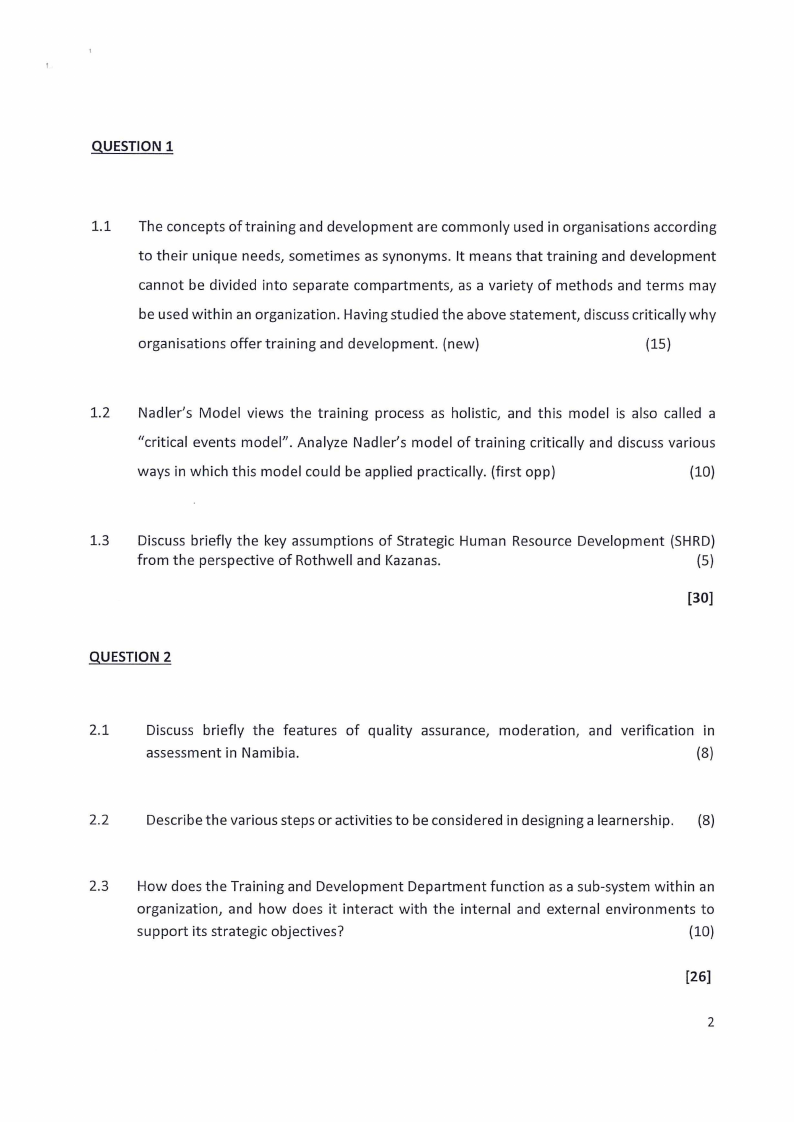
QUESTION 1
1.1 The concepts of training and development are commonly used in organisations according
to their unique needs, sometimes as synonyms. It means that training and development
cannot be divided into separate compartments, as a variety of methods and terms may
be used within an organization. Having studied the above statement, discuss critically why
organisations offer training and development. (new)
(15)
1.2 Nadler's Model views the training process as holistic, and this model is also called a
"critical events model". Analyze Nadler's model of training critically and discuss various
ways in which this model could be applied practically. (first opp)
(10)
1.3 Discuss briefly the key assumptions of Strategic Human Resource Development (SHRD)
from the perspective of Rothwell and Kazanas.
(5)
[30)
QUESTION 2
2.1
Discuss briefly the features of quality assurance, moderation, and verification in
assessment in Namibia.
(8)
2.2
Describe the various steps or activities to be considered in designing a learnership. (8)
2.3 How does the Training and Development Department function as a sub-system within an
organization, and how does it interact with the internal and external environments to
support its strategic objectives?
(10)
[26)
2
|
|
3 Page 3 |
▲back to top |
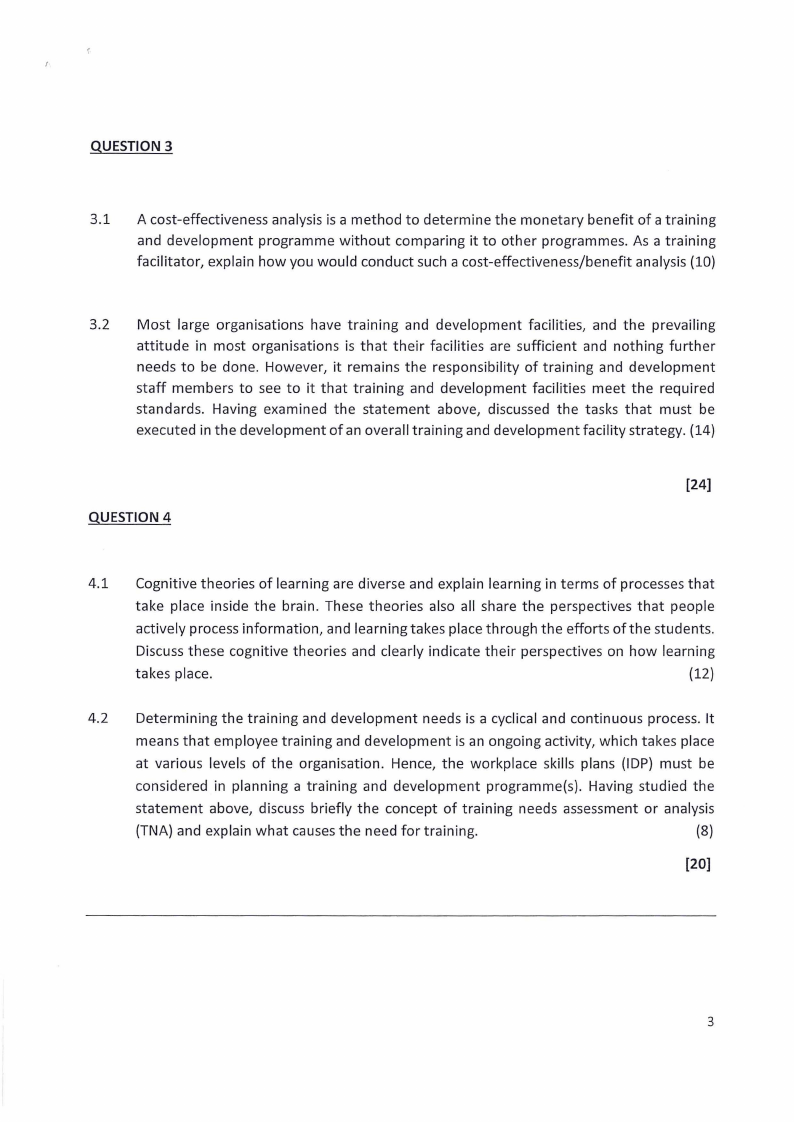
QUESTION 3
3.1 A cost-effectiveness analysis is a method to determine the monetary benefit of a training
and development programme without comparing it to other programmes. As a training
facilitator, explain how you would conduct such a cost-effectiveness/benefit analysis (10}
3.2 Most large organisations have training and development facilities, and the prevailing
attitude in most organisations is that their facilities are sufficient and nothing further
needs to be done. However, it remains the responsibility of training and development
staff members to see to it that training and development facilities meet the required
standards. Having examined the statement above, discussed the tasks that must be
executed in the development of an overall training and development facility strategy. (14}
[24]
QUESTION 4
4.1 Cognitive theories of learning are diverse and explain learning in terms of processes that
take place inside the brain. These theories also all share the perspectives that people
actively process information, and learning takes place through the efforts of the students.
Discuss these cognitive theories and clearly indicate their perspectives on how learning
takes place.
(12)
4.2 Determining the training and development needs is a cyclical and continuous process. It
means that employee training and development is an ongoing activity, which takes place
at various levels of the organisation. Hence, the workplace skills plans (IDP} must be
considered in planning a training and development programme(s). Having studied the
statement above, discuss briefly the concept of training needs assessment or analysis
(TNA} and explain what causes the need for training.
(8)
[20]
3