LAL112S - Labour Law - 1st Opp - Nov 2025


LAL112S - Labour Law - 1st Opp - Nov 2025


1 Page 1

▲back to top


nAmlBIA UnlVERSITY
OF SCIEnCE AnD TECHnOLOGY
FACULTY OF HUMAN SCIENCES
DEPARTMENT OF SOCIAL SCIENCES
QUALIFICATIONS: BACHELOR OF HUMAN RESOURCES; BACHELOR OF HUMAN RESOURCES
MANAGEMENT; BACHELOR OF BUSINESS AND INFORMATION ADMINISTRATION
QUALIFICATION CODES: 21BHUR;
07BHRM; 07BBIA
LEVEL: 5
COURSE CODE : LAL 112 S
COURSE NAME : LABOUR LAW 1B
SESSION: OCTOBER 2025
PAPER: THEORY
DURATION: 2 HOURS
MARKS: 100
FIRST OPPORTUNITY EXAMINATION QUESTION PAPER
EXAMINER(S} Miss K Claasen
MODERATOR: Mrs E Wabomba
INSTRUCTIONS
1. This paper consists of 7 (seven) questions.
2. All questions are compulsory.
3. All questions must be answered in your Examination Book
4. Read all questions carefully before answering.
5. Incorrect spelling and illegible handwriting may prevent mark allocation .
PERMISSIBLE MATERIALS
1. Calculator
THIS QUESTION PAPER CONSISTS OF 10 PAGES (Including this front page)

2 Page 2

▲back to top


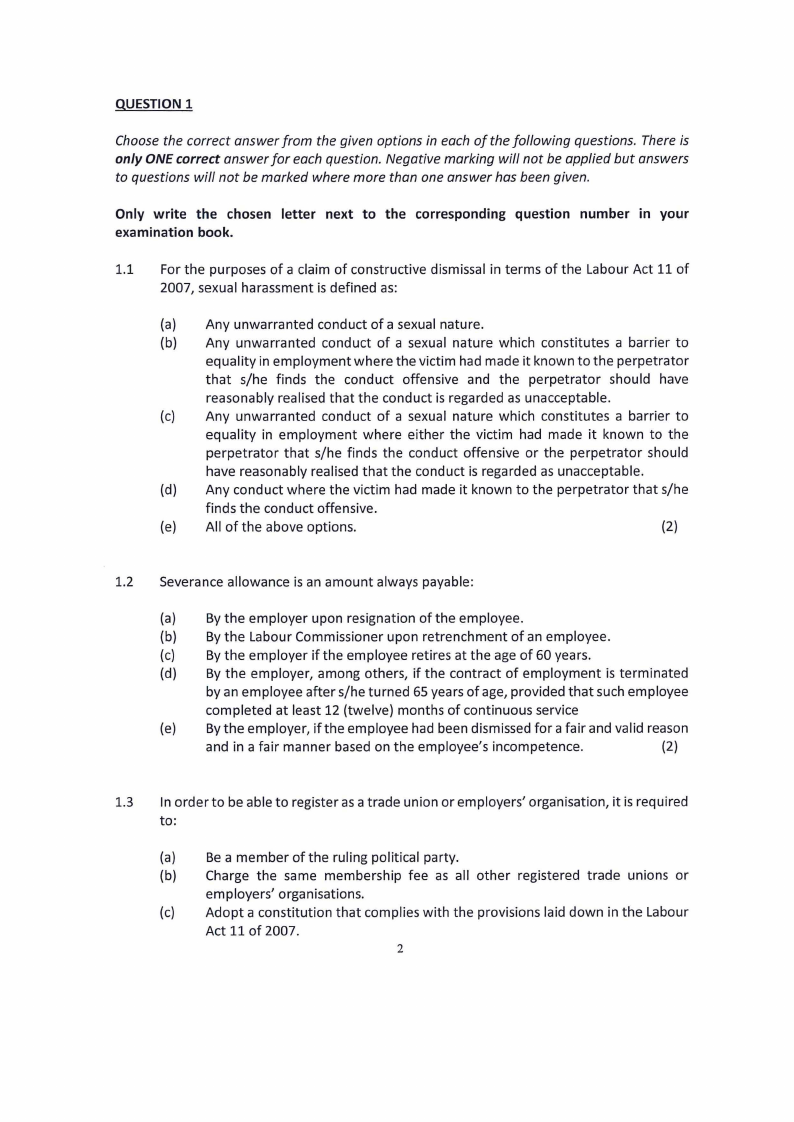
QUESTION 1
Choose the correct answer from the given options in each of the following questions. There is
only ONE correct answerfor each question. Negative marking will not be applied but answers
to questions will not be marked where more than one answer has been given.
Only write the chosen letter next to the corresponding question number in your
examination book.
1.1 For the purposes of a claim of constructive dismissal in terms of the Labour Act 11 of
2007, sexual harassment is defined as:
(a) Any unwarranted conduct of a sexual nature.
(b) Any unwarranted conduct of a sexual nature which constitutes a barrier to
equality in employment where the victim had made it known to the perpetrator
that s/he finds the conduct offensive and the perpetrator should have
reasonably realised that the conduct is regarded as unacceptable.
(c) Any unwarranted conduct of a sexual nature which constitutes a barrier to
equality in employment where either the victim had made it known to the
perpetrator that s/he finds the conduct offensive or the perpetrator should
have reasonably realised that the conduct is regarded as unacceptable.
(d) Any conduct where the victim had made it known to the perpetrator thats/he
finds the conduct offensive.
(e) All of the above options.
(2)
1.2 Severance allowance is an amount always payable:
(a) By the employer upon resignation of the employee.
(b) By the Labour Commissioner upon retrenchment of an employee.
(c) By the employer if the employee retires at the age of 60 years.
(d) By the employer, among others, if the contract of employment is terminated
by an employee afters/he turned 65 years of age, provided that such employee
completed at least 12 (twelve) months of continuous service
(e) By the employer, if the employee had been dismissed for a fair and valid reason
and in a fair manner based on the employee's incompetence.
(2)
1.3 In order to be able to register as a trade union or employers' organisation, it is required
to:
(a) Be a member of the ruling political party.
(b) Charge the same membership fee as all other registered trade unions or
employers' organisations.
(c) Adopt a constitution that complies with the provisions laid down in the Labour
Act 11 of 2007.
2

3 Page 3

▲back to top


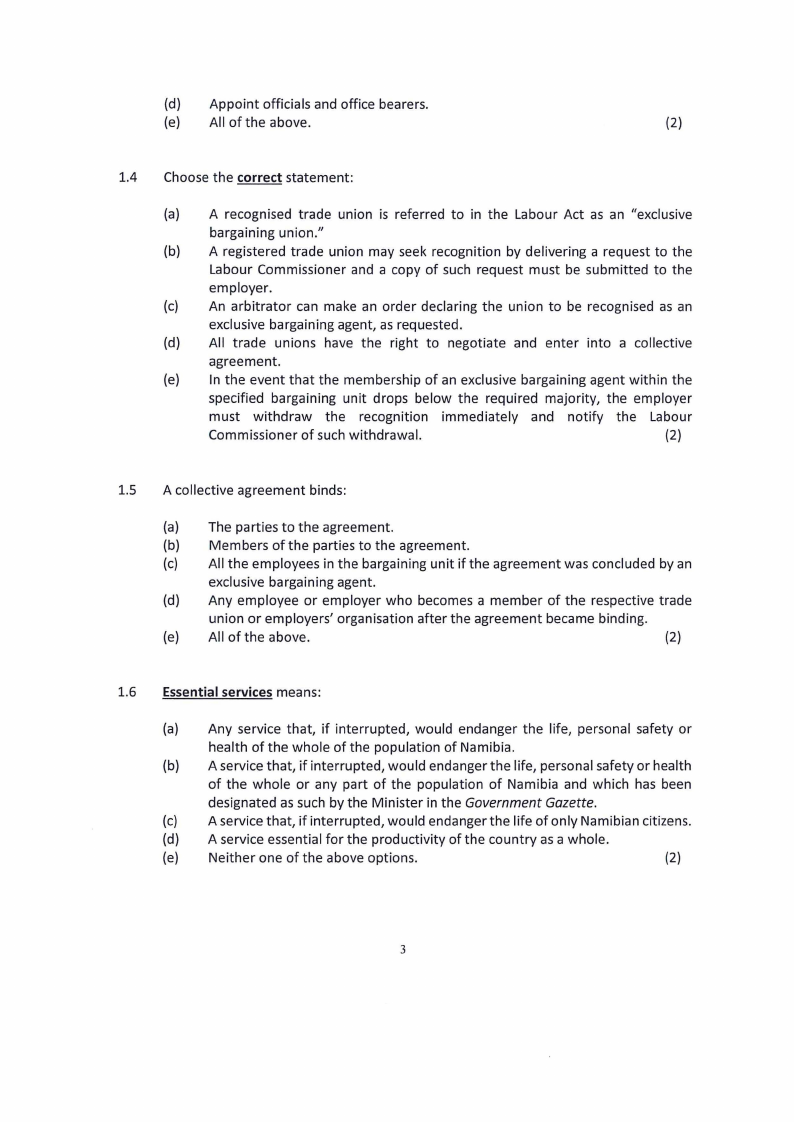
{d) Appoint officials and office bearers.
{e) All of the above.
(2)
1.4 Choose the correct statement:
(a) A recognised trade union is referred to in the Labour Act as an "exclusive
bargaining union."
{b) A registered trade union may seek recognition by delivering a request to the
Labour Commissioner and a copy of such request must be submitted to the
employer.
{c) An arbitrator can make an order declaring the union to be recognised as an
exclusive bargaining agent, as requested.
(d) All trade unions have the right to negotiate and enter into a collective
agreement.
(e) In the event that the membership of an exclusive bargaining agent within the
specified bargaining unit drops below the required majority, the employer
must withdraw the recognition immediately and notify the Labour
Commissioner of such withdrawal.
(2)
1.5 A collective agreement binds:
(a) The parties to the agreement.
(b) Members of the parties to the agreement.
(c) All the employees in the bargaining unit if the agreement was concluded by an
exclusive bargaining agent.
(d) Any employee or employer who becomes a member of the respective trade
union or employers' organisation after the agreement became binding.
(e) All of the above.
(2)
1.6 Essential services means:
(a) Any service that, if interrupted, would endanger the life, personal safety or
health of the whole of the population of Namibia.
(b) A service that, if interrupted, would endanger the life, personal safety or health
of the whole or any part of the population of Namibia and which has been
designated as such by the Minister in the Government Gazette.
(c) A service that, if interrupted, would endanger the life of only Namibian citizens.
(d) A service essential for the productivity of the country as a whole.
(e) Neither one of the above options.
(2)
3

4 Page 4

▲back to top


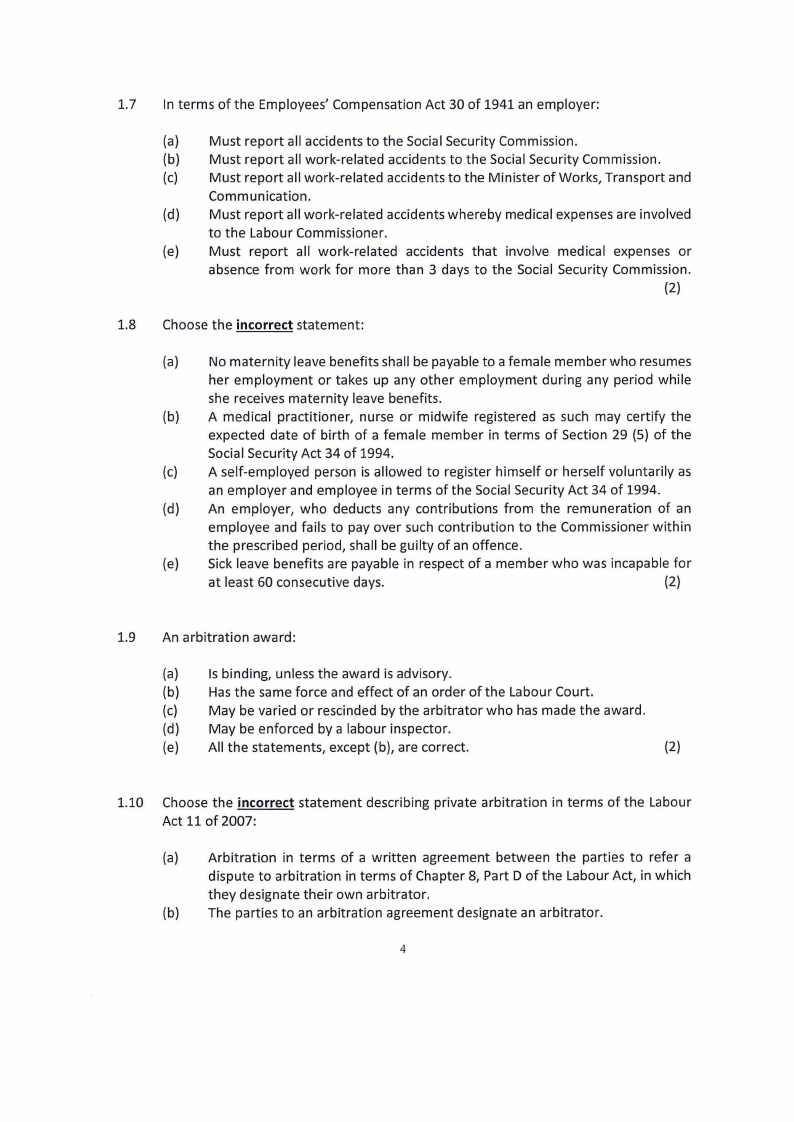
1.7 In terms of the Employees' Compensation Act 30 of 1941 an employer:
(a) Must report all accidents to the Social Security Commission .
(b) Must report all work-related accidents to the Social Security Commission .
(c) Must report all work-related accidents to the Minister of Works, Transport and
Communication.
(d) Must report all work-related accidents whereby medical expenses are involved
to the Labour Commissioner.
(e) Must report all work-related accidents that involve medical expenses or
absence from work for more than 3 days to the Social Security Commission.
(2)
1.8 Choose the incorrect statement:
(a) No maternity leave benefits shall be payable to a female member who resumes
her employment or takes up any other employment during any period while
she receives maternity leave benefits.
(b) A medical practitioner, nurse or midwife registered as such may certify the
expected date of birth of a female member in terms of Section 29 (5) of the
Social Security Act 34 of 1994.
(c) A self-employed person is allowed to register himself or herself voluntarily as
an employer and employee in terms of the Social Security Act 34 of 1994.
(d) An employer, who deducts any contributions from the remuneration of an
employee and fails to pay over such contribution to the Commissioner within
the prescribed period, shall be guilty of an offence.
(e) Sick leave benefits are payable in respect of a member who was incapable for
at least 60 consecutive days.
(2)
1.9 An arbitration award:
(a) Is binding, unless the award is advisory.
(b) Has the same force and effect of an order of the Labour Court.
(c) May be varied or rescinded by the arbitrator who has made the award.
(d) May be enforced by a labour inspector.
(e) All the statements, except (b), are correct.
(2)
1.10 Choose the incorrect statement describing private arbitration in terms of the Labour
Act 11 of 2007:
(a) Arbitration in terms of a written agreement between the parties to refer a
dispute to arbitration in terms of Chapter 8, Part D of the Labour Act, in which
they designate their own arbitrator.
(b) The parties to an arbitration agreement designate an arbitrator.
4

5 Page 5

▲back to top


(c) A private arbitration award is final and binding, there is no right of appeal or
review.
(d) The arbitrator in private arbitration may make an order for costs.
(e) The arbitrator may vary or rescind the award, at the arbitrator's instance or on
the application of any party to the dispute.
(2)
1.11 In terms of the Social Security Act 34 of 1994, matern ity leave benefits shall, ifthe child
concerned dies within two weeks after the actual date of confinement, be payable:
(a) In respect of the rest of the period of maternity leave.
(b) In respect of a further period of four weeks only, reckoned from the date of
confinement.
(c) In respect of a further period of four weeks only, reckoned from the date of
death.
(d) No further benefits are payable if the child dies within two weeks after birth .
(e) To the person in whose care the mother is placed or any other person who is
considered a fit and proper person to administer the benefits on behalf of the
mother.
(2)
1.12 An employer is allowed to introduce a change to a term or condition of employment
when:
(a) Both parties agree to the said change.
(b) There is a more favourable change to the basic conditions of employment in
accordance with legislation.
(c) It falls within the terms of the contract of emp loyment.
(d) All of the above.
(e) None of the above.
(2)
1.13 The Employees' Compensation Act 30 of 1941 does not apply to:
(a) Casual employees.
(b) Employees earning more than a prescribed maximum amount of remuneration
per annum, unless the employer made a special arrangement with the
Commission.
(c) Employees who work solely for a commission or a share in the takings.
(d) None of the above .
(e) Both (b) and (c)
(2)
5

6 Page 6

▲back to top


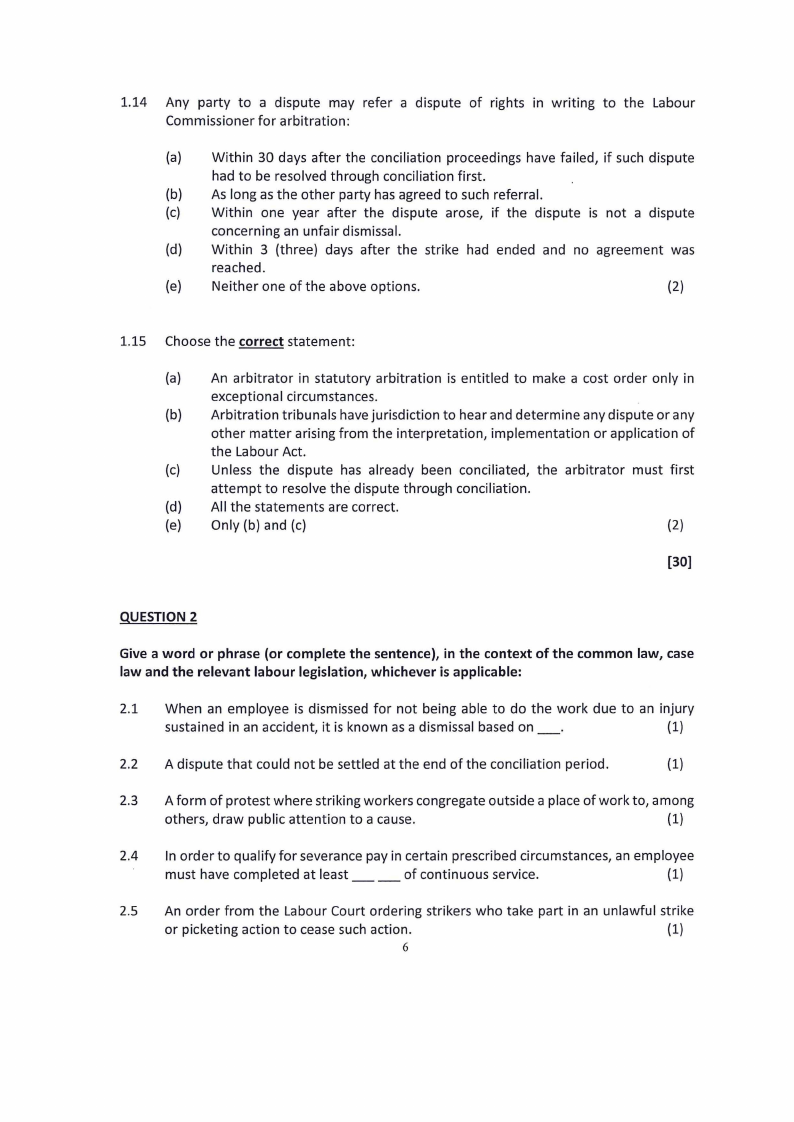
1.14 Any party to a dispute may refer a dispute of rights in writing to the Labour
Commissioner for arbitration:
(a) Within 30 days after the conciliation proceedings have failed, if such dispute
had to be resolved through conciliation first.
(b) As long as the other party has agreed to such referral.
(c) Within one year after the dispute arose, if the dispute is not a dispute
concerning an unfair dismissal.
(d) Within 3 (three) days after the strike had ended and no agreement was
reached.
(e) Neither one of the above options.
(2)
1.15 Choose the correct statement:
(a) An arbitrator in statutory arbitration is entitled to make a cost order only in
exceptional circumstances.
(b) Arbitration tribunals have jurisdiction to hear and determine any dispute or any
other matter arising from the interpretation, implementation or application of
the Labour Act.
(c) Unless the dispute has already been conciliated, the arbitrator must first
attempt to resolve the dispute through conciliation.
(d) All the statements are correct.
(e) Only (b) and (c)
(2)
(30]
QUESTION 2
Give a word or phrase (or complete the sentence), in the context of the common law, case
law and the relevant labour legislation, whichever is applicable:
2.1 When an employee is dismissed for not being able to do the work due to an injury
sustained in an accident, it is known as a dismissal based on_.
(1)
2.2 A dispute that could not be settled at the end of the conciliation period.
(1)
2.3 A form of protest where striking workers congregate outside a place of work to, among
others, draw public attention to a cause.
(1)
2.4 In order to qualify for severance pay in certain prescribed circumstances, an employee
must have completed at least _ _ of continuous service.
(1)
2.5 An order from the Labour Court ordering strikers who take part in an unlawful strike
or picketing action to cease such action.
(1)
6

7 Page 7

▲back to top


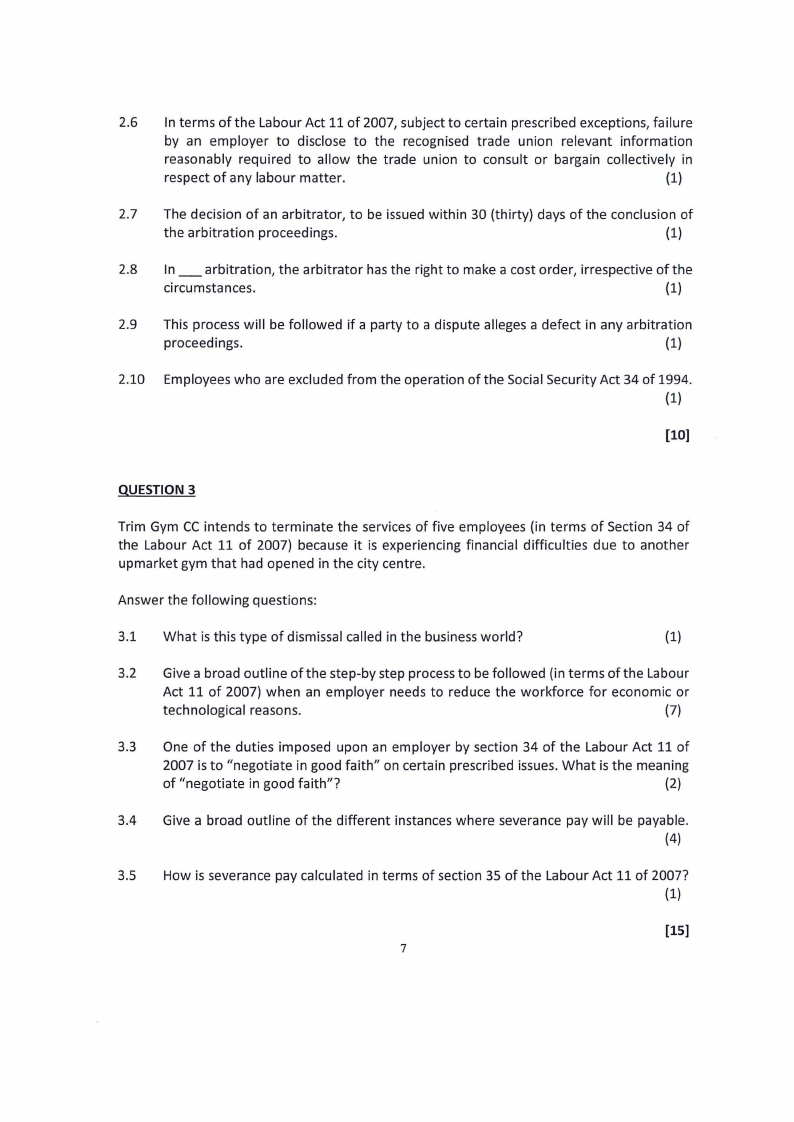
2.6 In terms of the Labour Act 11 of 2007, subject to certain prescribed exceptions, failure
by an employer to disclose to the recognised trade union relevant information
reasonably required to allow the trade union to consult or bargain collectively in
respect of any labour matter.
(1)
2.7 The decision of an arbitrator, to be issued within 30 (thirty) days of the conclusion of
the arbitration proceedings.
(1)
2.8 In_ arbitration, the arbitrator has the right to make a cost order, irrespective of the
circumstances.
(1)
2.9 This process will be followed if a party to a dispute alleges a defect in any arbitration
proceedings.
(1)
2.10 Employees who are excluded from the operation of the Social Security Act 34 of 1994.
(1)
[10]
QUESTION 3
Trim Gym CC intends to terminate the services of five employees (in terms of Section 34 of
the Labour Act 11 of 2007) because it is experiencing financial difficulties due to another
upmarket gym that had opened in the city centre.
Answer the following questions:
3.1 What is this type of dismissal called in the business world?
(1)
3.2 Give a broad outline of the step-by step process to be followed (in terms of the Labour
Act 11 of 2007) when an employer needs to reduce the workforce for economic or
technological reasons.
(7)
3.3 One of the duties imposed upon an employer by section 34 of the Labour Act 11 of
2007 is to "negotiate in good faith" on certain prescribed issues. What is the meaning
of "negotiate in good faith"?
(2)
3.4 Give a broad outline of the different instances where severance pay will be payable .
(4)
3.5 How is severance pay calculated in terms of section 35 of the Labour Act 11 of 20077
(1)
[15]
7

8 Page 8

▲back to top


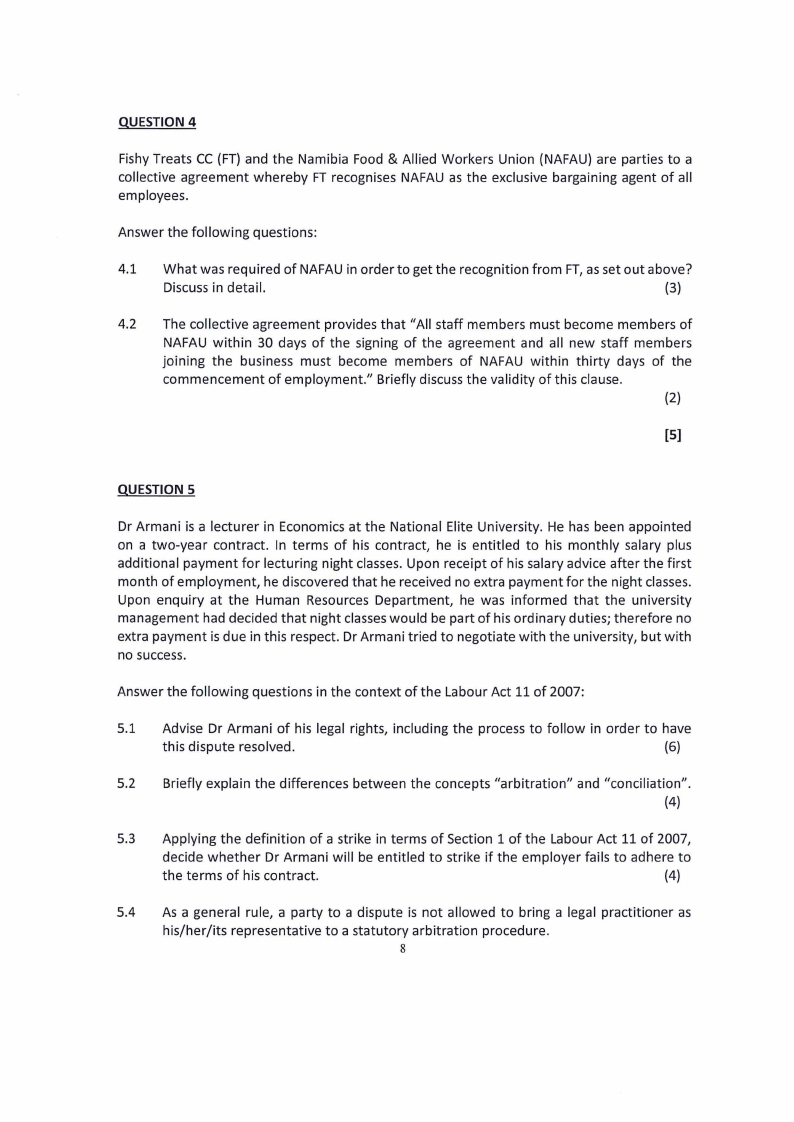
QUESTION 4
Fishy Treats CC (FT) and the Namibia Food & Allied Workers Union (NAFAU) are parties to a
collective agreement whereby FT recognises NAFAU as the exclusive bargaining agent of all
employees.
Answer the following questions:
4.1 What was required of NAFAU in order to get the recognition from FT, as set out above?
Discuss in detail.
(3)
4.2 The collective agreement provides that "All staff members must become members of
NAFAU within 30 days of the signing of the agreement and all new staff members
joining the business must become members of NAFAU within thirty days of the
commencement of employment." Briefly discuss the validity of this clause.
(2)
[S]
QUESTION 5
Dr Armani is a lecturer in Economics at the National Elite University. He has been appointed
on a two-year contract. In terms of his contract, he is entitled to his monthly salary plus
additional payment for lecturing night classes. Upon receipt of his salary advice after the first
month of employment, he discovered that he received no extra payment for the night classes.
Upon enquiry at the Human Resources Department, he was informed that the university
management had decided that night classes would be part of his ordinary duties; therefore no
extra payment is due in this respect. Dr Armani tried to negotiate with the university, but with
no success.
Answer the following questions in the context of the Labour Act 11 of 2007:
5.1 Advise Dr Armani of his legal rights, including the process to follow in order to have
this dispute resolved.
(6)
5.2 Briefly explain the differences between the concepts "arbitration" and "conciliation".
(4)
5.3 Applying the definition of a strike in terms of Section 1 of the Labour Act 11 of 2007,
decide whether Dr Armani will be entitled to strike if the employer fails to adhere to
the terms of his contract.
(4)
5.4 As a general rule, a party to a dispute is not allowed to bring a legal practitioner as
his/her/its representative to a statutory arbitration procedure.
8

9 Page 9

▲back to top


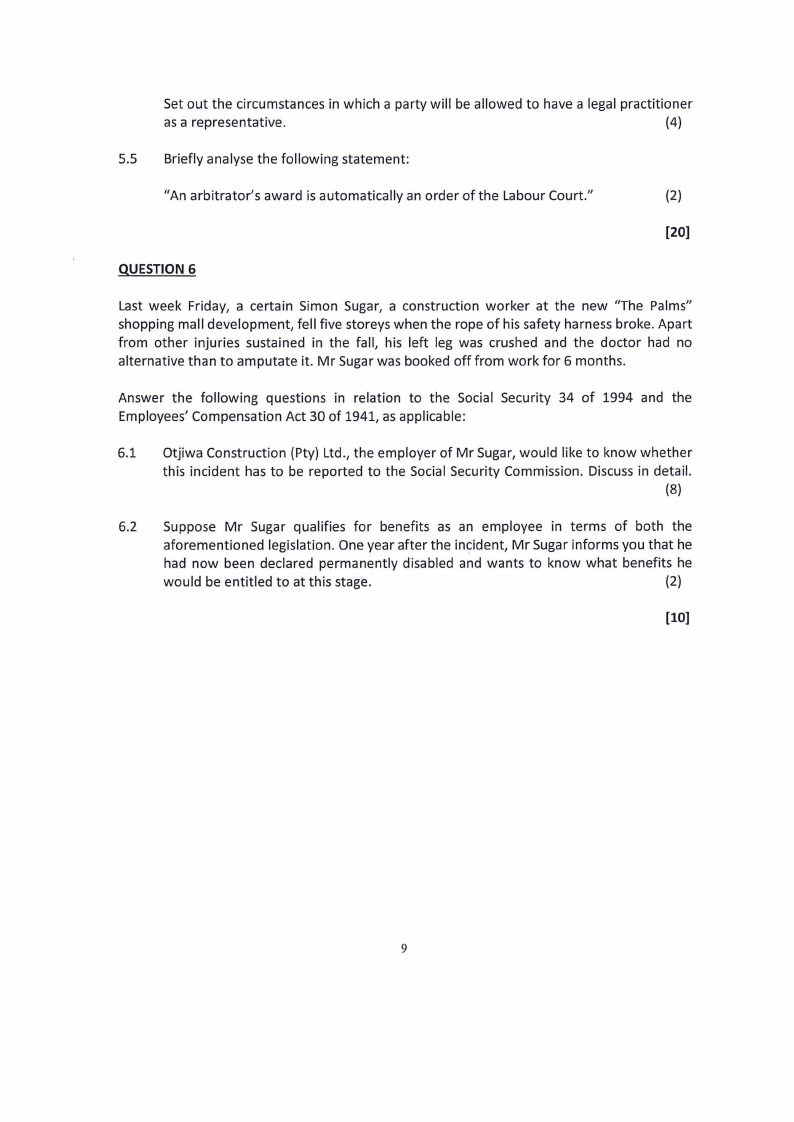
Set out the circumstances in which a party will be allowed to have a legal practitioner
as a representative.
{4)
5.5 Briefly analyse the following statement:
"An arbitrator's award is automatically an order of the Labour Court."
{2)
[20)
QUESTION 6
Last week Friday, a certain Simon Sugar, a construction worker at the new "The Palms"
shopping mall development, fell five storeys when the rope of his safety harness broke. Apart
from other injuries sustained in the fall, his left leg was crushed and the doctor had no
alternative than to amputate it. Mr Sugar was booked off from work for 6 months.
Answer the following questions in relation to the Social Security 34 of 1994 and the
Employees' Compensation Act 30 of 1941, as applicable:
6.1 Otjiwa Construction (Pty) Ltd., the employer of Mr Sugar, would like to know whether
this incident has to be reported to the Social Security Commission. Discuss in detail.
(8)
6.2 Suppose Mr Sugar qualifies for benefits as an employee in terms of both the
aforementioned legislation. One year after the incident, Mr Sugar informs you that he
had now been declared permanently disabled and wants to know what benefits he
would be entitled to at this stage .
(2)
[10)
9

10 Page 10

▲back to top


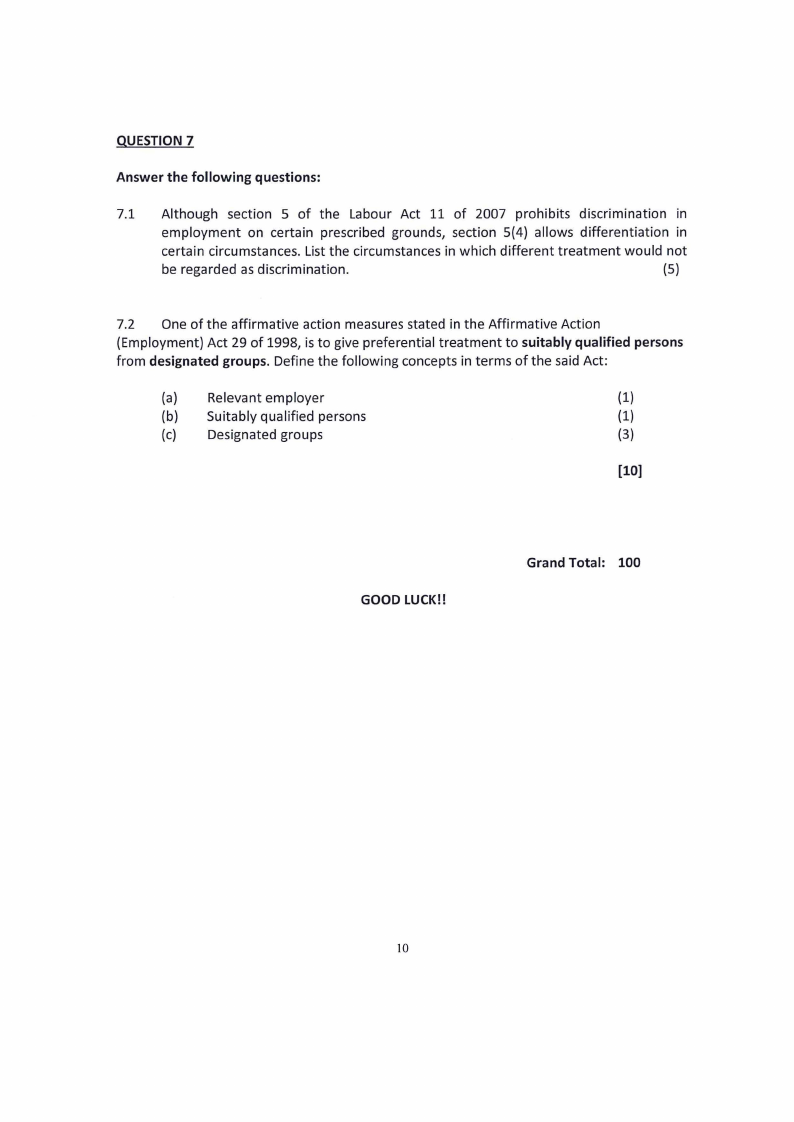
QUESTION 7
Answer the following questions:
7.1 Although section 5 of the Labour Act 11 of 2007 prohibits discrimination in
employment on certain prescribed grounds, section 5(4) allows differentiation in
certain circumstances. List the circumstances in which different treatment would not
be regarded as discrimination.
(5)
7.2 One of the affirmative action measures stated in the Affirmative Action
(Employment) Act 29 of 1998, is to give preferential treatment to suitably qualified persons
from designated groups. Define the following concepts in terms of the said Act:
(a) Relevant employer
(1)
(b) Suitably qualified persons
(1)
(c) Designated groups
(3)
[10)
GOOD LUCK!!
Grand Total: 100