


 |
LSA721S - LINUX SYSTEMS ADMINISTRATION - 2ND OPP - DEC 2025 |
|
|
1 Page 1 |
▲back to top |
nAm I BIA unlVERSITY
OF SCIEnCE Ano TECHnOLOGY
FACULTY OF COMPUTING AND INFORMATICS
DEPARTMENT OF COMPUTER SCIENCE
QUALIFICATION: BACHELOR OF COMPUTER SCIENCE
QUALIFICATION CODE: 07BACS 07BCMS
COURSE: LINUX SYSTEMS
ADMINISTRATION
LEVEL: 7
COURSE CODE: LSA721S
DATE: JANUARY 2026
PAPER: THEORY
DURATION: 3 HOURS
MARKS: 85
SECOND OPPORTUNITY EXAMINATION QUESTION PAPER
EXAMINER(S)
MR. SHOOPALA NAMBAHU
MODERATOR:
MS. JOVITA MATEUS
THIS QUESTION PAPER CONSISTS OF 3 PAGES
(Excluding this front page)
INSTRUCTIONS
1. Answer ALL the questions on the answer scripts.
2. Write clearly and neatly.
3. Number the answers clearly.
PERMISSIBLE MATERIALS
1. Calculator.
|
|
2 Page 2 |
▲back to top |

Section A: (Multiple choice)
[10 Marks]
Read each question carefully, and then select THE ANSWER that bestfits
the question
1. What is the significance of the Linux kernel?
a) It provides a graphical user interface b) It manages system resources
and hardware communication
c) It stores user data
d) It compiles software programs
2. Which command is used to update the package index in Red Hat-based
systems?
a) aptitude update
b) yum update
c) pkg update
d) updatepkg
3. In Linux, what is the purpose of the 'root' user?
a) A standard user with limited permissions b) The system
administrator with full privileges
c) Aguest user
d) A service account
4. Which command is used to change the ownership of a file in Linux?
a) chown
b) chmod
c) chgrp
d) mv
5. Which command can be used to display the last lines of a file?
a) tail
c) end
b) head
d) last
6. Which command can be used to monitor real-time system performance?
a) monitor
b) top
c) perf
d) stat
7. Which vi editor command copies the current line of the file?
a)yy
b)yw
c) ye
d) none of the mentioned
8. Which command changes a file's group owner?
a) cgrp
b) chgrp
c) change
d) group
9. Which command is used to extract a column from a text file?
a) paste
b) get
c) cut
d) tar
10. What is /root?
a) root filesystem
b) home directory of the root user
c) the directory which contains all the directories of the filesystem
d) none of the mentioned
|
|
3 Page 3 |
▲back to top |
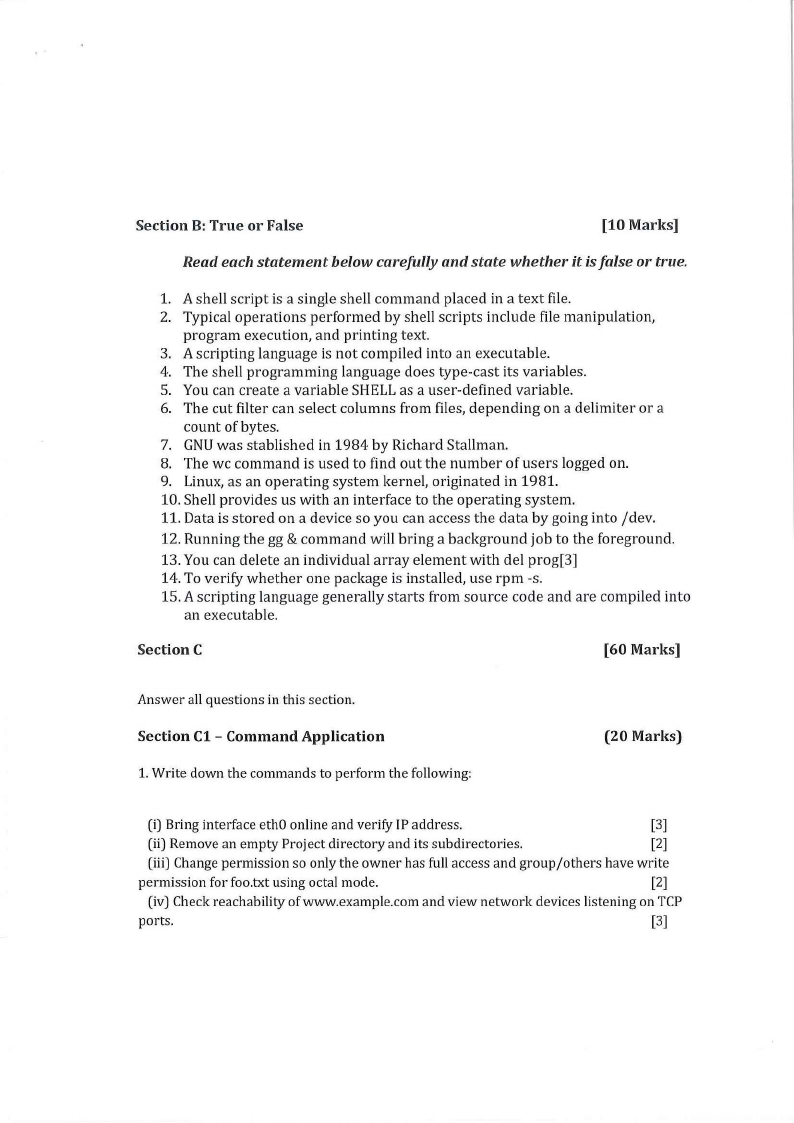
Section B: True or False
[10 Marks]
Read each statement below carefully and state whether it is false or true.
1. A shell script is a single shell command placed in a text file.
2. Typical operations performed by shell scripts include file manipulation,
program execution, and printing text.
3. A scripting language is not compiled into an executable.
4. The shell programming language does type-cast its variables.
5. You can create a variable SHELL as a user-defined variable.
6. The cut filter can select columns from files, depending on a delimiter or a
count of bytes.
7. GNU was stablished in 1984 by Richard Stallman.
8. The wc command is used to find out the number of users logged on.
9. Linux, as an operating system kernel, originated in 1981.
10. Shell provides us with an interface to the operating system.
11. Data is stored on a device so you can access the data by going into /dev.
12. Running the gg & command will bring a background job to the foreground.
13. You can delete an individual array element with de! prog[3]
14. To verify whether one package is installed, use rpm -s.
15. A scripting language generally starts from source code and are compiled into
an executable.
Section C
[60 Marks]
Answer all questions in this section.
Section Cl - Command Application
1. Write down the commands to perform the following:
(20 Marks)
(i) Bring interface ethO online and verify IP address.
[3]
(ii) Remove an empty Project directory and its subdirectories.
[2]
(iii) Change permission so only the owner has full access and group/others have write
permission for foo.txt using octal mode.
[2]
(iv) Check reachability ofwww.example.com and view network devices listening on TCP
ports.
[3]
|
|
4 Page 4 |
▲back to top |
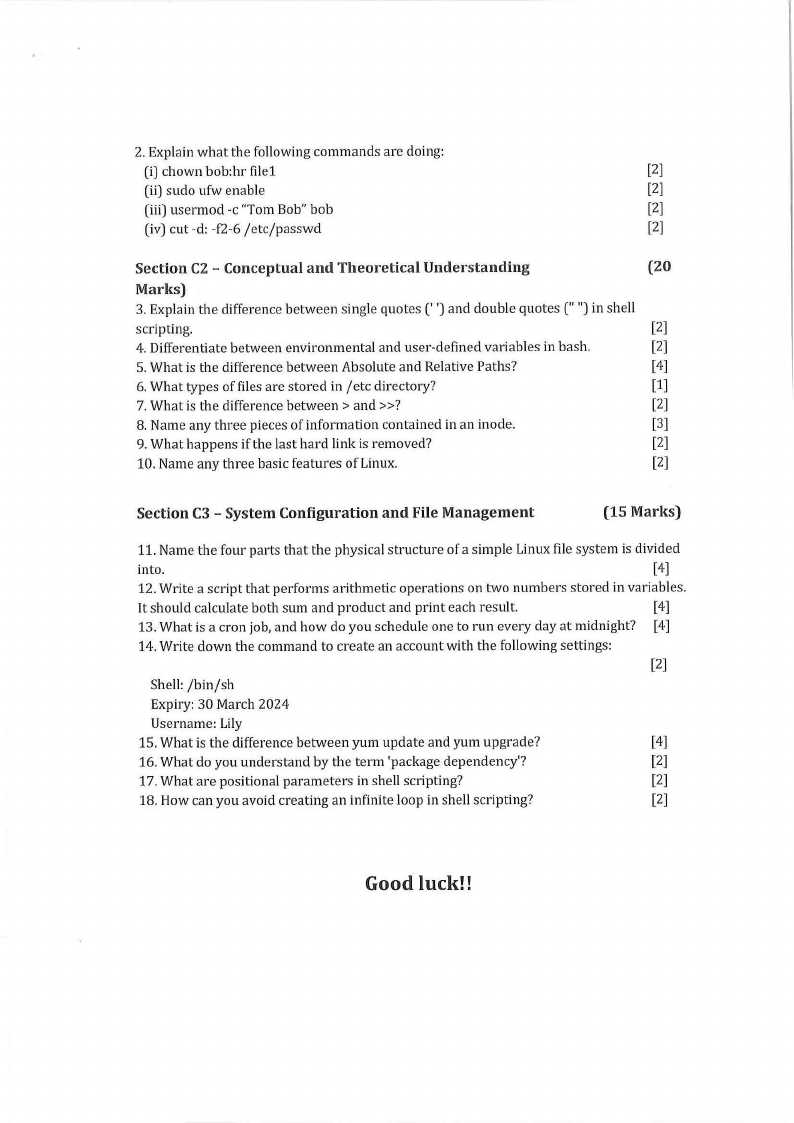
2. Explain what the following commands are doing:
(i) chown bob:hr filel
[2]
(ii) sudo ufw enable
[2]
(iii) usermod -c "Tom Bob" bob
[2]
(iv) cut -d: -f2-6 /etc/passwd
[2]
Section CZ - Conceptual and Theoretical Understanding
(20
Marks)
3. Explain the difference between single quotes('') and double quotes(" ") in shell
scripting.
[2]
4. Differentiate between environmental and user-defined variables in bash.
[2]
5. What is the difference between Absolute and Relative Paths?
[4]
6. What types of files are stored in /etc directory?
[1]
7. What is the difference between> and»?
[2]
8. Name any three pieces of information contained in an inode.
[3]
9. What happens if the last hard link is removed?
[2]
10. Name any three basic features of Linux.
[2]
Section C3 - System Configuration and File Management
(15 Marks)
11. Name the four parts that the physical structure of a simple Linux file system is divided
into.
[4]
12. Write a script that performs arithmetic operations on two numbers stored in variables.
It should calculate both sum and product and print each result.
[4]
13. What is a cron job, and how do you schedule one to run every day at midnight? [4]
14. Write down the command to create an account with the following settings:
[2]
Shell: /bin/sh
Expiry: 30 March 2024
Username: Lily
15. What is the difference between yum update and yum upgrade?
[4]
16. What do you understand by the term 'package dependency'?
[2]
17. What are positional parameters in shell scripting?
[2]
18. How can you avoid creating an infinite loop in shell scripting?
[2]
Good luck!!