


 |
WWR711S-WATER AND WETLAND RESOURCES MANAGEMENT-1ST OPP- JUNE 2025 |
|
|
1 Page 1 |
▲back to top |
nAmlBIA unlVERSITY
OF SCIEnCE Ano
FACULTY OF HEALTH, NATURAL RESOURCES AND APPLIED SCIENCES
DEPARTMENT OF NATURAL RESOURCE SCIENCES
QUALIFICATION: BACHELOR of NATURAL RESOURCE MANAGEMENT (NRM)
QUALIFICATION CODE: 07BNRS
LEVEL: 7
COURSE CODE: WWR711S
COURSE NAME: WATER AND WETLAND
RESOURCES MANAGEMENT
SESSION: JUNE 2025
DURATION: 2.5 HOURS
PAPER: THEORY
MARKS: 120
EXAMINER(S)
FIRST OPPORTUNITY EXAMINATION QUESTION PAPER
Mrs. C NTESA
MODERATOR: Ms. N NASHIPILI
INSTRUCTIONS
1. Answer ALL the questions.
2. Read all the questions carefully before answering.
3. Make sure your name and surname, question number and
the date appear on the answer script.
4. Please ensure that your writing is legible, neat and
presentable.
ATTACHMENTS
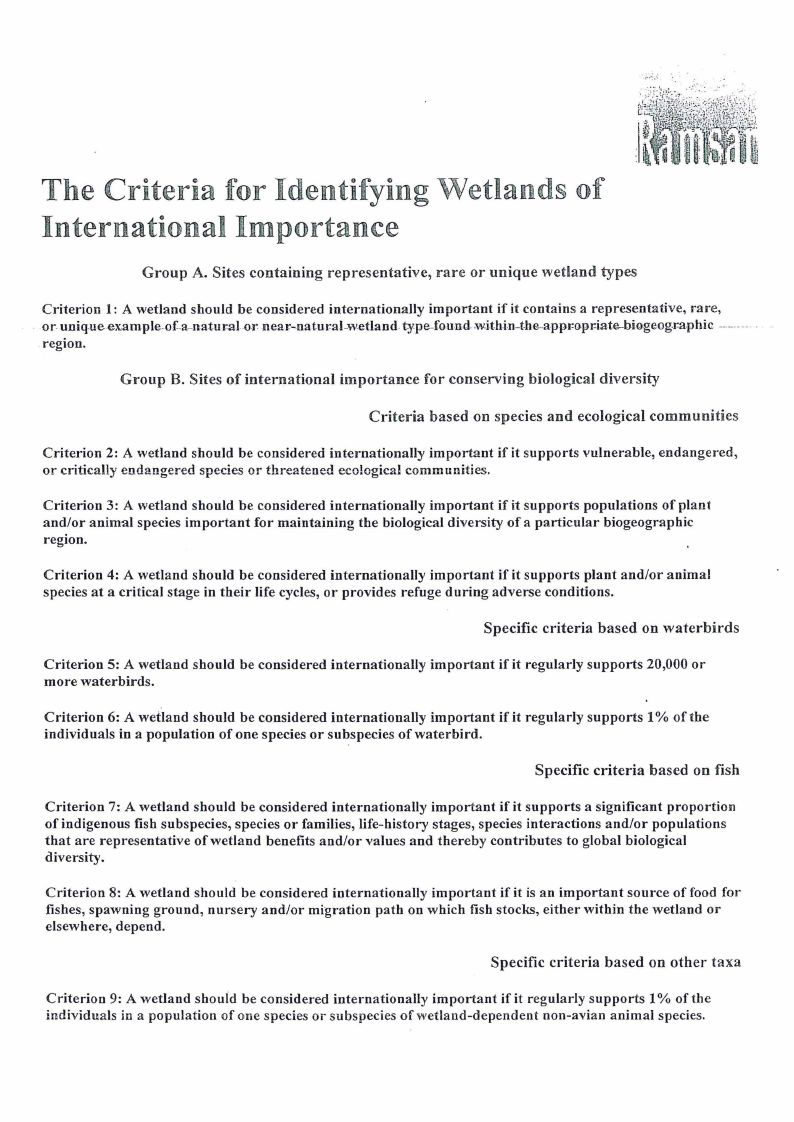
1. The Criteria for Identifying Wetlands of International Importance sheet.
THIS QUESTION PAPER CONSISTS OF 4 PAGES (Including this front page)
|
|
2 Page 2 |
▲back to top |
QUESTION 1
Write short notes to define the following terms:
1.1. Endoreic river system
(1)
1.2. Biological corridor
(2)
1.3. Linear oasis
(2)
1.4. Estuarine wetland
(1)
1.5. Resource accounting in the context of wetlands
(2)
1.6. Eutrophication
(1)
1.7. Stratification
(1)
[10]
QUESTION 2
Clearly distinguish between the following terms.
2.1. Lotic and lentic wetlands
(2)
2.2. Palustrine and lacustrine wetlands
(2)
2.3. Cenote and hemi-cenote sinkholes
(2)
2.4. Perennial rivers and ephemeral rivers
(2)
2.5. Hypogean groundwater and Epigean groundwater
(2)
[10]
QUESTION 3
Give a correct word/term/name for the following:
3.1. A wetland system that flows every year, but only during the rainy season.
(1)
3.2. The average amount of water that flows down a particular river, per year, (1)
expressed either as a depth (in millimetres) of water spread evenly across the
entire drainage basin or as a volume (in cubic metres) of water flowing past a
given point.
3.3. A name given to a marine zone that is more than 200 m deep and is beyond (1)
the continental shelf.
3.4. The largest floodplain lake in Namibia.
(1)
3.5. A layer of water in a dam that gets enough light for photosynthesis.
(1)
3.6. The measure of how muddy the water is or the measure of suspended solid (1)
particles in the water.
3.7. An IUCN conservation status that refers to a species with at least a 50%
(1)
chance of going extinct in 10 years.
3.8. A physical construction or wall across a river, blocking the flow.
(1)
3.9. The area around an impoundment where vegetation cannot re-establish
(1)
itself due to water level changes.
3.10. The river basin with the highest tree diversity in Namibia.
(1)
[10]
2
|
|
3 Page 3 |
▲back to top |
QUESTION 4
Name a Ramsar Site that is found and protected within the following protected areas.
a) Namib-Naukluft Park
b) Etosha National Park
c) Tsau Khaeb National Park (Sperrgebiet)
d) Bwabwata National Park
[4]
QUESTION 5
The Ramsar Convention has set specific criteria for wetlands to qualify as "wetlands of
international importance (Ramsar Site)". These criteria are based on ecological, botanical,
zoological, limnological, and hydrological significance. Choose one of the listed Ramsar
Sites and use the attached Ramsar criteria to draw up a table to show how and motivate
why it meets four of the Ramsar Criteria.
1) Walvis Bay Lagoon
2) Sandwich Harbour
3) Etosha Pan
[8]
QUESTION 6
Upwelling is an oceanographic process that occurs when deep, cold, and nutrient-rich water
rises to the surface. Along the Atlantic Coast of Southern Africa, particularly off the coast of
Namibia, upwelling plays a crucial role in supporting marine life and local economies. Discuss
the ecological and socio-economic importance of upwelling, specifically in relation to the
Atlantic Ocean.
[S]
QUESTION 7
7.1. Based on your excursion to the Okavango River Basin and class discussions, (8)
describe the flood dynamics of the Okavango River system. Explain how these
seasonal floods create different habitats and increase ecological productivity,
supporting biodiversity in the basin.
7.2. The spread of alien invasive species in Namibia's rivers, such as Kariba Weed (12)
(Salvinia molesta), poses a serious threat to biodiversity and ecosystem
health, particularly in the Eastern Caprivi floodplains of the Zambezi River
System. Discuss four control mechanisms that can be used to manage or
reduce the spread of this invasive species and critically evaluate the
effectiveness and disadvantages of each method.
[20]
3
|
|
4 Page 4 |
▲back to top |
QUESTION 8
Compare and contrast the Upper, Middle, and Lower catchments of the Cuvelai River
System with reference to their location, rainfall patterns and variability, type and frequency
of flow (perennial, seasonal, or ephemeral), and key hydrological features and processes.
In your response, describe the distinct characteristics of each catchment.
[12]
QUESTION 9
Describe the process of water stratification in summer and how it changes in winter.
[12]
QUESTION 10
Critically explain what the Mini-SASS technique is and its purpose in water quality
monitoring. Describe, in detail, how the method is practically applied in the field, including
the equipment used, sampling procedure, and how results are interpreted.
[13]
QUESTION 11
list and explain the four (4) Dublin Principles that guide the implementation of Integrated
Water Resources Management (IWRM) and critically evaluate how these principles are
applied in the Namibian context.
[16]
4
|
|
5 Page 5 |
▲back to top |
The Criteria for Identifying Wetlands of
International Importance
Group A. Sites containing representative, rare or unique wetland types
Criterion 1: A wetland should be considered internationally important if it contains a representative, rare,
.. or unique example-of.a-natural.or near-uatur=al-wetland- type-found-with-in-t-he-ap-prnpr-iate-biogeog-rnphic -------·-
. region.
Group B. Sites of international importance for conserving biological diversity
Criteria based on species and ecological communities
Criterion 2: A wetland should be considered internationally important if it supports vulnerable, endangered,
or critically endangered species or threatened ecological communities.
Criterion 3: A wetland should be considered internationally important if it supports populations of plant
and/or animal species important for maintaining the biological diversity of a particular biogeographic
region.
Criterion 4: A wetland should be considered internationally important if it supports plant and/or animal
species at a critical stage in their life cycles, or provides refuge during adverse conditions.
Specific criteria based on waterbirds
Criterion 5: A wetland should be considered internationally important if it regularly supports 20,000 or
more waterbirds.
Criterion 6: A wetland should be considered internationally important if it regularly supports 1% of the
individuals in a population of one species or subspecies of waterbird.
Specific criteria based on fish
Criterion 7: A wetland should be considered internationally important if it supports a significant proportion
of indigenous fish subspecies, species or families, life-history stages, species interactions and/or populations
that are representative of wetland benefits and/or values and thereby contributes to global biological
diversity.
Criterion 8: A wetland should be considered internationally important if it is an important source of food for
fishes, spawning ground, nursery and/or migration path on which fish stocks, either within the wetland or
elsewhere, depend.
Specific criteria based on other taxa
Criterion 9: A wetland shouid be considered internationally impo1iant if it regularly supports 1% of the
individuals in a population of one species or subspecies of wetland-dependent non-avian animal species.