


 |
LMP721C-LEADING MANAGING PROJECTS-2ND OPP-JULY 2025 |
|
|
1 Page 1 |
▲back to top |

t!J
nAm I BIA unlVERSITY
0 F SCIEn CE An D TECHn OLOGY
HAROLD PUPKEWITZ GRADUATE SCHOOL OF BUSINESS SCHOOL OF MANAGEMENT
COURSE CODE: LMP721C
COURSE NAME:
LEADING AND MANAGING PROJECTS
DATE: JUNE 2025
MODE: FM
DURATION: 3 Hours
MARKS: 100
EXAMINERS:
SECOND OPPORTUNITY EXAMINATION
DR VUSUMUZI SIBANDA
MODERATOR:
INSTRUCTIONS
1. There are five questions; answer any four (4).
2. Write clearly and neatly.
3. Begin a new Question on a fresh page
4. Number the answers clearly.
PERMISSIBLE MATERIALS
1. Examination script
2. Answer Sheet/Booklet
3. Calculator
THIS EXAMINATION CONSISTS OF 3 PAGES (INCLUDING THIS FRONT PAGE)
|
|
2 Page 2 |
▲back to top |
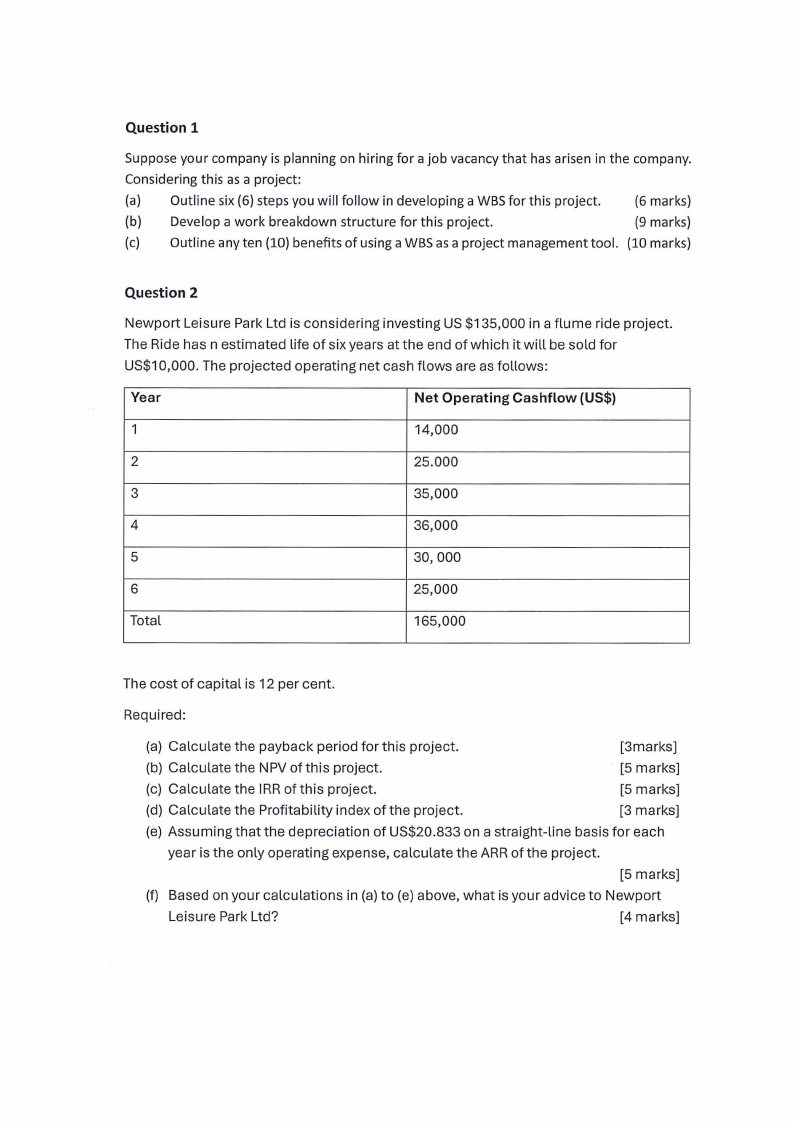
Question 1
Suppose your company is planning on hiring for a job vacancy that has arisen in the company.
Considering this as a project:
(a) Outline six (6) steps you will follow in developing a WBS for this project.
{6 marks)
(b) Develop a work breakdown structure for this project.
(9 marks)
(c) Outline any ten (10) benefits of using a WBS as a project management tool. (10 marks)
Question 2
Newport Leisure Park Ltd is considering investing US $135,000 in a flume ride project.
The Ride has n estimated life of six years at the end of which it will be sold for
US$10,000. The projected operating net cash flows are as follows:
Year
Net Operating Cashflow (US$)
1
14,000
2
25.000
3
35,000
4
36,000
5
30,000
6
25,000
Total
165,000
The cost of capital is 12 per cent.
Required:
(a) Calculate the payback period for this project.
[3marks]
(b) Calculate the NPV of this project.
[5 marks]
(c) Calculate the IRR of this project.
[5 marks]
(d) Calculate the Profitability index of the project.
[3 marks]
(e) Assuming that the depreciation of US$20.833 on a straight-line basis for each
year is the only operating expense, calculate the ARR of the project.
[5 marks]
(f) Based on your calculations in (a) to (e) above, what is your advice to Newport
Leisure Park Ltd?
[4 marks]
|
|
3 Page 3 |
▲back to top |
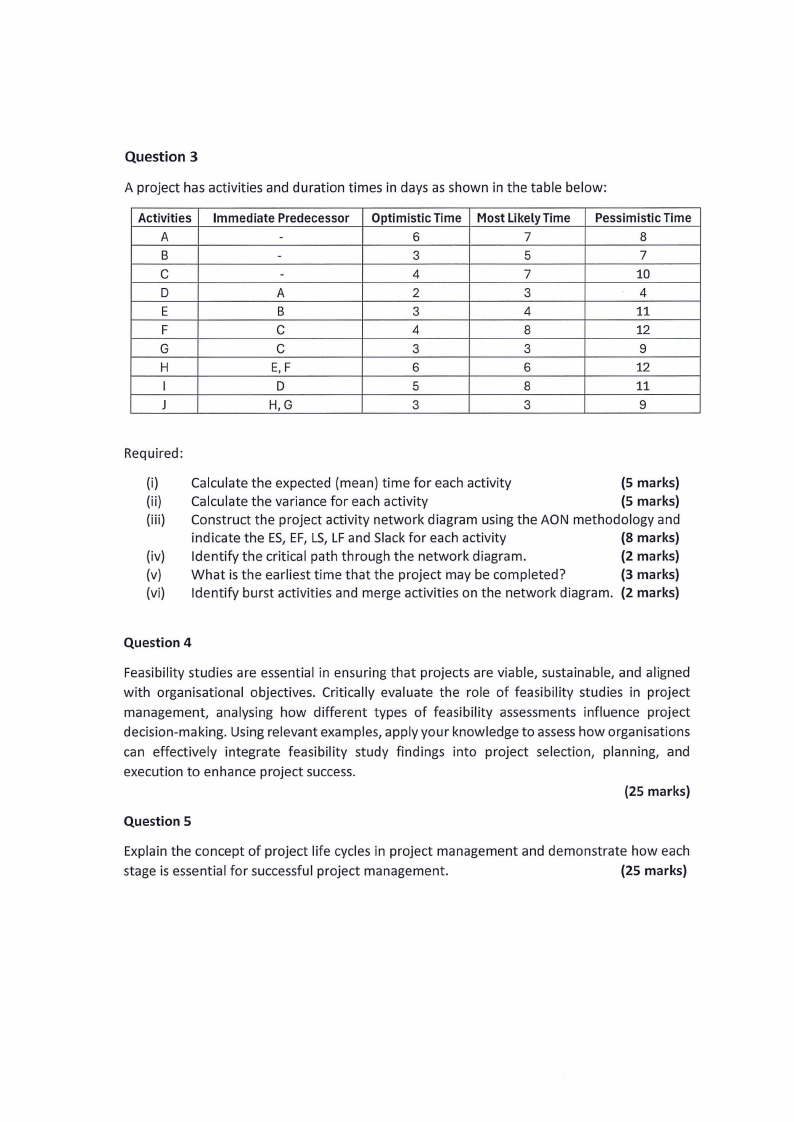
Question 3
A project has activities and duration times in days as shown in the table below:
Activities
A
B
C
D
E
F
G
H
I
J
Immediate Predecessor
-
-
-
A
B
C
C
E,F
D
H,G
Optimistic Time
6
3
4
2
3
4
3
6
5
3
Most LikelyTime
7
5
7
3
4
8
3
6
8
3
PessimisticTime
8
7
10
4
11
12
9
12
11
9
Required:
(i) Calculate the expected (mean) time for each activity
(5 marks)
(ii) Calculate the variance for each activity
(5 marks)
(iii) Construct the project activity network diagram using the AON methodology and
indicate the ES,EF,LS,LFand Slack for each activity
(8 marks)
(iv) Identify the critical path through the network diagram.
(2 marks)
(v) What is the earliest time that the project may be completed?
(3 marks)
(vi) Identify burst activities and merge activities on the network diagram. (2 marks)
Question 4
Feasibility studies are essential in ensuring that projects are viable, sustainable, and aligned
with organisational objectives. Critically evaluate the role of feasibility studies in project
management, analysing how different types of feasibility assessments influence project
decision-making. Using relevant examples, apply your knowledge to assesshow organisations
can effectively integrate feasibility study findings into project selection, planning, and
execution to enhance project success.
(25 marks)
Question 5
Explain the concept of project life cycles in project management and demonstrate how each
stage is essential for successful project management.
(25 marks)
|
|
4 Page 4 |
▲back to top |

n Am I BI A u n IVER s ITY
OF SCIEnCE TECHnOLOGY
HAROLD PUPKEWITZ GRADUATE SCHOOL OF BUSINESS SCHOOL OF MANAGEMENT
COURSE CODE: LMP721C
COURSE NAME:
LEADING AND MANAGING PROJECTS
DATE: JUNE 2025
MODE: FM
DURATION: 3 Hours
MARKS: 100
EXAMINERS:
SECOND OPPORTUNITY EXAMINATION
DR VUSUMUZI SIBANDA
MODERATOR: MRS SAARA NAMBINGA
INSTRUCTIONS
1. Answer ALL the questions.
2. Write clearly and neatly.
3. Begin a new Question on a fresh page
4. Number the answers clearly.
PERMISSIBLE MATERIALS
1. Examination script
2. Answer Sheet/Booklet
3. Calculator
THIS EXAMINATION CONSISTS OF 3 PAGES {INCLUDING THIS FRONT PAGE}
|
|
5 Page 5 |
▲back to top |
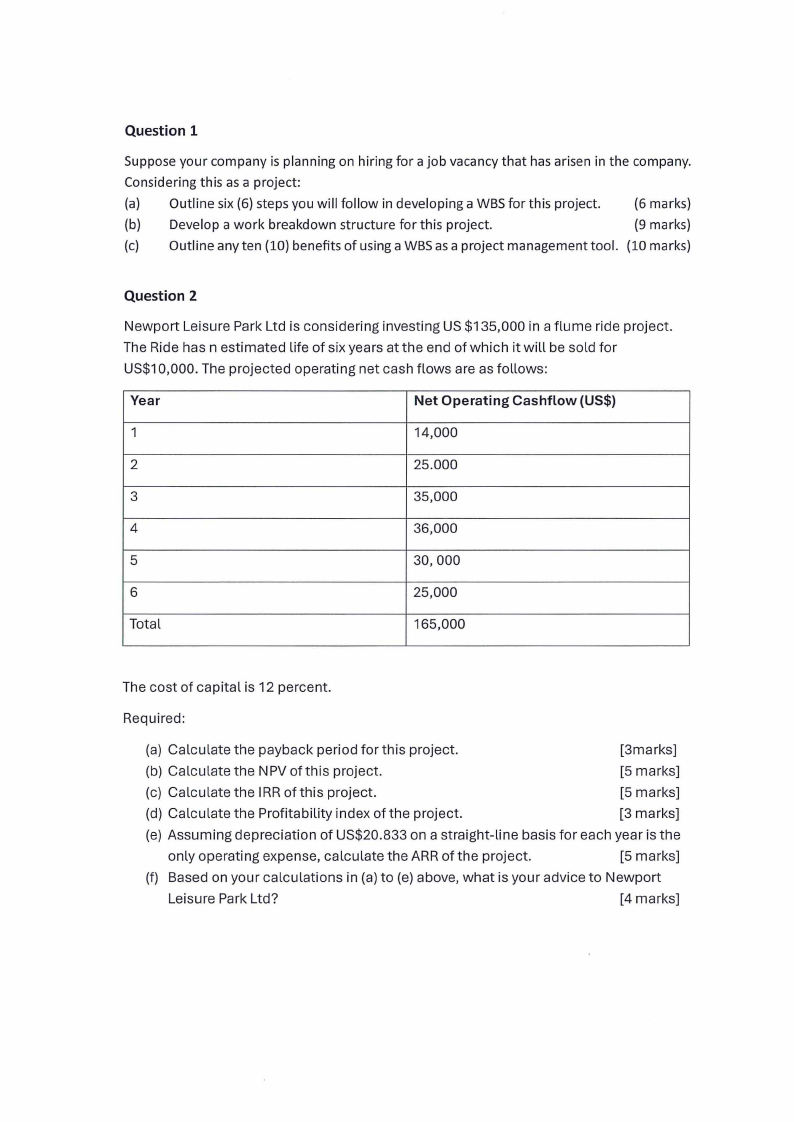
Question 1
Suppose your company is planning on hiring for a job vacancy that has arisen in the company.
Considering this as a project:
(a) Outline six (6) steps you will follow in developing a WBS for this project.
(6 marks)
(b) Develop a work breakdown structure for this project.
(9 marks)
(c) Outline any ten (10) benefits of using a WBS as a project management tool. (10 marks)
Question 2
Newport Leisure Park Ltd is considering investing US $135,000 in a flume ride project.
The Ride has n estimated life of six years at the end of which it will be sold for
US$10,000. The projected operating net cash flows are as follows:
Year
Net Operating Cashflow (US$)
1
14,000
2
25.000
3
35,000
4
36,000
5
30,000
6
25,000
Total
165,000
The cost of capital is 12 percent.
Required:
(a) Calculate the payback period for this project.
[3marks]
(b) Calculate the NPVofthis project.
[5 marks]
(c) Calculate the IRR of this project.
[5 marks]
(d) Calculate the Profitability index of the project.
[3 marks]
(e) Assuming depreciation of US$20.833 on a straight-line basis for each year is the
only operating expense, calculate the ARR of the project.
[5 marks]
(f) Based on your calculations in (a) to (e) above, what is your advice to Newport
Leisure Park Ltd?
[4 marks]
|
|
6 Page 6 |
▲back to top |
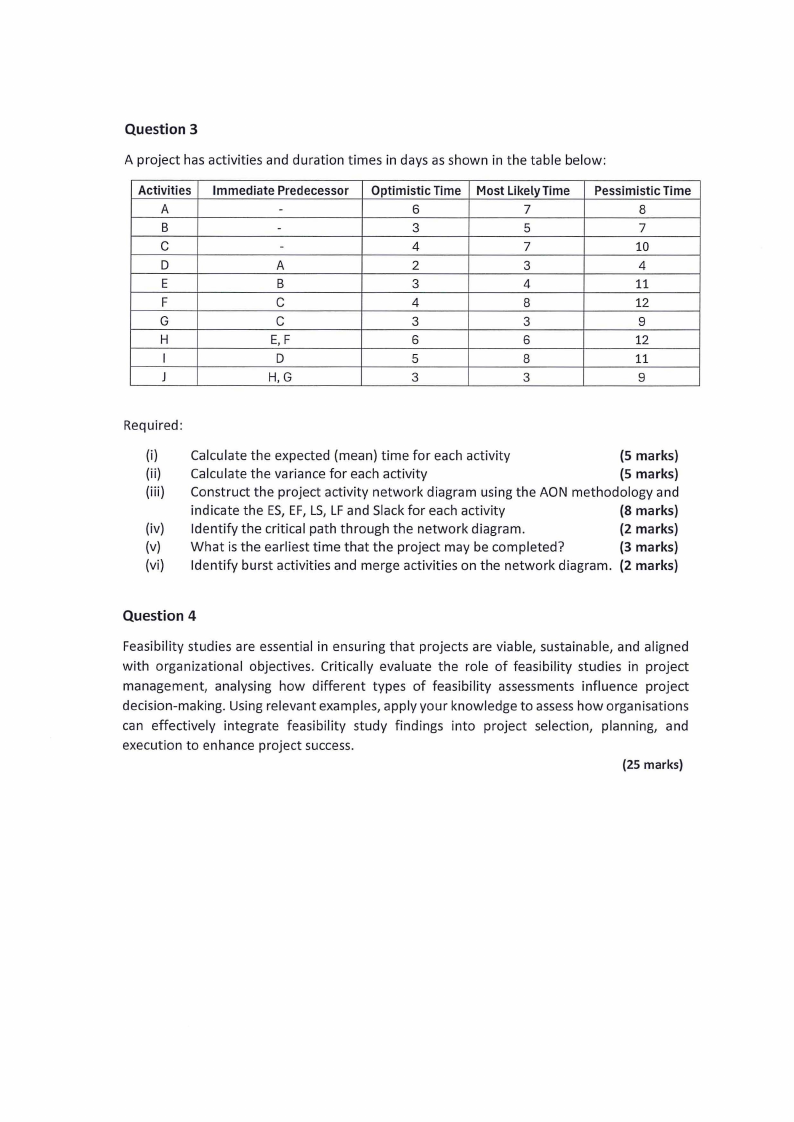
Question 3
A project has activities and duration times in days as shown in the table below:
Activities
A
B
C
D
E
F
G
H
I
J
Immediate Predecessor
-
-
-
A
B
C
C
E,F
D
H,G
Optimistic Time
6
3
4
2
3
4
3
6
5
3
Most LikelyTime
7
5
7
3
4
8
3
6
8
3
PessimisticTime
8
7
10
4
11
12
9
12
11
9
Required:
(i) Calculate the expected (mean) time for each activity
(5 marks)
(ii) Calculate the variance for each activity
(5 marks)
(iii) Construct the project activity network diagram using the AON methodology and
indicate the ES,EF,LS,LFand Slack for each activity
(8 marks)
(iv) Identify the critical path through the network diagram.
(2 marks)
(v) What is the earliest time that the project may be completed?
(3 marks)
(vi) Identify burst activities and merge activities on the network diagram. (2 marks)
Question 4
Feasibility studies are essential in ensuring that projects are viable, sustainable, and aligned
with organizational objectives. Critically evaluate the role of feasibility studies in project
management, analysing how different types of feasibility assessments influence project
decision-making. Using relevant examples, apply your knowledge to assesshow organisations
can effectively integrate feasibility study findings into project selection, planning, and
execution to enhance project success.
(25 marks)