


 |
SML610S - STRATEGIC MANAGEMENT AND LEADERSHIP - 1ST OPP - JUNE 2025 |
|
|
1 Page 1 |
▲back to top |
r.I'
nAmI BI AunIVER s ITY
OF SCIEnCE Ano TECHnOLOGY
FACULTY OF COMMERCE, HUMAN SCIENCESAND EDUCATION
DEPARTMENT OF TECHNICAL AND VOCATIONAL EDUCATION AND TRAINING
QUALIFICATION : DIPLOMA IN TECHNICAL AND VOCATIONAL EDUCATION AND TRAINING:
MANAGEMENT
QUALIFICATION CODE: 06DTVM
LEVEL: 6
COURSE CODE: SML610S
COURSE NAME: STRATEGICMANAGEMENT AND
LEADERSHIP
SESSION: JUNE 2025
PAPER: PAPER1
DURATION: 3 HOURS
MARKS: 100
EXAMINER{S)
FIRST OPPORTUNITY EXAMINATION PAPER
Mr. Benhardt U Kauteza
MODERATOR: Dr. lndepentia de Waldt
INSTRUCTIONS
1. Answer all questions.
2. Read all the questions carefully before answering.
3. This paper consists of Sections A and B with a total of six questions.
4. Make sure your name and surname, question number and the date appear on the
answer script.
5. Number the answers clearly.
6. Please ensure that your writing is legible, neat and presentable
THIS QUESTION PAPER CONSISTS OF _5_ PAGES (Including this front page)
|
|
2 Page 2 |
▲back to top |
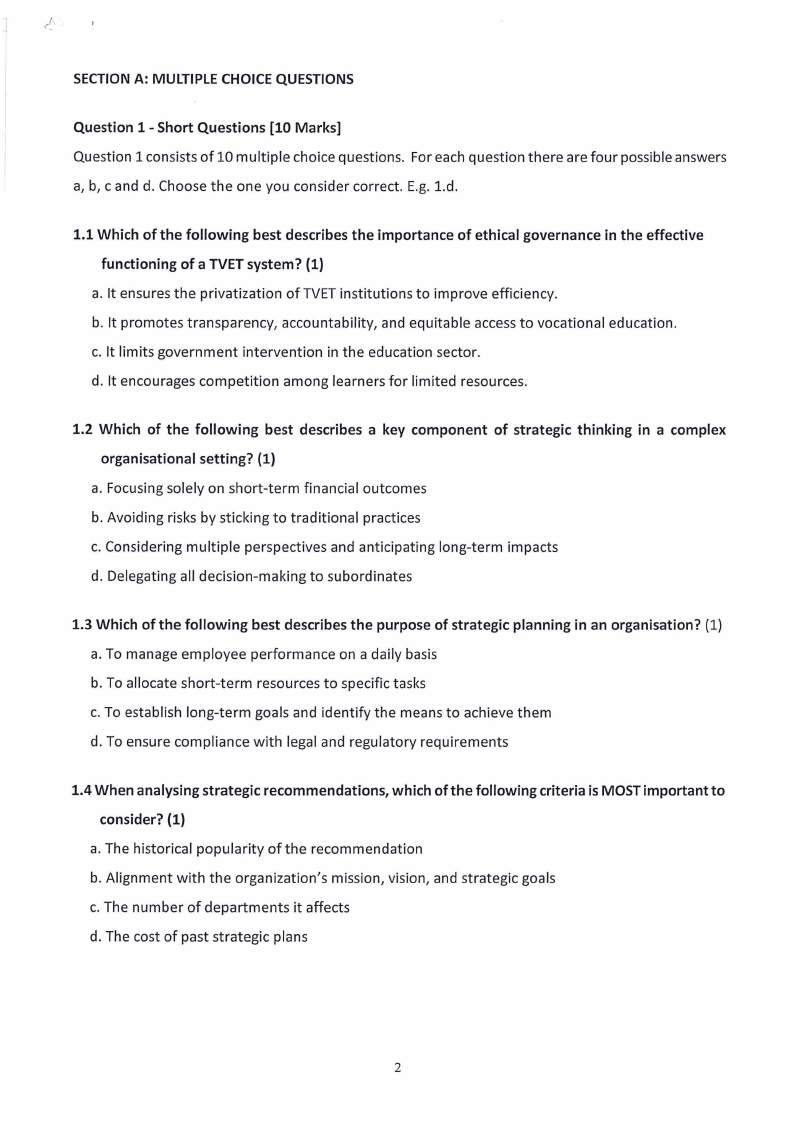
SECTION A: MULTIPLE CHOICE QUESTIONS
Question 1 - Short Questions [10 Marks]
Question 1 consists of 10 multiple choice questions. For each question there are four possible answers
a, b, c and d. Choose the one you consider correct. E.g. 1.d.
1.1 Which of the following best describes the importance of ethical governance in the effective
functioning of a TVET system? (1)
a. It ensures the privatization of TVET institutions to improve efficiency.
b. It promotes transparency, accountability, and equitable access to vocational education.
c. It limits government intervention in the education sector.
d. It encourages competition among learners for limited resources.
1.2 Which of the following best describes a key component of strategic thinking in a complex
organisational setting? (1)
a. Focusing solely on short-term financial outcomes
b. Avoiding risks by sticking to traditional practices
c. Considering multiple perspectives and anticipating long-term impacts
d. Delegating all decision-making to subordinates
1.3 Which of the following best describes the purpose of strategic planning in an organisation? (1)
a. To manage employee performance on a daily basis
b. To allocate short-term resources to specific tasks
c. To establish long-term goals and identify the means to achieve them
d. To ensure compliance with legal and regulatory requirements
1.4 When analysing strategic recommendations, which of the following criteria is MOST important to
consider? (1)
a. The historical popularity of the recommendation
b. Alignment with the organization's mission, vision, and strategic goals
c. The number of departments it affects
d. The cost of past strategic plans
2
|
|
3 Page 3 |
▲back to top |
r I'
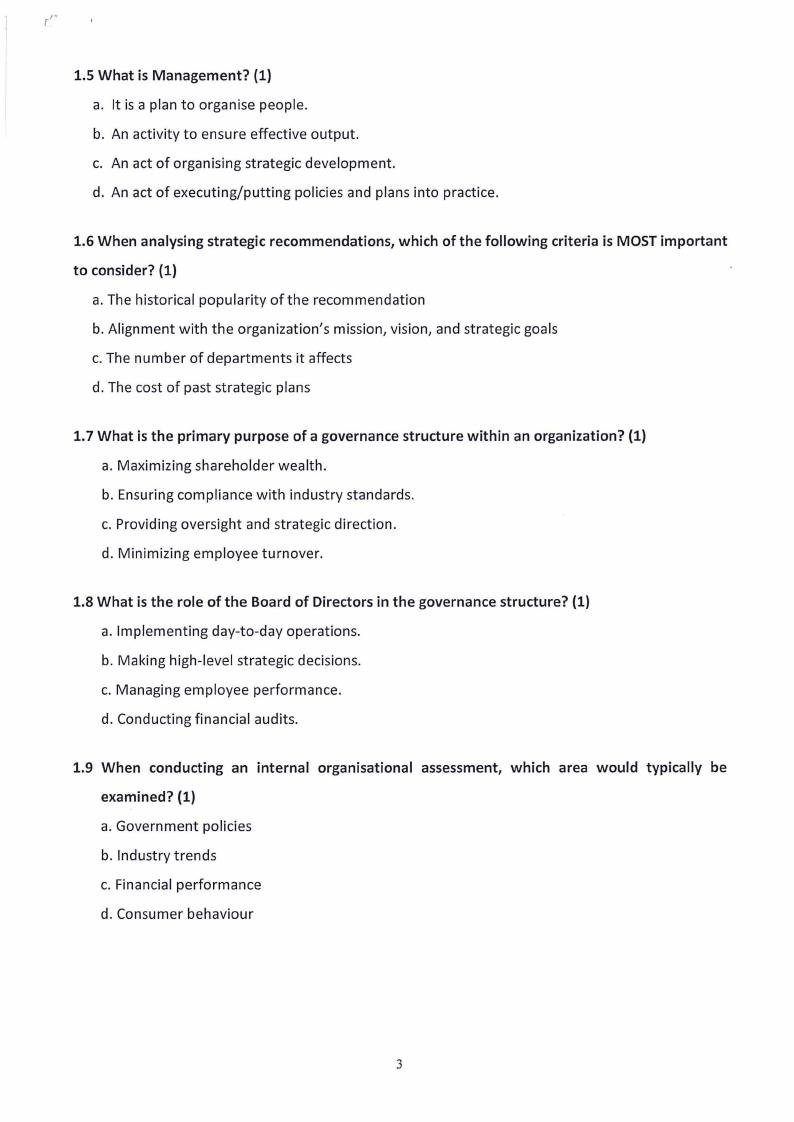
1.5 What is Management? (1)
a. It is a plan to organise people.
b. An activity to ensure effective output.
c. An act of organising strategic development.
d. An act of executing/putting policies and plans into practice.
1.6 When analysing strategic recommendations, which of the following criteria is MOST important
to consider? (1)
a. The historical popularity of the recommendation
b. Alignment with the organization's mission, vision, and strategic goals
c. The number of departments it affects
d. The cost of past strategic plans
1.7 What is the primary purpose of a governance structure within an organization? (1)
a. Maximizing shareholder wealth.
b. Ensuring compliance with industry standards.
c. Providing oversight and strategic direction.
d. Minimizing employee turnover.
1.8 What is the role of the Board of Directors in the governance structure? (1)
a. Implementing day-to-day operations.
b. Making high-level strategic decisions.
c. Managing employee performance.
d. Conducting financial audits.
1.9 When conducting an internal organisational assessment, which area would typically be
examined? (1)
a. Government policies
b. Industry trends
c. Financial performance
d. Consumer behaviour
3
|
|
4 Page 4 |
▲back to top |
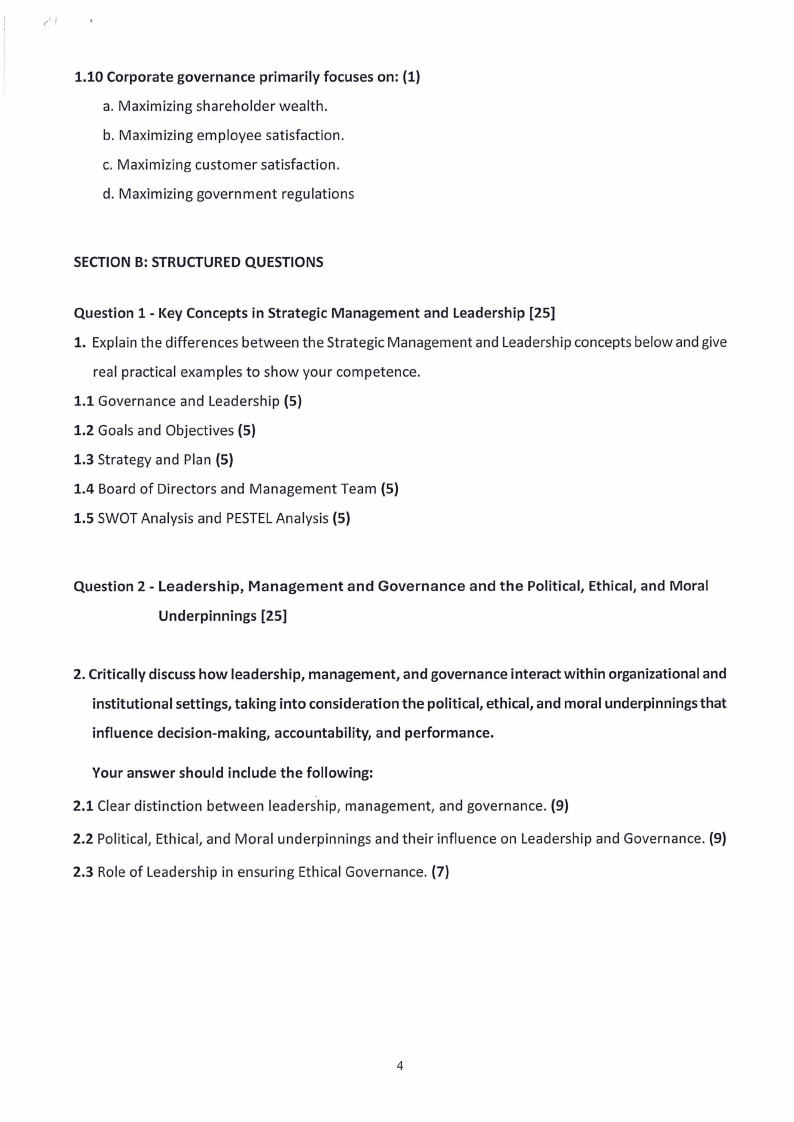
1.10 Corporate governance primarily focuses on: (1)
a. Maximizing shareholder wealth.
b. Maximizing employee satisfaction.
c. Maximizing customer satisfaction.
d. Maximizing government regulations
SECTION B: STRUCTURED QUESTIONS
Question 1 - Key Concepts in Strategic Management and Leadership [25]
1. Explain the differences between the Strategic Management and Leadership concepts below and give
real practical examples to show your competence.
1.1 Governance and Leadership (5)
1.2 Goals and Objectives (5)
1.3 Strategy and Plan (5)
1.4 Board of Directors and Management Team (5)
1.5 SWOTAnalysis and PESTELAnalysis (5)
Question 2 - Leadership, Management and Governance and the Political, Ethical, and Moral
Underpinnings [25)
2. Critically discuss how leadership, management, and governance interact within organizational and
institutional settings, taking into consideration the political, ethical, and moral underpinnings that
influence decision-making, accountability, and performance.
Your answer should include the following:
2.1 Clear distinction between leadership, management, and governance. (9)
2.2 Political, Ethical, and Moral underpinnings and their influence on Leadership and Governance. (9)
2.3 Role of Leadership in ensuring Ethical Governance. (7)
4
|
|
5 Page 5 |
▲back to top |
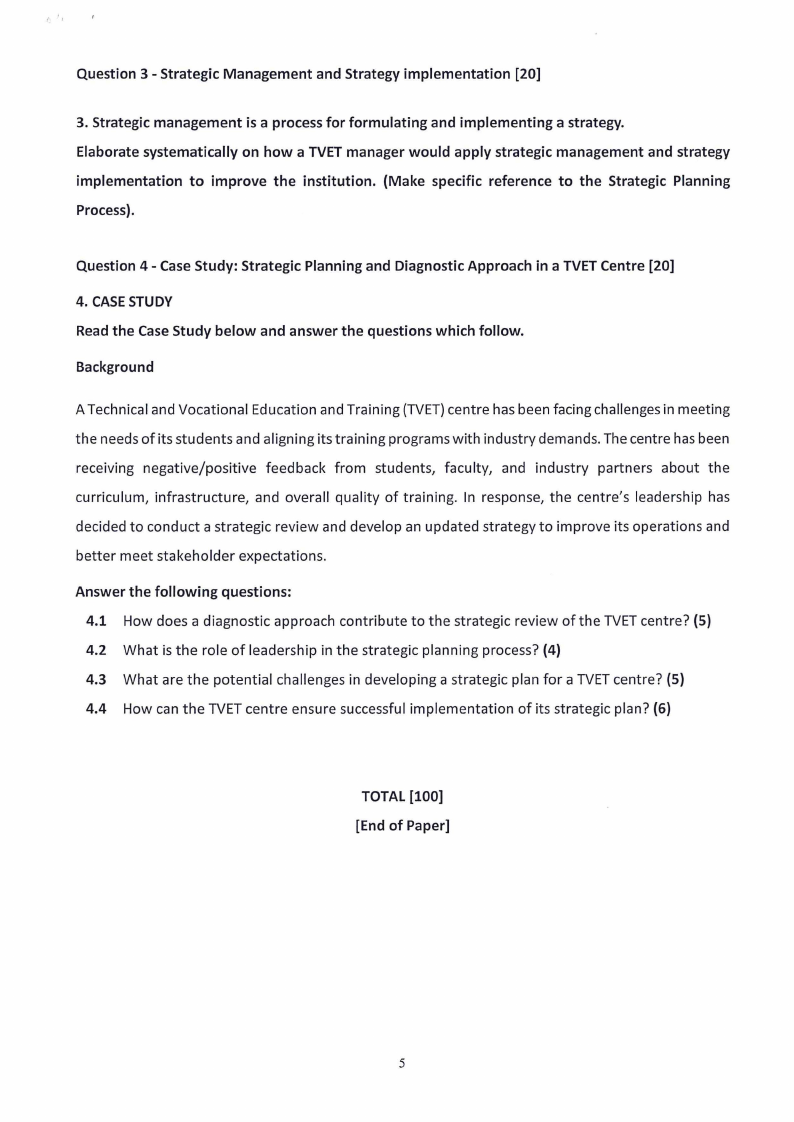
Question 3 - Strategic Management and Strategy implementation [20]
3. Strategic management is a process for formulating and implementing a strategy.
Elaborate systematically on how a TVET manager would apply strategic management and strategy
implementation to improve the institution. (Make specific reference to the Strategic Planning
Process).
Question 4 - Case Study: Strategic Planning and Diagnostic Approach in a TVET Centre [20]
4. CASESTUDY
Read the Case Study below and answer the questions which follow.
Background
A Technical and Vocational Education and Training (TVET)centre has been facing challenges in meeting
the needs of its students and aligning its training programs with industry demands. The centre has been
receiving negative/positive feedback from students, faculty, and industry partners about the
curriculum, infrastructure, and overall quality of training. In response, the centre's leadership has
decided to conduct a strategic review and develop an updated strategy to improve its operations and
better meet stakeholder expectations.
Answer the following questions:
4.1 How does a diagnostic approach contribute to the strategic review of the TVET centre? (5)
4.2 What is the role of leadership in the strategic planning process? (4)
4.3 What are the potential challenges in developing a strategic plan for a TVET centre? (5)
4.4 How can the TVET centre ensure successful implementation of its strategic plan? (6)
TOTAL [100]
[End of Paper]
5