


 |
SML610S - STRATEGIC MANAGEMENT AND LEADERSHIP - 2ND OPP - JULY 2025 |
|
|
1 Page 1 |
▲back to top |
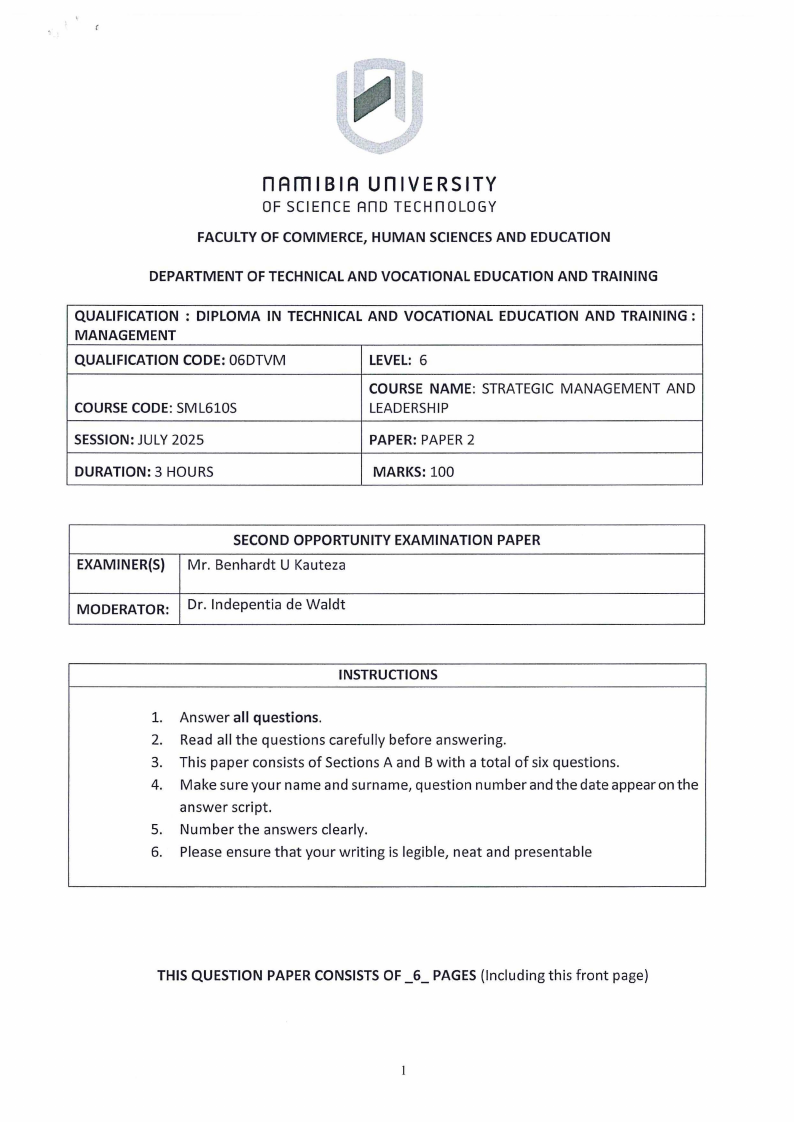
n Am I BI A u n IVER s I TY
OF SCIEn CE Ano TECHn OLOGY
FACULTY OF COMMERCE, HUMAN SCIENCESAND EDUCATION
DEPARTMENT OF TECHNICAL AND VOCATIONAL EDUCATION AND TRAINING
QUALIFICATION : DIPLOMA IN TECHNICAL AND VOCATIONAL EDUCATION AND TRAINING:
MANAGEMENT
QUALIFICATION CODE: 06DTVM
LEVEL: 6
COURSE CODE: SML610S
COURSE NAME: STRATEGICMANAGEMENT AND
LEADERSHIP
SESSION: JULY2025
PAPER: PAPER2
DURATION: 3 HOURS
MARKS: 100
EXAMINER(S)
SECOND OPPORTUNITY EXAMINATION PAPER
Mr. Benhardt U Kauteza
MODERATOR: Dr. lndepentia de Waldt
INSTRUCTIONS
1. Answer all questions.
2. Read all the questions carefully before answering.
3. This paper consists of Sections A and B with a total of six questions.
4. Make sure your name and surname, question number and the date appear on the
answer script.
5. Number the answers clearly.
6. Please ensure that your writing is legible, neat and presentable
THIS QUESTION PAPER CONSISTS OF _6_ PAGES (Including this front page)
|
|
2 Page 2 |
▲back to top |
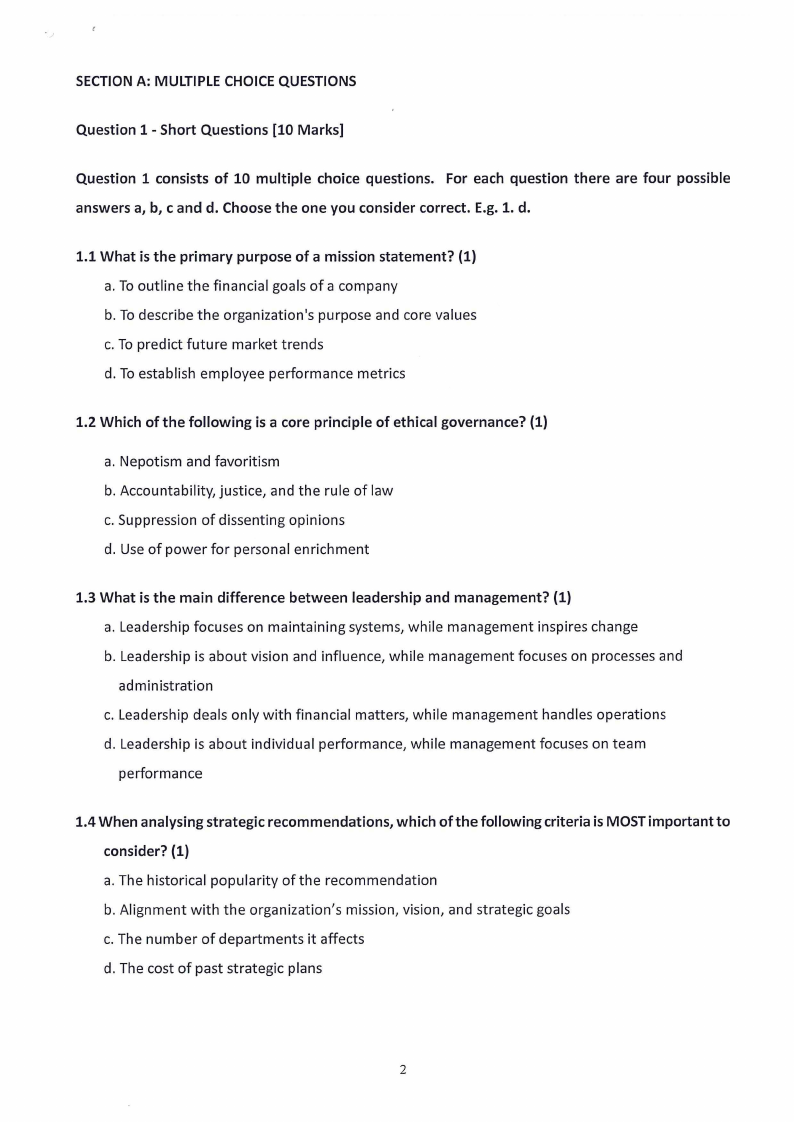
SECTION A: MULTIPLE CHOICE QUESTIONS
Question 1 - Short Questions [10 Marks]
Question 1 consists of 10 multiple choice questions. For each question there are four possible
answers a, b, c and d. Choose the one you consider correct. E.g. 1. d.
1.1 What is the primary purpose of a mission statement? (1)
a. To outline the financial goals of a company
b. To describe the organization's purpose and core values
c. To predict future market trends
d. To establish employee performance metrics
1.2 Which of the following is a core principle of ethical governance? (1)
a. Nepotism and favoritism
b. Accountability, justice, and the rule of law
c. Suppression of dissenting opinions
d. Use of power for personal enrichment
1.3 What is the main difference between leadership and management? (1)
a. Leadership focuses on maintaining systems, while management inspires change
b. Leadership is about vision and influence, while management focuses on processes and
administration
c. Leadership deals only with financial matters, while management handles operations
d. Leadership is about individual performance, while management focuses on team
performance
1.4 When analysing strategic recommendations, which of the following criteria is MOST important to
consider? (1)
a. The historical popularity of the recommendation
b. Alignment with the organization's mission, vision, and strategic goals
c. The number of departments it affects
d. The cost of past strategic plans
2
|
|
3 Page 3 |
▲back to top |
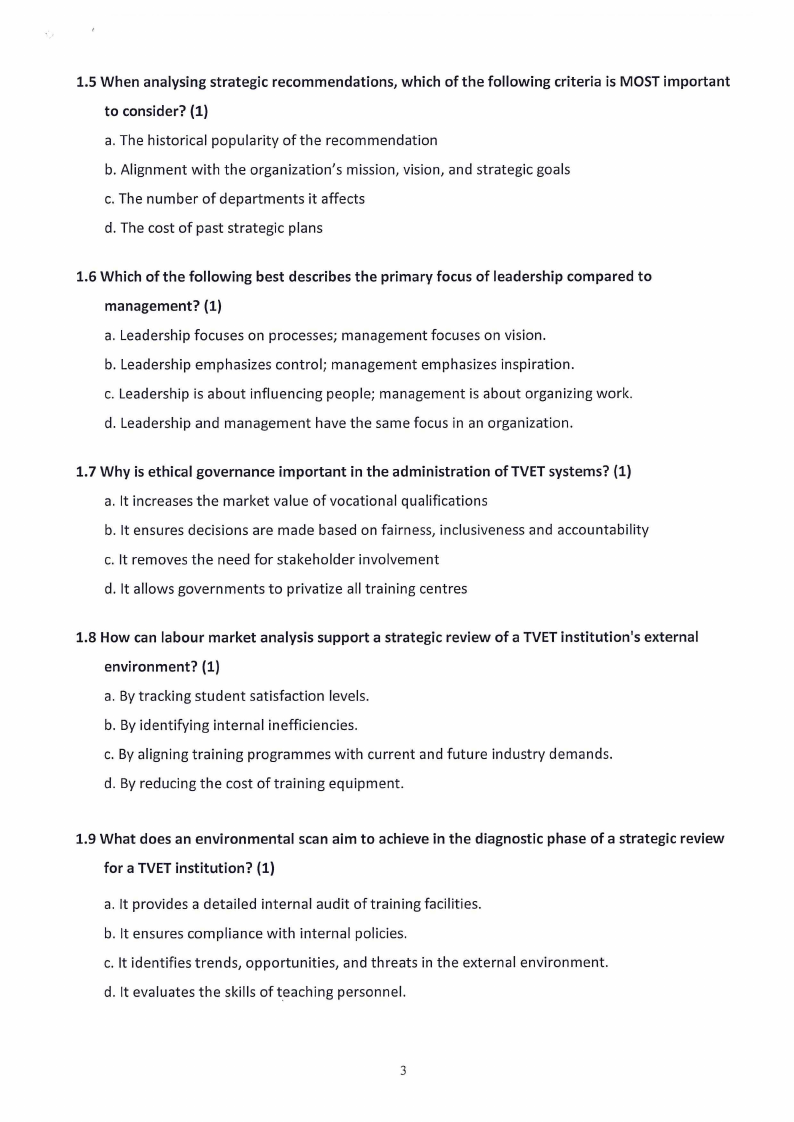
1.5 When analysing strategic recommendations, which of the following criteria is MOST important
to consider? (1)
a. The historical popularity of the recommendation
b. Alignment with the organization's mission, vision, and strategic goals
c. The number of departments it affects
d. The cost of past strategic plans
1.6 Which of the following best describes the primary focus of leadership compared to
management? (1)
a. Leadership focuses on processes; management focuses on vision.
b. Leadership emphasizes control; management emphasizes inspiration.
c. Leadership is about influencing people; management is about organizing work.
d. Leadership and management have the same focus in an organization.
1.7 Why is ethical governance important in the administration of TVET systems? (1)
a. It increases the market value of vocational qualifications
b. It ensures decisions are made based on fairness, inclusiveness and accountability
c. It removes the need for stakeholder involvement
d. It allows governments to privatize all training centres
1.8 How can labour market analysis support a strategic review of a TVET institution's external
environment? (1)
a. By tracking student satisfaction levels.
b. By identifying internal inefficiencies.
c. By aligning training programmes with current and future industry demands.
d. By reducing the cost of training equipment.
1.9 What does an environmental scan aim to achieve in the diagnostic phase of a strategic review
for a TVET institution? (1)
a. It provides a detailed internal audit of training facilities.
b. It ensures compliance with internal policies.
c. It identifies trends, opportunities, and threats in the external environment.
d. It evaluates the skills of t_eachingpersonnel.
3
|
|
4 Page 4 |
▲back to top |
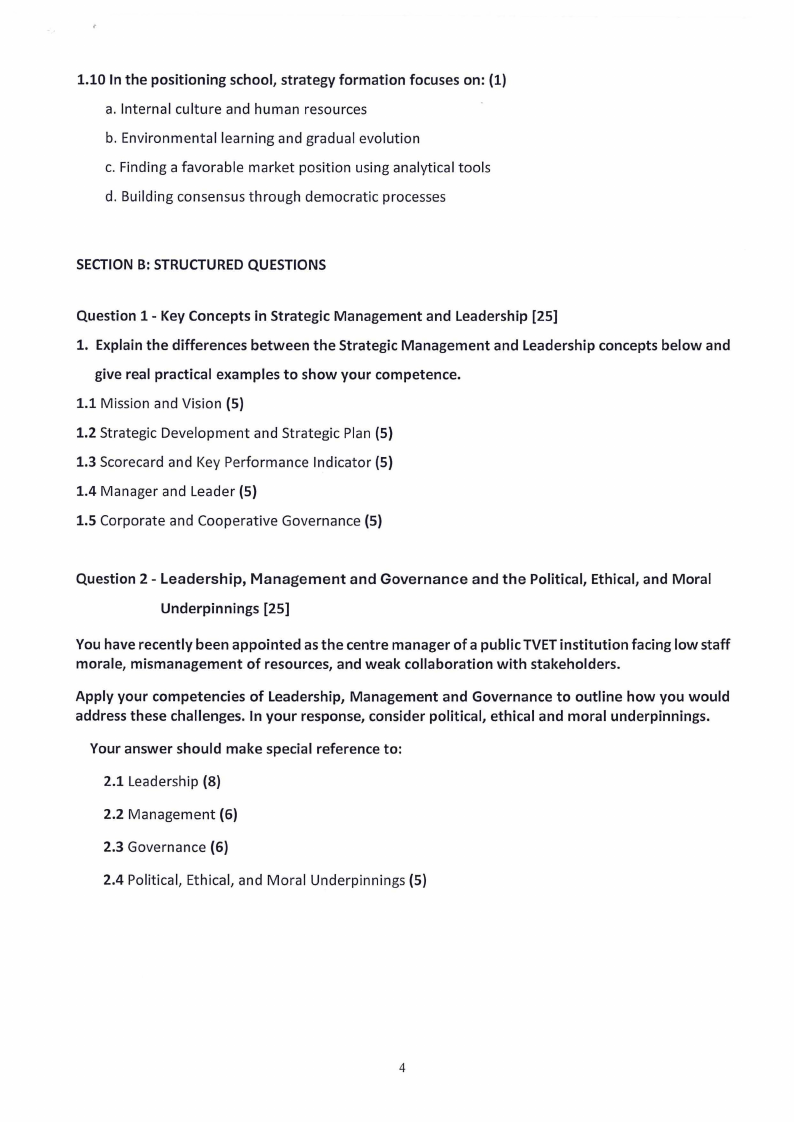
1.10 In the positioning school, strategy formation focuses on: (1)
a. Internal culture and human resources
b. Environmental learning and gradual evolution
c. Finding a favorable market position using analytical tools
d. Building consensus through democratic processes
SECTION B: STRUCTURED QUESTIONS
Question 1 - Key Concepts in Strategic Management and Leadership [25]
1. Explain the differences between the Strategic Management and Leadership concepts below and
give real practical examples to show your competence.
1.1 Mission and Vision (5)
1.2 Strategic Development and Strategic Plan (5)
1.3 Scorecard and Key Performance Indicator (5)
1.4 Manager and Leader (5)
1.5 Corporate and Cooperative Governance (5)
Question 2 - Leadership, Management and Governance and the Political, Ethical, and Moral
Underpinnings [25]
You have recently been appointed as the centre manager of a public TVET institution facing low staff
morale, mismanagement of resources, and weak collaboration with stakeholders.
Apply your competencies of Leadership, Management and Governance to outline how you would
address these challenges. In your response, consider political, ethical and moral underpinnings.
Your answer should make special reference to:
2.1 Leadership (8)
2.2 Management (6)
2.3 Governance (6)
2.4 Political, Ethical, and Moral Underpinnings (5)
4
|
|
5 Page 5 |
▲back to top |
Question 3 - The Process of Strategic Thinking, Leadership in a complex Organizational and
Interpersonal Challenges (20]
You have been appointed to lead a change initiative in a large skills development institution facing
low staff morale, fragmented leadership, and resistance to new sustainability goals.
Apply your understanding of strategic thinking and leadership to answer the following:
3.1 Outline four key elements of strategic thinking you should take to reduce resistance and improve
staff engagement. (6)
3.2 Suggest two practical actions you would apply in this situation. (8)
3.3 Identify and explain two leadership styles that would help you manage organisational and
interpersonal challenges effectively. (6)
Question 4 - Central Concepts of Planning in the Development of Organisational Strategy (20]
Case Study: Strategic Planning at Rakutuka Solutions
Read the Case Study below and answer the questions which follow.
Background
Rakutuka Solutions is a mid-sized company specialising in eco-friendly technology solutions. Facing
intense competition and rapidly changing market demands, the management recognised the need for a
structured organisational strategy to guide growth and ensure long-term sustainability.
In 2023, the company undertook a strategic planning process. This included conducting an
environmental scan, defining a clear mission and vision, setting long-term goals, and identifying key
strategic initiatives. The planning team used tools such as SWOT analysis and SMART goals to ensure
clarity and feasibility.
They also involved cross-functional teams to align departmental plans with broader strategic objectives.
Regular reviews and contingency plans were included to ensure adaptability in response to changes in
the external environment.
5
|
|
6 Page 6 |
▲back to top |
' I'
Answer the questions below:
4.1 Define strategic planning in the context of an organisation. (2)
4.2 Identify two key benefits of strategic planning. (2)
4.3 What is a SWOT analysis, and how was it applied by Rakutuka Solutions? (3)
4.4 Explain the importance of aligning departmental plans with strategic objectives. (3)
4.5 List and briefly explain two planning tools or techniques used in strategy development. (5)
4.6 Why is flexibility important in strategic planning, and how did Rakutuka address this? (2)
4.7 What role does stakeholder involvement play in strategic planning? (3)
TOTAL [100]
[End of Paper]
6