


 |
IHA521S-INTRODUCTION TO HOSPITALITY AND TOURISM ACCOUNTING-1ST OPP-JUNE 2025 |
|
|
1 Page 1 |
▲back to top |
nAmlBIA unlVERSITY
OF SCIEn CE Ano TECHn OLOGY
FACULTY OF COMMERCE, HUMAN SCIENCESAND EDUCATION
DEPARTMENTOF HOSPITALITYAND TOURISM
QUALIFICATION:
BACHELOROF CULINARYARTS& BACHELOROF TOURISM INNOVATION AND DEVELOPMENT
QUALIFICATIONCODE:07BCNA & 07BTID
COURSECODE: IHA521S
SESSION:JUNE 2025
DURATION: 3 HOURS
LEVEL:6
COURSENAME: INTRODUCTIONTO HOSPITALITY
& TOURISM ACCOUNTING
PAPER:THEORYAND CALCULATIONS
MARKS: 100
EXAMINER
FIRST OPPORTUNITY EXAMINATION QUESTION PAPER
Sheehama, K.G.H.
MODERATOR Odada, L.
INSTRUCTIONS
• Answer ALL five (5) questions in blue or black ink only. NO PENCIL.
• Start each question on a new page, number the answers correctly and clearly.
• Write clearly, and neatly showing all your workings/assumptions.
• Work with at least four (4) decimal places in all your calculations and only round off only
final answers to two (2) decimal places.
• Questions relating to this examination may be raised in the initial 30 minutes after the start
of the examination. Thereafter, candidates must use their initiative to deal with any
perceived errors or ambiguities and any assumptions made by the candidate should be
clearly stated.
PERMISSIBLE MATERIALS
• Silent, non-programmable calculators
THIS QUESTION PAPERCONSISTSOF _6_ PAGES(including this front page)
|
|
2 Page 2 |
▲back to top |
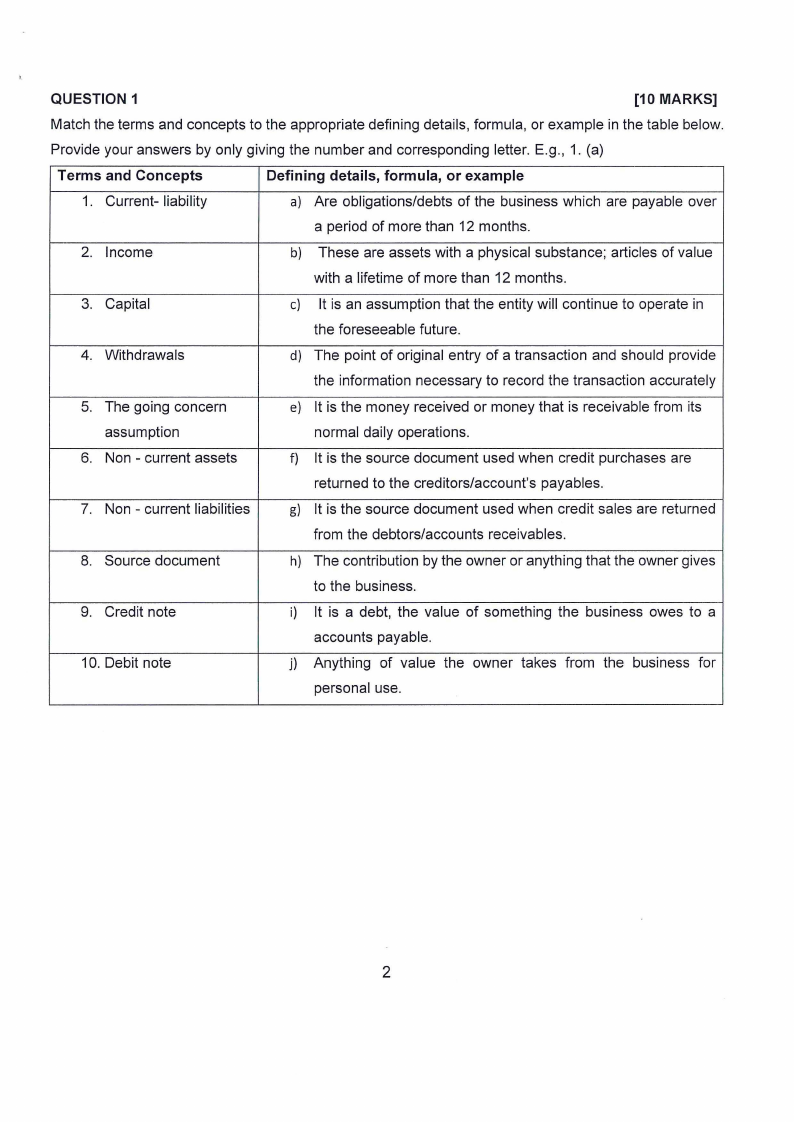
QUESTION 1
[10 MARKS]
Match the terms and concepts to the appropriate defining details, formula, or example in the table below.
Provide your answers by only giving the number and corresponding letter. E.g., 1. (a)
Terms and Concepts
Defining details, formula, or example
1. Current- liability
a) Are obligations/debts of the business which are payable over
a period of more than 12 months.
2. Income
b) These are assets with a physical substance; articles of value
with a lifetime of more than 12 months.
3. Capital
c) It is an assumption that the entity will continue to operate in
the foreseeable future.
4. Withdrawals
d) The point of original entry of a transaction and should provide
the information necessary to record the transaction accurately
5. The going concern
e) It is the money received or money that is receivable from its
assumption
normal daily operations.
6. Non - current assets
f) It is the source document used when credit purchases are
returned to the creditors/account's payables.
7. Non - current liabilities
g) It is the source document used when credit sales are returned
from the debtors/accounts receivables.
8. Source document
h) The contribution by the owner or anything that the owner gives
to the business.
9. Credit note
i) It is a debt, the value of something the business owes to a
accounts payable.
10. Debit note
j) Anything of value the owner takes from the business for
personal use.
2
|
|
3 Page 3 |
▲back to top |
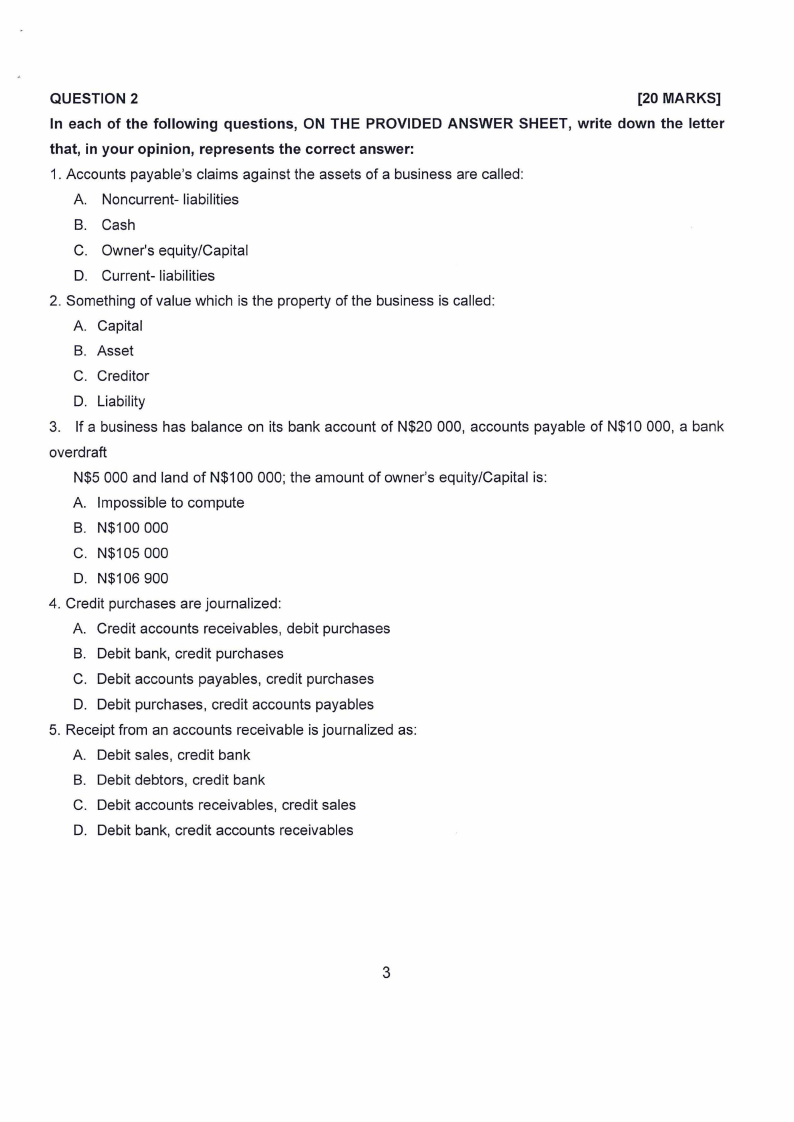
QUESTION 2
[20 MARKS]
In each of the following questions, ON THE PROVIDED ANSWER SHEET, write down the letter
that, in your opinion, represents the correct answer:
1. Accounts payable's claims against the assets of a business are called:
A. Noncurrent- liabilities
B. Cash
C. Owner's equity/Capital
D. Current- liabilities
2. Something of value which is the property of the business is called:
A. Capital
B. Asset
C. Creditor
D. Liability
3. If a business has balance on its bank account of N$20 000, accounts payable of N$1O 000, a bank
overdraft
N$5 000 and land of N$100 000; the amount of owner's equity/Capital is:
A. Impossible to compute
B. N$100 000
C. N$105 000
D. N$106 900
4. Credit purchases are journalized:
A. Credit accounts receivables, debit purchases
B. Debit bank, credit purchases
C. Debit accounts payables, credit purchases
D. Debit purchases, credit accounts payables
5. Receipt from an accounts receivable is journalized as:
A. Debit sales, credit bank
B. Debit debtors, credit bank
C. Debit accounts receivables, credit sales
D. Debit bank, credit accounts receivables
3
|
|
4 Page 4 |
▲back to top |
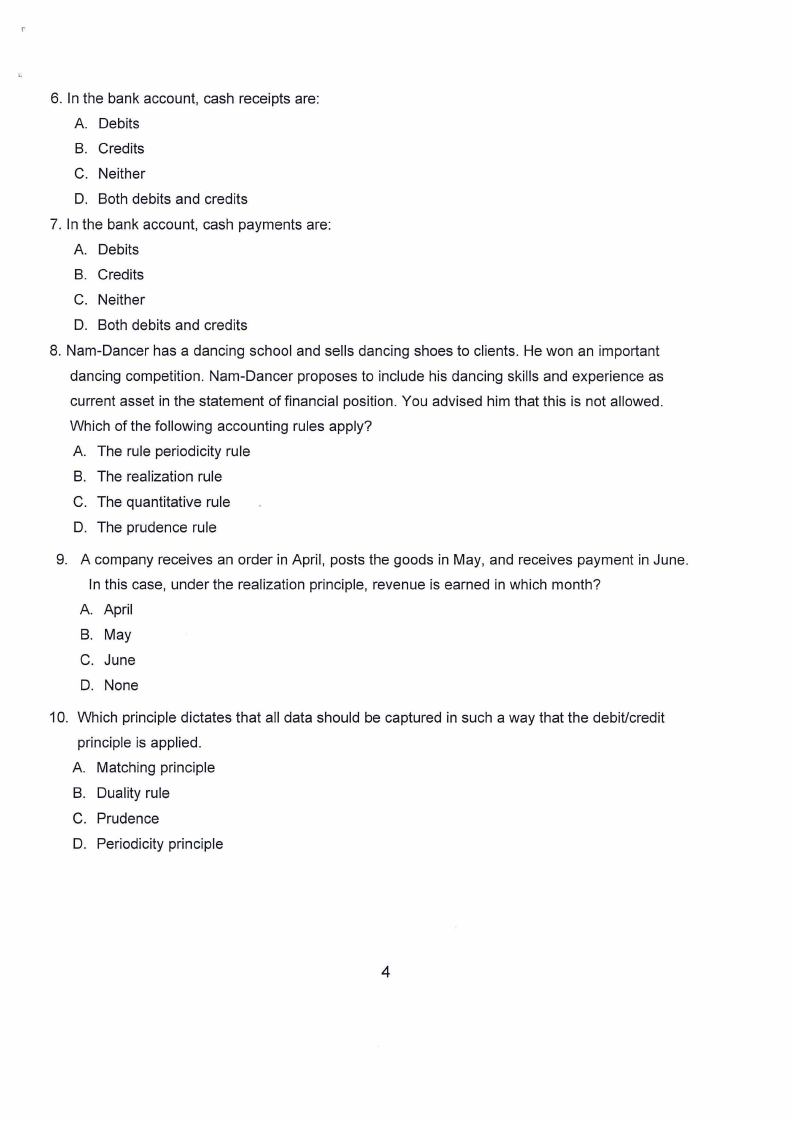
6. In the bank account, cash receipts are:
A. Debits
B. Credits
C. Neither
D. Both debits and credits
7. In the bank account, cash payments are:
A. Debits
B. Credits
C. Neither
D. Both debits and credits
8. Nam-Dancer has a dancing school and sells dancing shoes to clients. He won an important
dancing competition. Nam-Dancer proposes to include his dancing skills and experience as
current asset in the statement of financial position. You advised him that this is not allowed.
Which of the following accounting rules apply?
A. The rule periodicity rule
B. The realization rule
C. The quantitative rule
D. The prudence rule
9. A company receives an order in April, posts the goods in May, and receives payment in June.
In this case, under the realization principle, revenue is earned in which month?
A. April
B. May
C. June
D. None
10. Which principle dictates that all data should be captured in such a way that the debit/credit
principle is applied.
A. Matching principle
B. Duality rule
C. Prudence
D. Periodicity principle
4
|
|
5 Page 5 |
▲back to top |
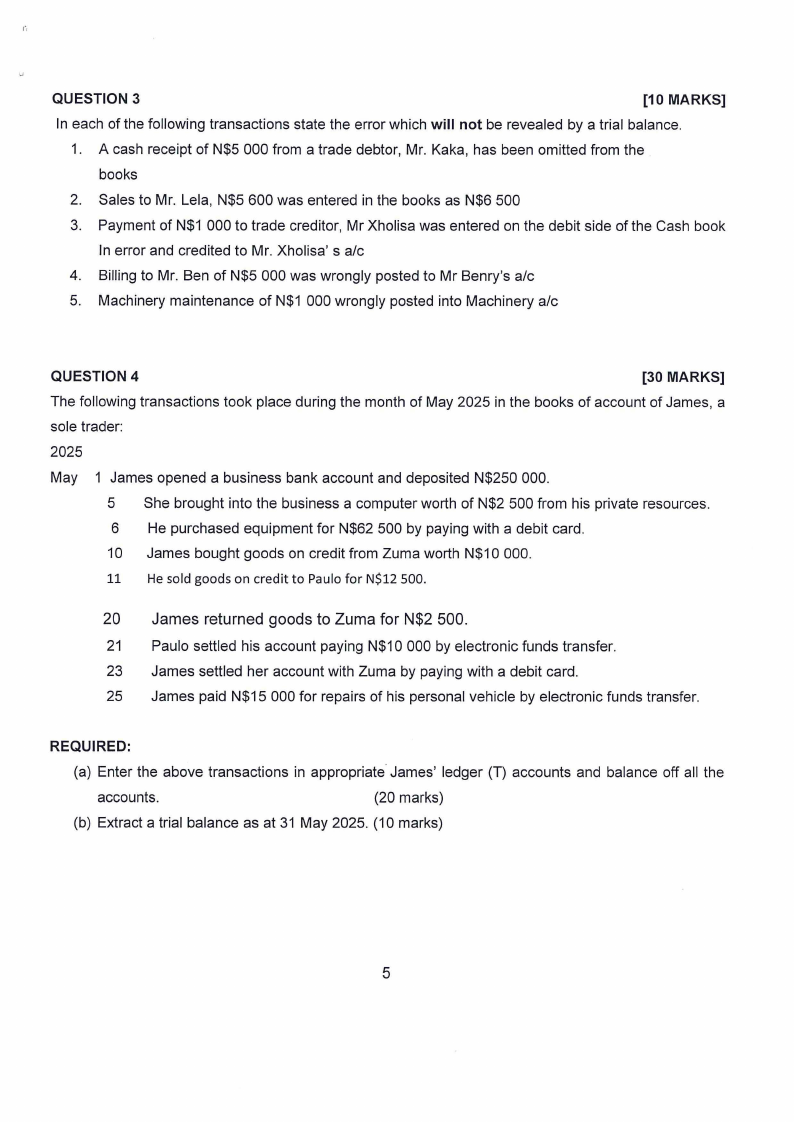
QUESTION 3
[10 MARKS]
In each of the following transactions state the error which will not be revealed by a trial balance.
1. A cash receipt of N$5 000 from a trade debtor, Mr. Kaka, has been omitted from the
books
2. Sales to Mr. Lela, N$5 600 was entered in the books as N$6 500
3. Payment of N$1 000 to trade creditor, Mr Xholisa was entered on the debit side of the Cash book
In error and credited to Mr. Xholisa' s ale
4. Billing to Mr. Ben of N$5 000 was wrongly posted to Mr Benry's ale
5. Machinery maintenance of N$1 000 wrongly posted into Machinery ale
QUESTION 4
[30 MARKS]
The following transactions took place during the month of May 2025 in the books of account of James, a
sole trader:
2025
May 1 James opened a business bank account and deposited N$250 000.
5 She brought into the business a computer worth of N$2 500 from his private resources.
6 He purchased equipment for N$62 500 by paying with a debit card.
10 James bought goods on credit from Zuma worth N$10 000.
11 He sold goods on credit to Paulo for N$12 500.
20 James returned goods to Zuma for N$2 500.
21 Paulo settled his account paying N$10 000 by electronic funds transfer.
23 James settled her account with Zuma by paying with a debit card.
25 James paid N$15 000 for repairs of his personal vehicle by electronic funds transfer.
REQUIRED:
(a) Enter the above transactions in appropriate· James' ledger (T) accounts and balance off all the
accounts.
(20 marks)
(b) Extract a trial balance as at 31 May 2025. (10 marks)
5
|
|
6 Page 6 |
▲back to top |
I'
QUESTION 5
[30 MARKS]
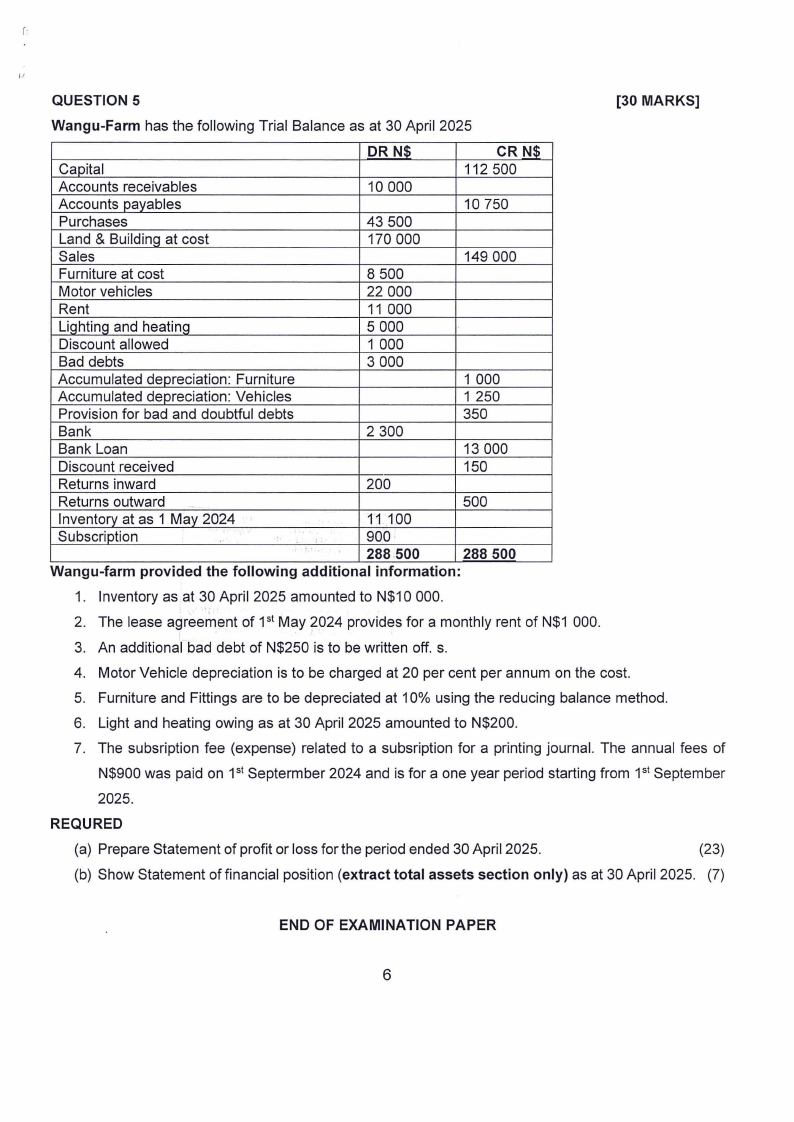
Wangu-Farm has the following Trial Balance as at 30 April 2025
DR N$
CR N$
Capital
112 500
Accounts receivables
10 000
Accounts payables
10 750
Purchases
43 500
Land & BuildinQat cost
170 000
Sales
149 000
Furniture at cost
8 500
Motor vehicles
22 000
Rent
11 000
Lighting and heating
5 000
Discount allowed
1 000
Bad debts
3 000
Accumulated depreciation: Furniture
1 000
Accumulated depreciation: Vehicles
1 250
Provision for bad and doubtful debts
350
Bank
2 300
Bank Loan
13 000
Discount received
150
Returns inward
200
Returns outward --
Inventory at as 1 May 2024
500
11 100
Subscription
;
900
288 500
288 500
Wangu-farm provided the following additional information:
1. Inventory as at 30 April 2025 amounted to N$10 000.
2. The lease agreement of 1st May 2024 provides for a monthly rent of N$1 000.
3. An additional bad debt of N$250 is to be written off. s.
4. Motor Vehicle depreciation is to be charged at 20 per cent per annum on the cost.
5. Furniture and Fittings are to be depreciated at 10% using the reducing balance method.
6. Light and heating owing as at 30 April 2025 amounted to N$200.
7. The subsription fee (expense) related to a subsription for a printing journal. The annual fees of
N$900 was paid on 1st Septermber 2024 and is for a one year period starting from 1st September
2025.
REQURED
(a) Prepare Statement of profit or loss for the period ended 30 April 2025.
(23)
(b) Show Statement of financial position (extract total assets section only) as at 30 April 2025. (7)
END OF EXAMINATION PAPER
6