


 |
GMN621S - GEOINFORMATION MANAGEMENT - 1ST OPP - JUNE 2025 |
|
|
1 Page 1 |
▲back to top |
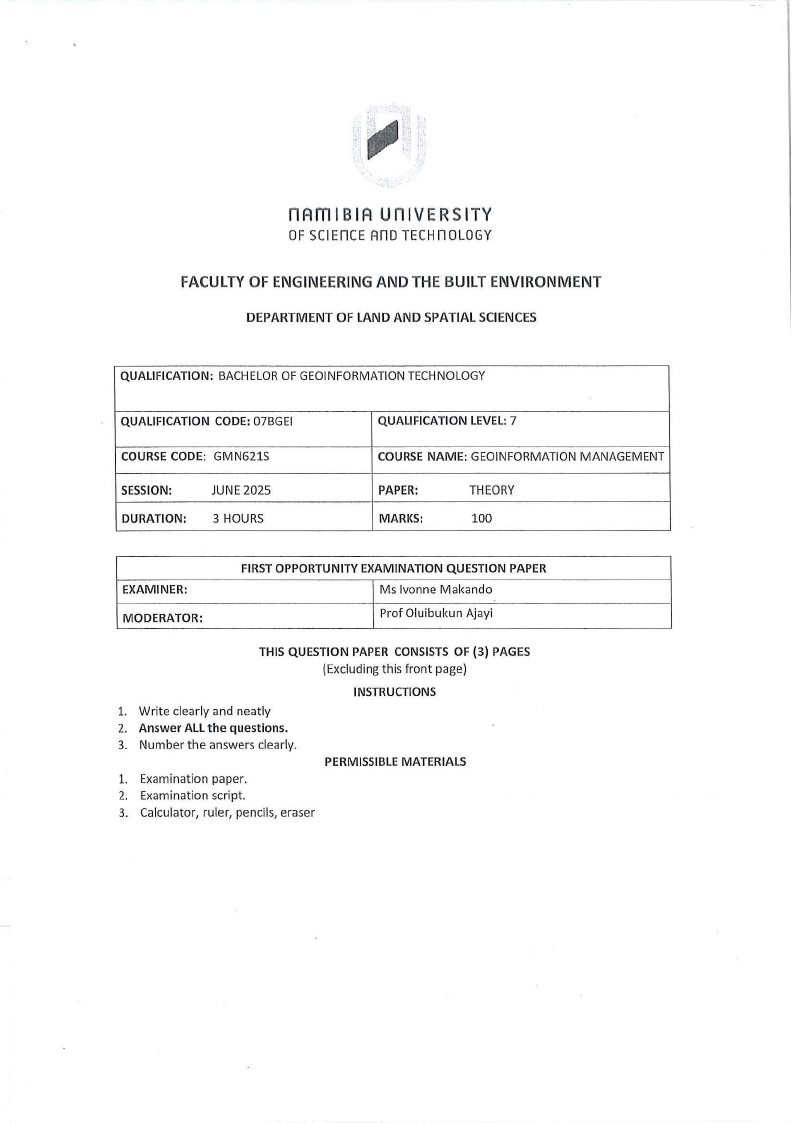
nAm I BIA un IVERSITY
OFSCIEnCE Ano TECHn OLOGY
FACULTYOF ENGINEERINGAND THE BUILTENVIRONMENT
DEPARTMENTOF LANDANDSPATIALSCIENCES
QUALIFICATION: BACHELOROF GEOINFORMATIONTECHNOLOGY
QUALIFICATION CODE: 07BGEI
COURSECODE: GMN621S
SESSION:
DURATION:
JUNE 2025
3 HOURS
QUALIFICATION LEVEL:7
COURSENAME: GEOINFORMATIONMANAGEMENT
PAPER:
MARKS:
THEORY
100
EXAMINER:
MODERATOR:
FIRSTOPPORTUNITY EXAMINATION QUESTION PAPER
Ms Ivonne Makanda
Prof Oluibukun Ajayi
THIS QUESTION PAPER CONSISTSOF (3) PAGES
(Excluding this front page)
INSTRUCTIONS
1. Write clearly and neatly
2. Answer ALLthe questions.
3. Number the answers clearly.
PERMISSIBLEMATERIALS
1. Examination paper.
2. Examination script.
3. Calculator, ruler, pencils, eraser
|
|
2 Page 2 |
▲back to top |
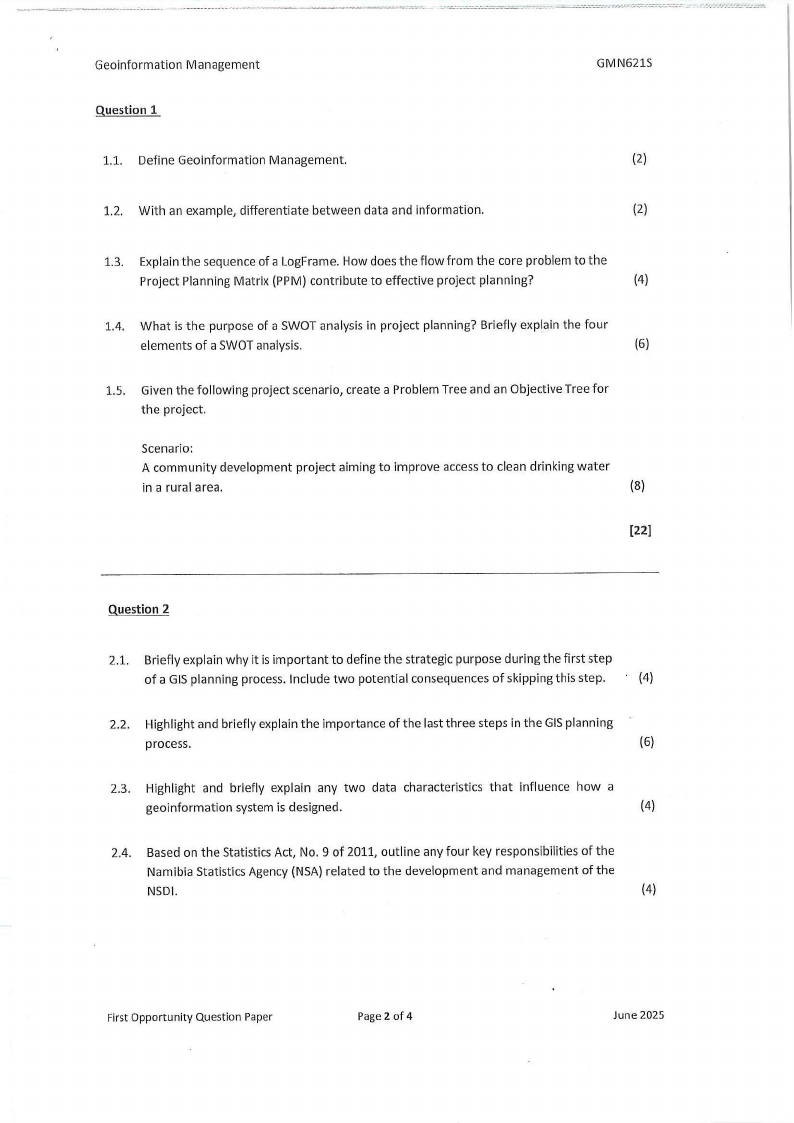
Geoinformation Management
Question 1
GMN621S
1.1. Define Geoinformation Management.
(2)
1.2. With an example, differentiate between data and information.
(2)
1.3. Explain the sequence of a LogFrame. How does the flow from the core problem to the
Project Planning Matrix (PPM) contribute to effective project planning?
(4)
1.4. What is the purpose of a SWOT analysis in project planning? Briefly explain the four
elements of a SWOTanalysis.
(6)
1.5. Given the following project scenario, create a Problem Tree and an Objective Tree for
the project.
Scenario:
A community development project aiming to improve accessto clean drinking water
in a rural area.
(8)
[22]
Question 2
2.1. Briefly explain why it is important to define the strategic purpose during the first step
of a GISplanning process. Include two potential consequences of skipping this step. · (4)
2.2. Highlight and briefly explain the importance of the last three steps in the GISplanning
process.
(6)
2.3. Highlight and briefly explain any two data characteristics that influence how a
geoinformation system is designed.
(4)
2.4. Based on the Statistics Act, No. 9 of 2011, outline any four key responsibilities of the
Namibia Statistics Agency (NSA) related to the development and management of the
NSDI.
(4)
First Opportunity Question Paper
Page 2 of 4
June 2025
|
|
3 Page 3 |
▲back to top |
Geoinformation Management
GMN621S
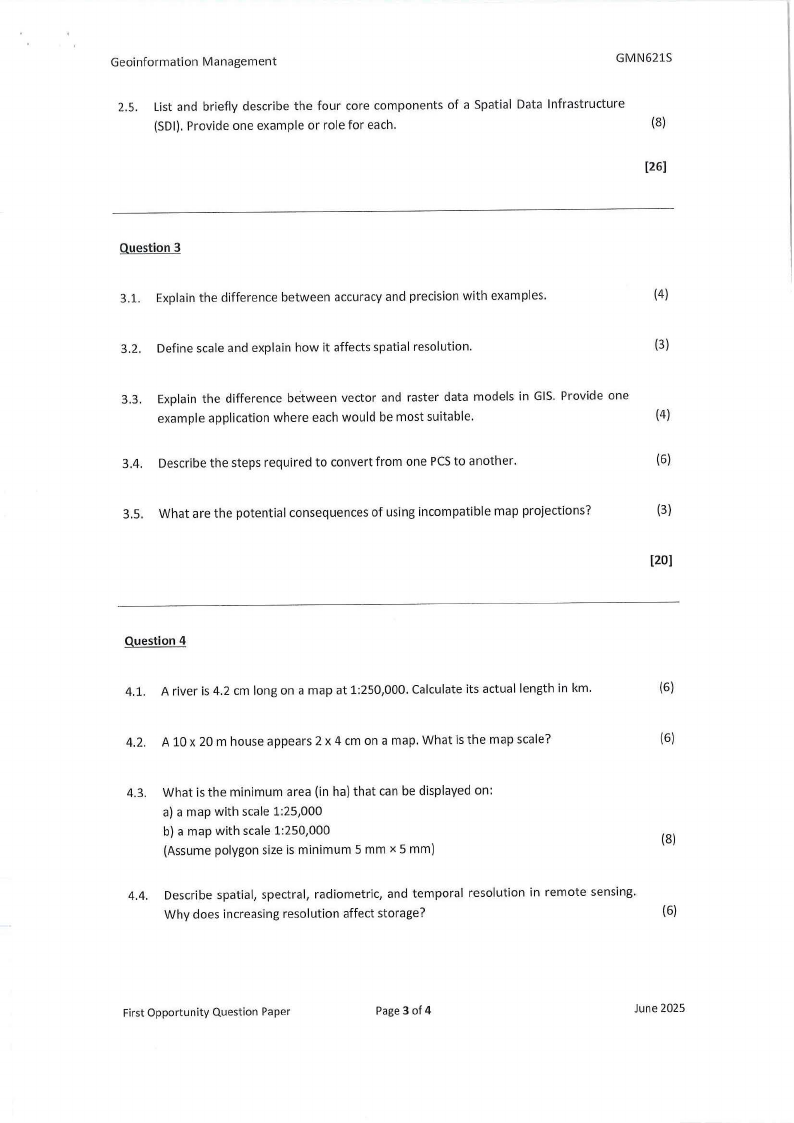
2.5. List and briefly describe the four core components of a Spatial Data Infrastructure
(SDI). Provide one example or role for each.
(8)
[26)
Question 3
3.1. Explain the difference between accuracy and precision with examples.
(4)
3.2. Define scale and explain how it affects spatial resolution.
(3)
3.3. Explain the difference between vector and raster data models in GIS. Provide one
example application where each would be most suitable.
(4)
3.4. Describe the steps required to convert from one PCSto another.
(6)
3.5. What are the potential consequences of using incompatible map projections?
(3)
[20)
Question 4
4.1. A river is 4.2 cm long on a map at 1:250,000. Calculate its actual length in km.
(6)
4.2. A 10 x 20 m house appears 2 x 4 cm on a map. What is the map scale?
(6)
4.3. What is the minimum area (in ha) that can be displayed on:
a) a map with scale 1:25,000
b) a map with scale 1:250,000
(8)
(Assume polygon size is minimum 5 mm x 5 mm)
4.4. Describe spatial, spectral, radiometric, and temporal resolution in remote sensing.
Why does increasing resolution affect storage?
(6)
First Opportunity Question Paper
Page 3 of 4
June 2025
|
|
4 Page 4 |
▲back to top |

Geoinformation Management
GMN621S
4.5. Name and briefly describe two types of logical data models used in GIS. Provide one
key advantage for each.
(6)
[32]
First Opportunity Question Paper
Page 4 of 4
June 2025
|
|
5 Page 5 |
▲back to top |
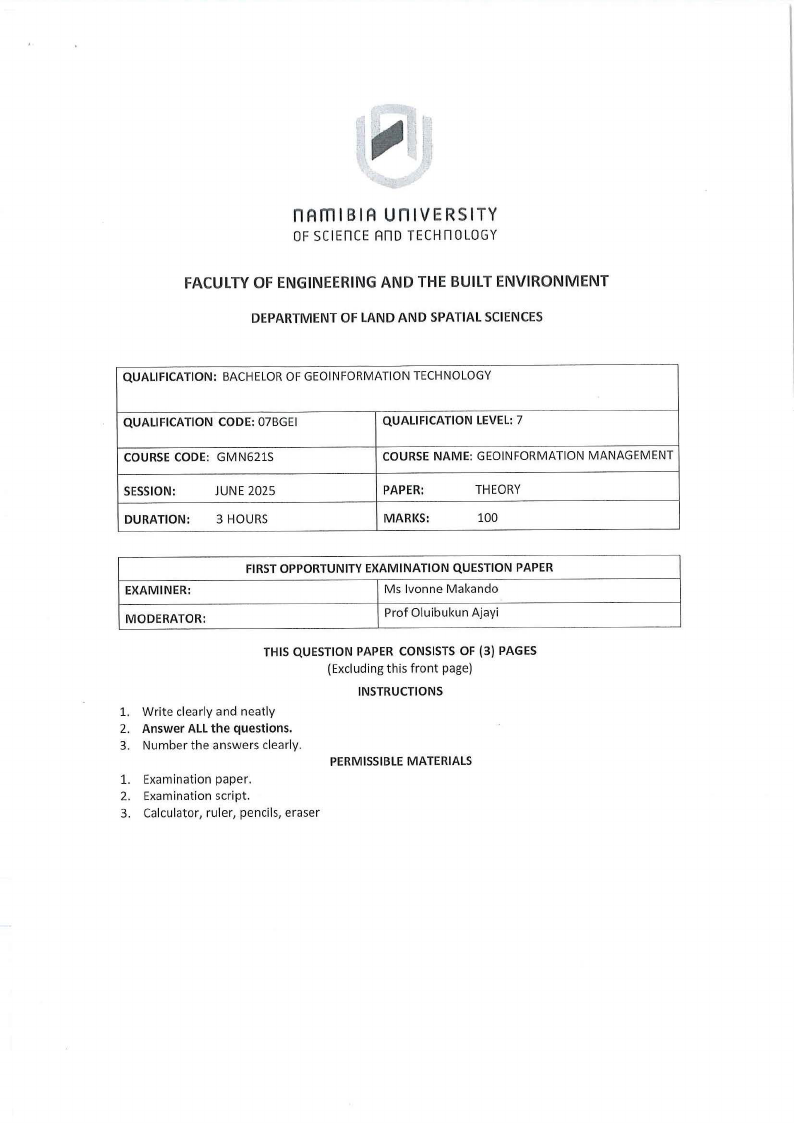
n Am I BI A u n IVER s ITY
OF SCIEnCE Ano TECHnOLOGY
FACULTYOF ENGINEERINGAND THE BUILTENVIRONMENT
DEPARTMENTOF LANDAND SPATIALSCIENCES
QUALIFICATION: BACHELOROF GEOINFORMATION TECHNOLOGY
QUALIFICATION CODE:07BGEI
COURSECODE: GMN621S
SESSION:
DURATION:
JUNE 2025
3 HOURS
QUALIFICATIONLEVEL:7
COURSENAME: GEOINFORMATION MANAGEMENT
PAPER:
MARKS:
THEORY
100
EXAMINER:
MODERATOR:
FIRSTOPPORTUNITYEXAMINATION QUESTIONPAPER
Ms Ivonne Makando
Prof Oluibukun Ajayi
THIS QUESTIONPAPERCONSISTSOF (3) PAGES
(Excluding this front page)
INSTRUCTIONS
1. Write clearly and neatly
2. Answer ALLthe questions.
3. Number the answers clearly.
PERMISSIBLEMATERIALS
1. Examination paper.
2. Examination script.
3. Calculator, ruler, pencils, eraser
|
|
6 Page 6 |
▲back to top |
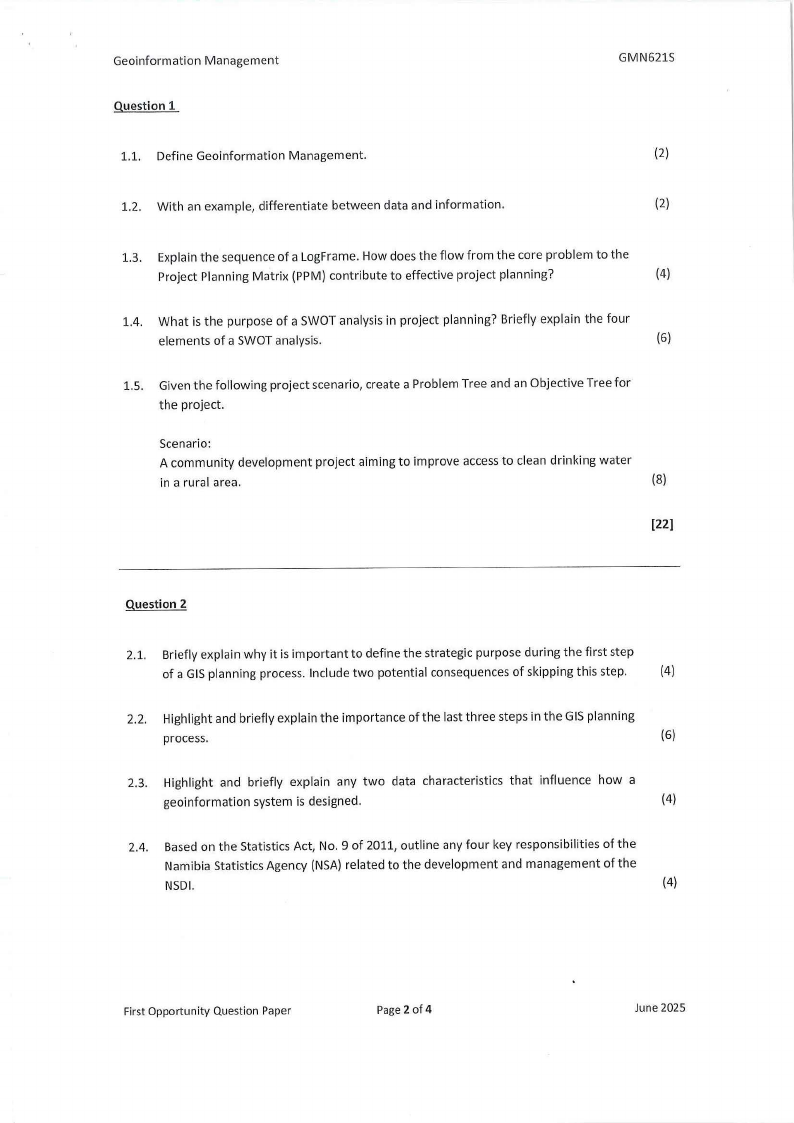
Geoinformation Management
Question 1
1.1. Define Geoinformation Management.
1.2. With an example, differentiate between data and information.
GMN621S
(2)
(2)
1.3. Explain the sequence of a LogFrame. How does the flow from the core problem to the
Project Planning Matrix (PPM) contribute to effective project planning?
(4)
1.4. What is the purpose of a SWOT analysis in project planning? Briefly explain the four
elements of a SWOTanalysis.
(6)
1.5. Given the following project scenario, create a Problem Tree and an Objective Tree for
the project.
Scenario:
A community development project aiming to improve accessto clean drinking water
in a rural area.
(8)
[22)
Question 2
2.1. Briefly explain why it is important to define the strategic purpose during the first step
of a GISplanning process. Include two potential consequences of skipping this step.
(4)
2.2. Highlight and briefly explain the importance of the last three steps in the GIS planning
process.
(6)
2.3. Highlight and briefly explain any two data characteristics that influence how a
geoinformation system is designed.
(4)
2.4. Based on the Statistics Act, No. 9 of 2011, outline any four key responsibilities of the
Namibia Statistics Agency (NSA) related to the development and management of the
NSDI.
(4)
First Opportunity Question Paper
Page 2 of4
June 2025
|
|
7 Page 7 |
▲back to top |

Geoinformation Management
GMN621S
4.5. Name and briefly describe two types of logical data models used in GIS. Provide one
key advantage for each.
(6)
[32)
First Opportunity Question Paper
Page4 of 4
,, .
June 2025