


 |
GMN621S - GEOINFORMATION MANAGEMENT - 2ND OPP - JULY 2025 |
|
|
1 Page 1 |
▲back to top |
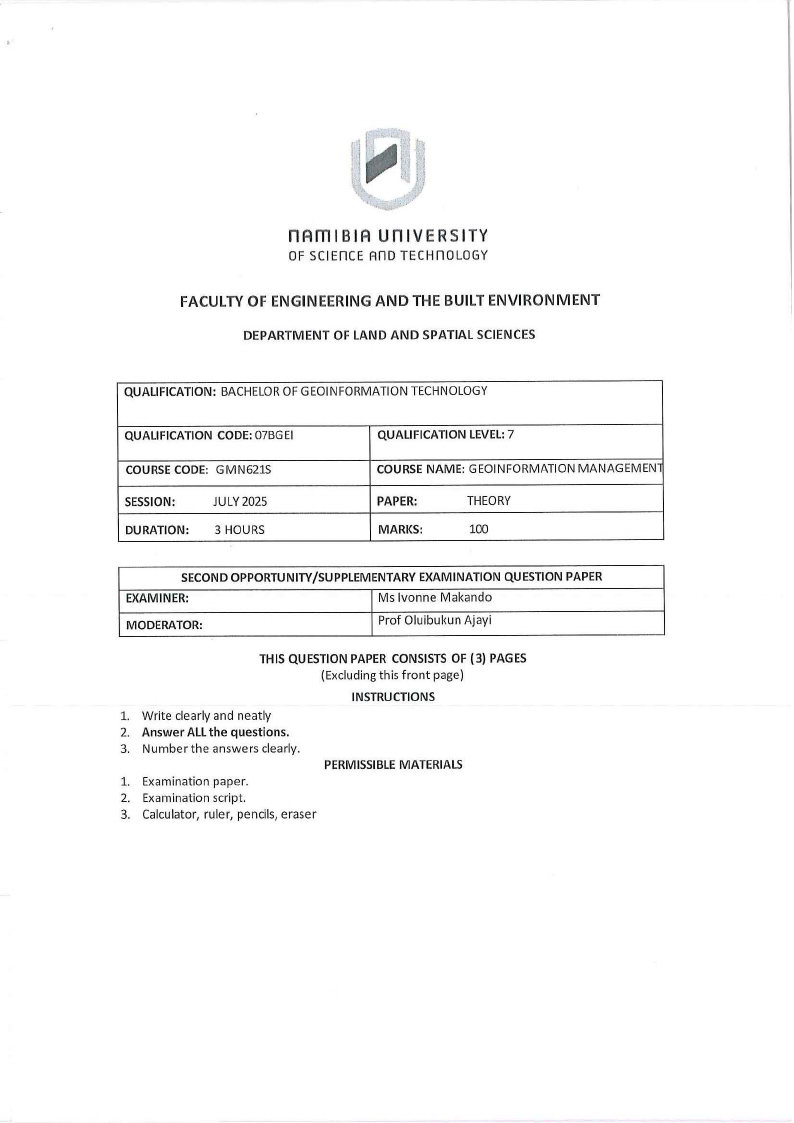
nAmlBIA untVERSITY
OF SCIEnCE AnD TECHnOLOGY
FACULTY OF ENGINEERING AND THE BUILT ENVIRONMENT
DEPARTMENT OF LAND AND SPATIAL SCIENCES
QUALIFICATION:BACHELOROF GEOINFORMATION TECHNOLOGY
QUALIFICATIONCODE:07BGEI
COURSECODE: GMN621S
SESSION:
JULY 2025
DURATION: 3 HOURS
QUALIFICATIONLEVEL7:
COURSENAME: GEOINFORMATION MANAGEMENl
PAPER:
MARKS:
THEORY
100
SECONDOPPORTUNITY/SUPPLEMENTAREYXAMINATION QUESTIONPAPER
EXAMINER:
Ms Ivonne Makando
MODERATOR:
Prof Oluibukun Ajayi
THIS QUESTIONPAPERCONSISTSOF (3) PAGES
(Excluding this front page)
INSTRUCTIONS
1. Write clearly and neatly
2. Answer ALLthe questions.
3. Number the answers clearly.
PERMISSIBLEMATERIALS
1. Examination paper.
2. Examination script.
3. Calculator, ruler, pencils, eraser
|
|
2 Page 2 |
▲back to top |
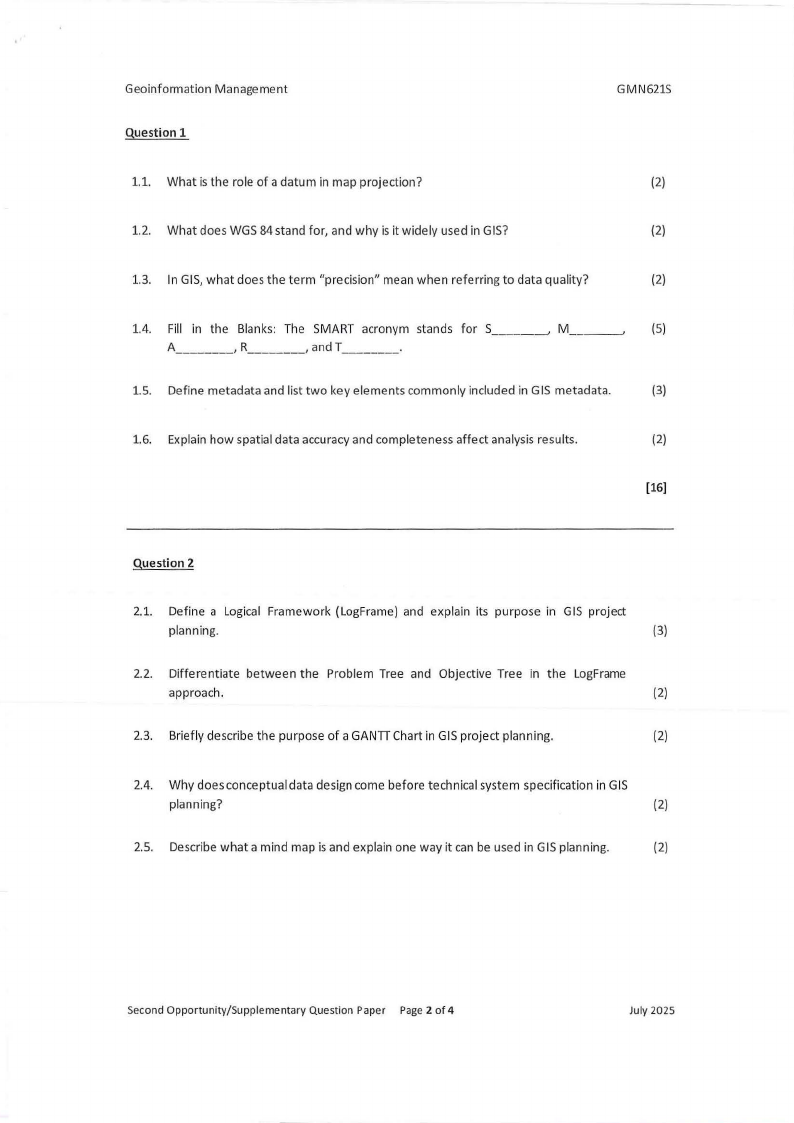
Geoinformation Management
Question 1
GMN621S
1.1. What is the role of a datum in map projection?
(2)
1.2. What does WGS 84 stand for, and why is it widely used in GIS?
(2)
1.3. In GIS,what does the term "precision" mean when referring to data quality?
(2)
1.4. Fill in the Blanks: The SMART acronym stands for S___
(5)
A______ , R____
, and T_______ .
1.5. Define metadata and list two key elements commonly included in GIS metadata.
(3)
1.6. Explain how spatial data accuracy and completeness affect analysis results.
(2)
[16]
Question 2
2.1. Define a Logical Framework (LogFrame) and explain its purpose in GIS project
planning.
(3)
2.2. Differentiate between the Problem Tree and Objective Tree in the LogFrame
approach.
(2)
2.3. Briefly describe the purpose of a GANTTChart in GIS project planning.
(2)
2.4. Why does conceptual data design come before technical system specification in GIS
planning?
(2)
2.5. Describe what a mind map is and explain one way it can be used in GIS planning.
(2)
Second Opportunity/Supplementary Question Paper Page 2 of4
July 2025
|
|
3 Page 3 |
▲back to top |
Geoinformation Management
GMN621S
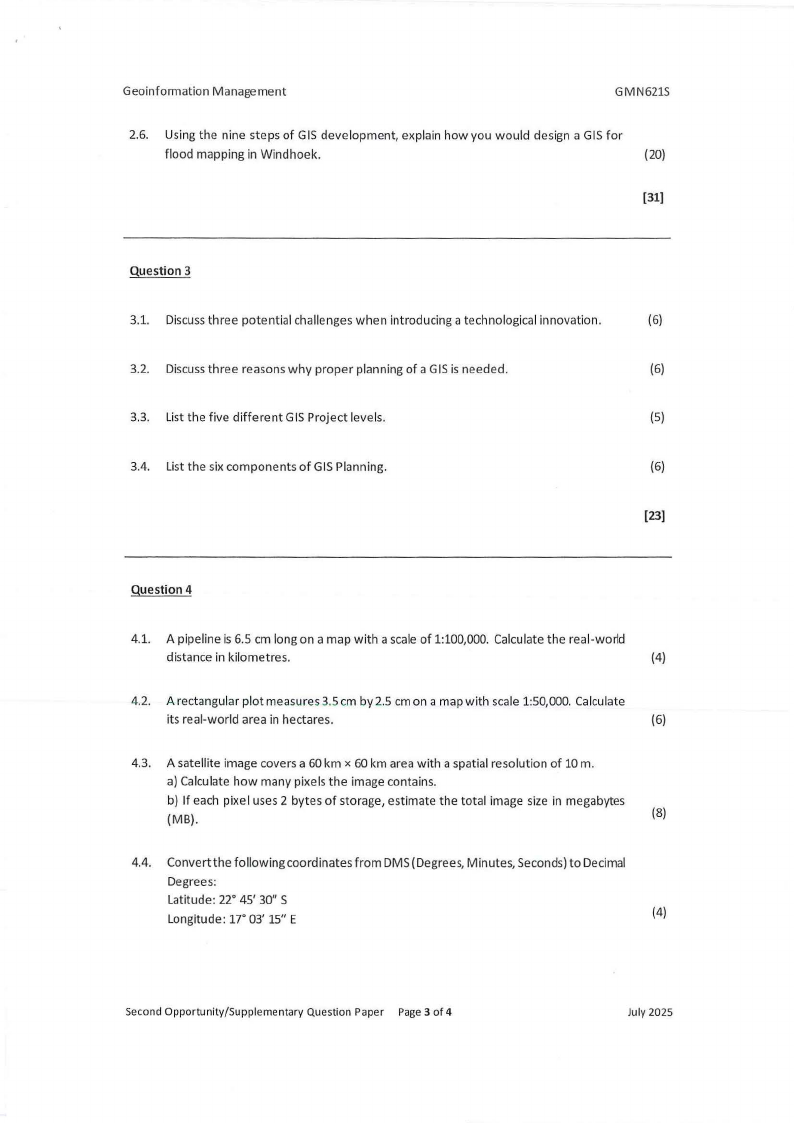
2.6. Using the nine steps of GIS development, explain how you would design a GIS for
flood mapping in Windhoek.
(20)
(31)
Question 3
3.1. Discussthree potential challenges when introducing a technological innovation.
(6)
3.2. Discussthree reasons why proper planning of a GISis needed.
(6)
3.3. List the five different GIS Project levels.
(5)
3.4. List the six components of GIS Planning.
(6)
[23)
Question 4
4.1. A pipeline is 6.5 cm long on a map with a scale of 1:100,000. Calculate the real-world
distance in kilometres.
(4)
4.2. A rectangular plot measures 3.5 cm by 2.5 cm on a map with scale 1:50,000. Calculate
its real-world area in hectares.
(6)
4.3. A satellite image covers a 60 km x 60 km area with a spatial resolution of 10 m.
a) Calculate how many pixels the image contains.
b) If each pixel uses 2 bytes of storage, estimate the total image size in megabytes
(MB).
(8)
4.4. Convert the following coordinates from OMS(Degrees, Minutes, Seconds)to Decimal
Degrees:
Latitude: 22° 45' 30" S
Longitude: 17° 03' 15" E
(4)
Second Opportunity/Supplementary Question Paper Page 3 of 4
July 2025
|
|
4 Page 4 |
▲back to top |

Geoinfonnation Management
GMN621S
4.5. Differentiate between the Relational and Object-Oriented logicaldata models usedin
GIS by completing the table below.
(8)
Data Model
Relational Model
How Data is Stored
Object-Oriented Model
Key Advantage
[30]
Second Opportunity/Supplementary Question Paper Page4 of 4
July 2025