PLU411S - PRINCIPLES OF LANGUAGE USE - 2ND OPP - JULY 2025


PLU411S - PRINCIPLES OF LANGUAGE USE - 2ND OPP - JULY 2025


1 Page 1

▲back to top


,I
nAmlBIA unlVERSITY
OF SCIEnCE Ano TECHnOLOGY
FACULTY OF COMMERCE, HUMAN SCIENCE AND EDUCATION
DEPARTMENT OF COMMUNICATION AND LANGUAGES
QUALIFICATION : VARIOUS
QUALIFICATION CODE: VARIOUS
COURSE CODE: PLU411S
LEVEL: 4
COURSE NAME: PRINCIPLES OF LANGUAGE USE
SESSION:
JUNE/JULY2025
DURATION: 3 HOURS
PAPER:
MARKS:
THEORY
100
EXAMINER($)
SECOND OPPORTUNITY EXAMINATION QUESTION PAPER
Dr R. Nekongo
Dr E. lthindi
Ms N. Haimbodi
Ms N. Ashimbuli
Ms K. Tameja
Ms J. Ndamanhomhata
Ms V. Verbeeck
Ms R. Ndengu
Mr R. Muyunda
MODERATOR: Mr C. Gwasira
INSTRUCTIONS
1. Answer ALL the questions.
2. Write clearly and neatly.
3. Number the answers clearly.
THIS QUESTION PAPER CONSISTS OF _10_ PAGES (Including this front page)
1

2 Page 2

▲back to top


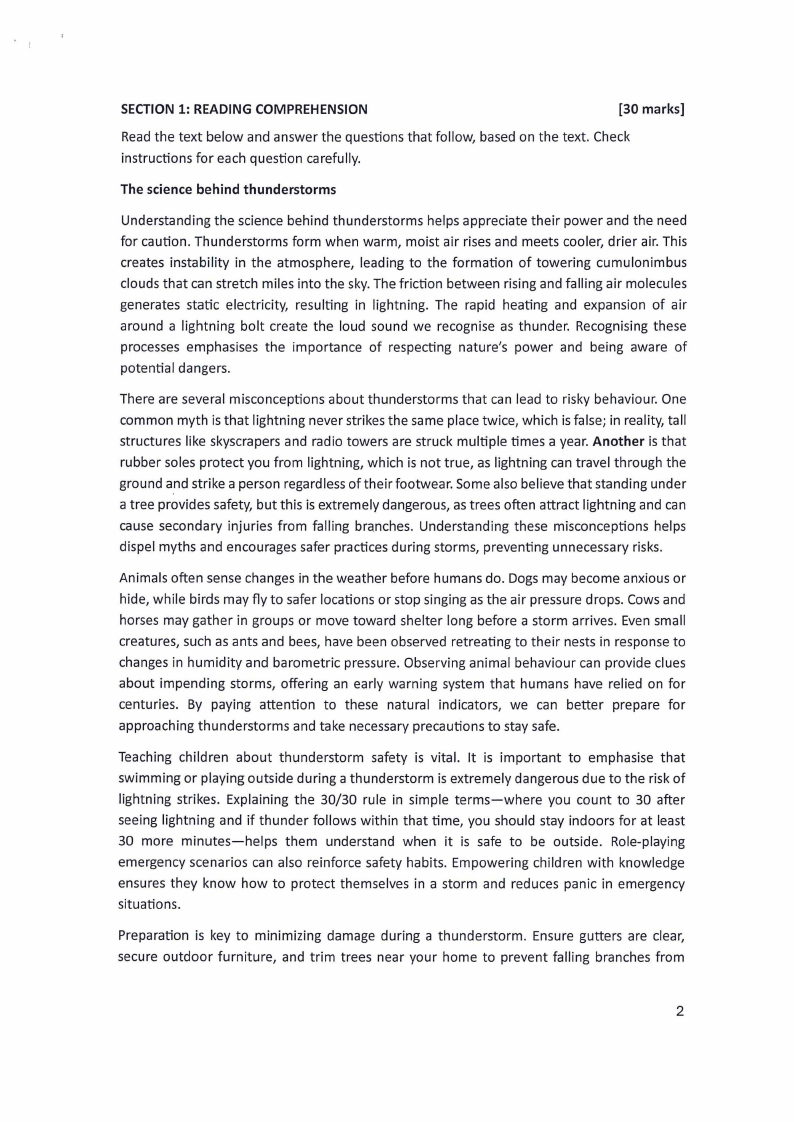
SECTION 1: READING COMPREHENSION
[30 marks]
Readthe text below and answer the questions that follow, based on the text. Check
instructions for each question carefully.
The science behind thunderstorms
Understanding the science behind thunderstorms helps appreciate their power and the need
for caution. Thunderstorms form when warm, moist air rises and meets cooler, drier air. This
creates instability in the atmosphere, leading to the formation of towering cumulonimbus
clouds that can stretch miles into the sky. The friction between rising and falling air molecules
generates static electricity, resulting in lightning. The rapid heating and expansion of air
around a lightning bolt create the loud sound we recognise as thunder. Recognising these
processes emphasises the importance of respecting nature's power and being aware of
potential dangers.
There are several misconceptions about thunderstorms that can lead to risky behaviour. One
common myth is that lightning never strikes the same place twice, which is false; in reality, tall
structures like skyscrapers and radio towers are struck multiple times a year. Another is that
rubber soles protect you from lightning, which is not true, as lightning can travel through the
ground and strike a person regardless of their footwear. Some also believe that standing under
a tree provides safety, but this is extremely dangerous, as trees often attract lightning and can
cause secondary injuries from falling bra.nches. Understanding these misconceptions helps
dispel myths and encourages safer practices during storms, preventing unnecessary risks.
Animals often sense changes in the weather before humans do. Dogs may become anxious or
hide, while birds may fly to safer locations or stop singing as the air pressure drops. Cows and
horses may gather in groups or move toward shelter long before a storm arrives. Even small
creatures, such as ants and bees, have been observed retreating to their nests in response to
changes in humidity and barometric pressure. Observing animal behaviour can provide clues
about impending storms, offering an early warning system that humans have relied on for
centuries. By paying attention to these natural indicators, we can better prepare for
approaching thunderstorms and take necessary precautions to stay safe.
Teaching children about thunderstorm safety is vital. It is important to emphasise that
swimming or playing outside during a thunderstorm is extremely dangerous due to the risk of
lightning strikes. Explaining the 30/30 rule in simple terms-where you count to 30 after
seeing lightning and if thunder follows within that time, you should stay indoors for at least
30 more minutes-helps them understand when it is safe to be outside. Role-playing
emergency scenarios can also reinforce safety habits. Empowering children with knowledge
ensures they know how to protect themselves in a storm and reduces panic in emergency
situations.
Preparation is key to minimizing damage during a thunderstorm. Ensure gutters are clear,
secure outdoor furniture, and trim trees near your home to prevent falling branches from
2

3 Page 3

▲back to top


causing damage. Checking your home's structural integrity, such as ensuring roofs and
windows are in good condition, can also reduce potential hazards. Investing in surge
protectors and backup power sources can protect your electronics and prevent costly repairs.
Having an emergency kit with flashlights, batteries, and non-perishable food is essential in
case of power outages. By taking these steps, you reduce the risk of damage and ensure your
home is a haven during a storm, giving you peace of mind.
Sometimes, thunderstorms escalate into severe storms, bringing hail, high winds, and
tornadoes. Large hailstones can break windows and damage vehicles, while strong winds may
uproot trees and knock down power lines. Recognising the signs of a severe storm, such as
darkening skies, rapid temperature changes, and sudden strong gusts of wind, can be
lifesaving. It is also crucial to listen for emergency alerts or sirens that indicate tornado activity
in your area. Stay informed through weather alerts and be ready to take shelter, if necessary,
especially if meteorologists issue warnings. Preparedness is essential for staying safe during
severe weather events, as quick action can make all the difference.
Meteorologists play a crucial role in thunderstorm safety by providing accurate forecasts and
warnings. Using advanced radar and satellite technology, they monitor weather patterns to
predict the likelihood and severity of storms. Their expertise helps communities prepare for
storms and minimize damage by issuing timely alerts. Without their work, people would have
little time to take necessary precautions against extreme weather. By understanding the work
of meteorologists, we can better appreciate the importance of heeding their advice and taking
proactive measures during thunderstorms to protect lives and property.
Lightning is both beautiful and deadly. It illuminates the sky with breathtaking displays of
energy, creating stunning natural light shows that have fascinated humans for centuries.
However, it carries immense power, capable of heating the air around it to temperatures
hotter than the surface of the sun. Eachyear, lightning causesthousands of wildfires, property
damage, and even fatalities. Understanding the dual nature of lightning fosters respect for its
potential dangers and the need to take shelter when storms approach. By appreciating its
beauty from a safe distance, we learn the importance of caution and safety during a
thunderstorm, ensuring that we can enjoy nature without putting ourselves at risk.
Thunderstorms are powerful natural phenomena that demand respect and caution. By
understanding what actions to avoid and taking necessary precautions, we can protect
ourselves and our loved ones. Knowledge, preparation, and respect for nature's fury are key
to staying safe during a thunderstorm. Whether through monitoring weather forecasts,
following safety guidelines, or staying informed about storm developments, being prepared is
the best defence against the unpredictable power of thunderstorms.
Adapted from https://www.msn.com/
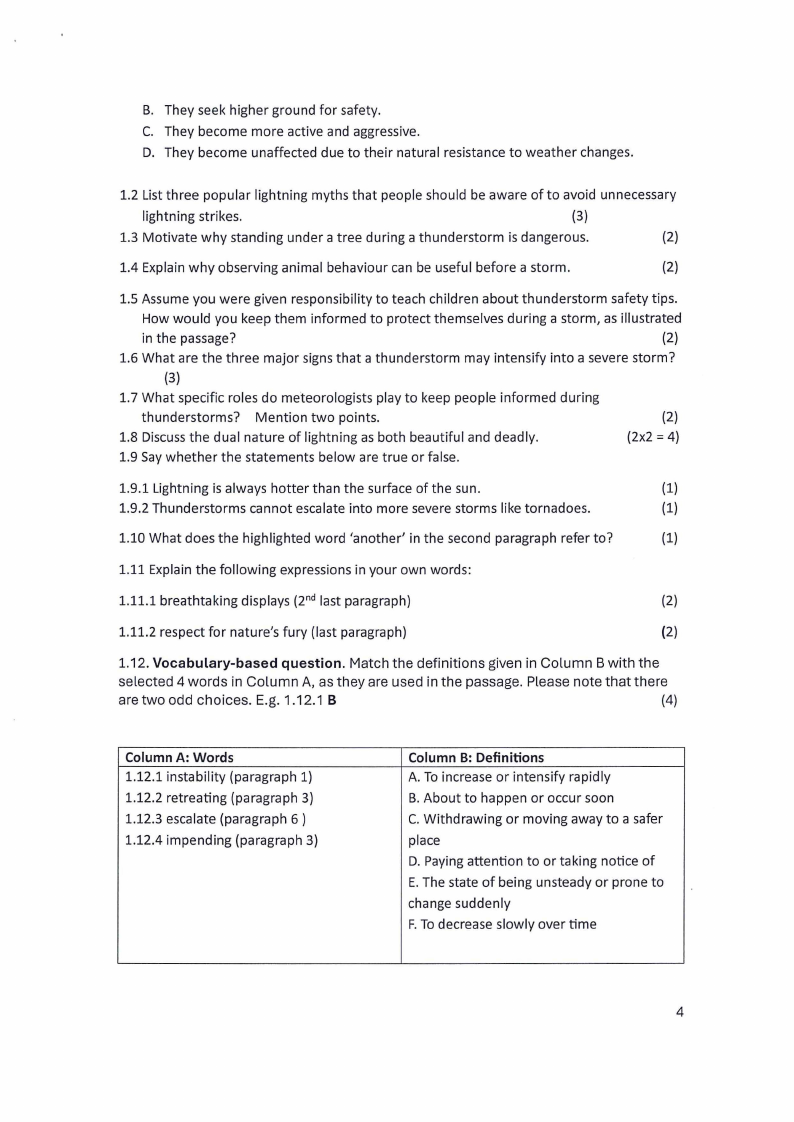
1.1 How do animals react to an approaching thunderstorm?
(1)
A. They hide, stop singing, or move toward shelter.
3

4 Page 4

▲back to top


B. They seek higher ground for safety.
C. They become more active and aggressive.
D. They become unaffected due to their natural resistance to weather changes.
1.2 List three popular lightning myths that people should be aware of to avoid unnecessary
lightning strikes.
(3)
1.3 Motivate why standing under a tree during a thunderstorm is dangerous.
(2)
1.4 Explain why observing animal behaviour can be useful before a storm.
(2)
1.5 Assume you were given responsibility to teach children about thunderstorm safety tips.
How would you keep them informed to protect themselves during a storm, as illustrated
in the passage?
(2)
1.6 What are the three major signs that a thunderstorm may intensify into a severe storm?
(3)
1.7 What specific roles do meteorologists play to keep people informed during
thunderstorms? Mention two points.
(2)
1.8 Discussthe dual nature of lightning as both beautiful and deadly.
(2x2 = 4)
1.9 Say whether the statements below are true or false.
1.9.1 Lightning is always hotter than the surface of the sun.
(1)
1.9.2 Thunderstorms cannot escalate into more severe storms like tornadoes.
(1)
1.10 What does the highlighted word 'another' in the second paragraph refer to?
(1)
1.11 Explain the following expressions in your own words:
1.11.1 breathtaking displays (2nd last paragraph)
(2)
1.11.2 respect for nature's fury (last paragraph)
(2)
1.12. Vocabulary-based question. Match the definitions given in Column B with the
selected 4 words in Column A, as they are used in the passage. Please note that there
are two odd choices. E.g. 1.12.1 B
(4)
Column A: Words
1.12.1 instability (paragraph 1)
1.12.2 retreating (paragraph 3)
1.12.3 escalate (paragraph 6)
1.12.4 impending (paragraph 3)
Column B: Definitions
A. To increase or intensify rapidly
B. About to happen or occur soon
C. Withdrawing or moving away to a safer
place
D. Paying attention to or taking notice of
E.The state of being unsteady or prone to
change suddenly
F.To decrease slowly over time
4

5 Page 5

▲back to top


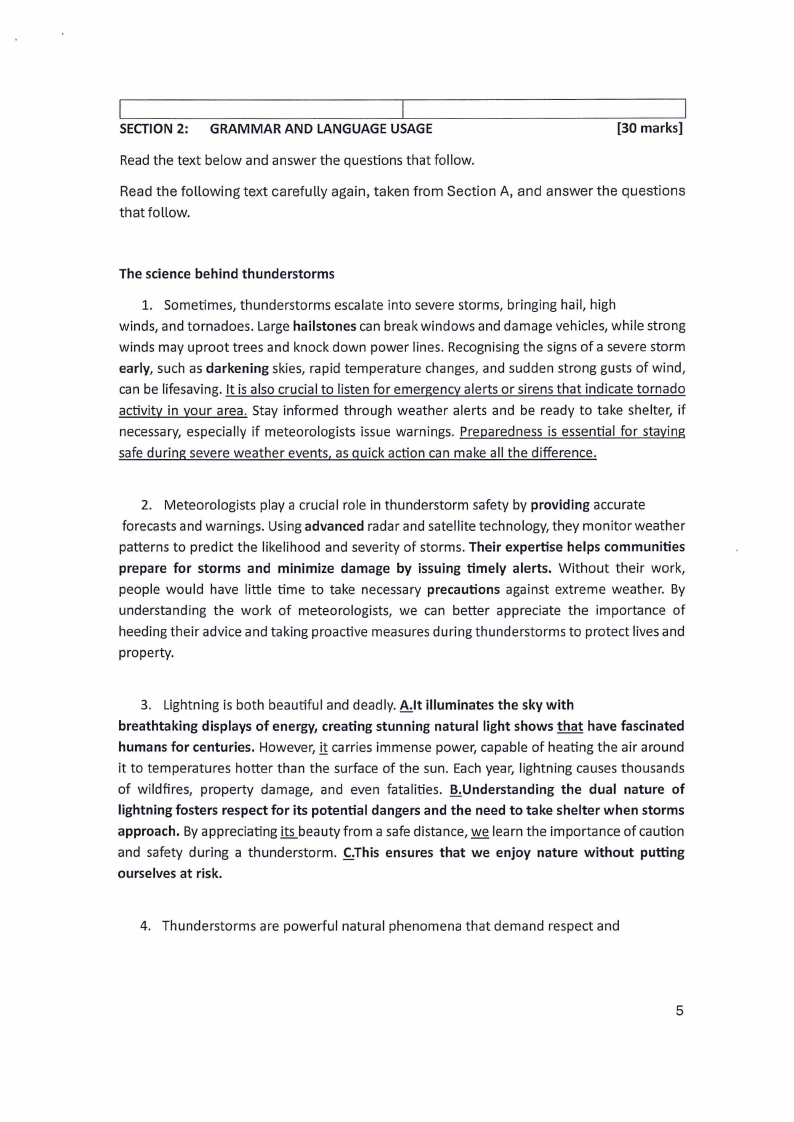
SECTION2: GRAMMAR AND LANGUAGEUSAGE
[30 marks]
Read the text below and answer the questions that follow.
Read the following text carefully again, taken from Section A, and answer the questions
that follow.
The science behind thunderstorms
1. Sometimes, thunderstorms escalate into severe storms, bringing hail, high
winds, and tornadoes. Large hailstones can break windows and damage vehicles, while strong
winds may uproot trees and knock down power lines. Recognising the signs of a severe storm
early, such as darkening skies, rapid temperature changes, and sudden strong gusts of wind,
can be lifesaving. It is also crucial to listen for emergency alerts or sirens that indicate tornado
activity in your area. Stay informed through weather alerts and be ready to take shelter, if
necessary, especially if meteorologists issue warnings. Preparedness is essential for staying
safe during severe weather events, as quick action can make all the difference.
2. Meteorologists play a crucial role in thunderstorm safety by providing accurate
forecasts and warnings. Using advanced radar and satellite technology, they monitor weather
patterns to predict the likelihood and severity of storms. Their expertise helps communities
prepare for storms and minimize damage by issuing timely alerts. Without their work,
people would have little time to take necessary precautions against extreme weather. By
understanding the work of meteorologists, we can better appreciate the importance of
heeding their advice and taking proactive measures during thunderstorms to protect lives and
property.
3. Lightning is both beautiful and deadly. A.It illuminates the sky with
breathtaking displays of energy, creating stunning natural light shows that have fascinated
humans for centuries. However, l! carries immense power, capable of heating the air around
it to temperatures hotter than the surface of the sun. Each year, lightning causes thousands
of wildfires, property damage, and even fatalities. B.Understanding the dual nature of
lightning fosters respect for its potential dangers and the need to take shelter when storms
approach. By appreciating ll_beauty from a safe distance, we learn the importance of caution
and safety during a thunderstorm. C.This ensures that we enjoy nature without putting
ourselves at risk.
4. Thunderstorms are powerful natural phenomena that demand respect and
5

6 Page 6

▲back to top


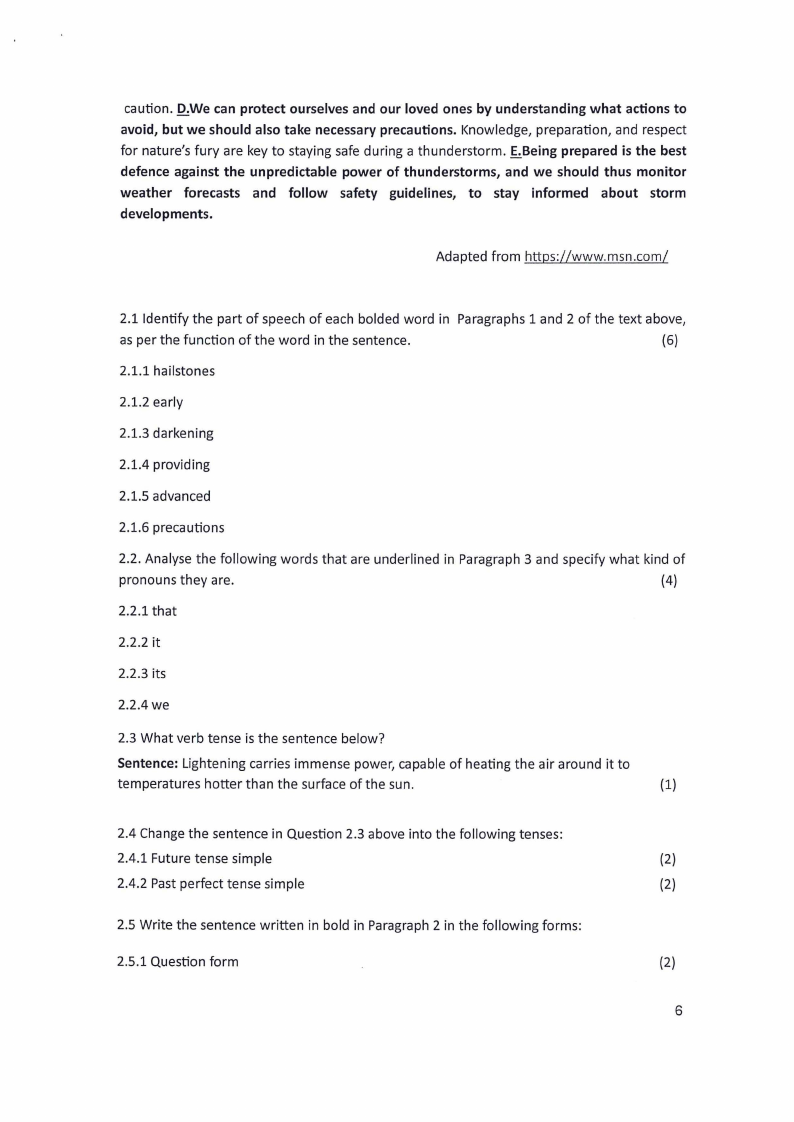
caution. D.We can protect ourselves and our loved ones by understanding what actions to
avoid, but we should also take necessary precautions. Knowledge, preparation, and respect
for nature's fury are key to staying safe during a thunderstorm. E.Being prepared is the best
defence against the unpredictable power of thunderstorms, and we should thus monitor
weather forecasts and follow safety guidelines, to stay informed about storm
developments.
Adapted from https://www.msn.com/
2.1 Identify the part of speech of each balded word in Paragraphs 1 and 2 of the text above,
as per the function of the word in the sentence.
(6)
2.1.1 hailstones
2.1.2 early
2.1.3 darkening
2.1.4 providing
2.1.5 advanced
2.1.6 precautions
2.2. Analyse the following words that are underlined in Paragraph 3 and specify what kind of
pronouns they are.
(4)
2.2.1 that
2.2.2 it
2.2.3 its
2.2.4 we
2.3 What verb tense is the sentence below?
Sentence: Lightening carries immense power, capable of heating the air around it to
temperatures hotter than the surface of the sun.
(1)
2.4 Change the sentence in Question 2.3 above into the following tenses:
2.4.1 Future tense simple
(2)
2.4.2 Past perfect tense simple
(2)
2.5 Write the sentence written in bold in Paragraph 2 in the following forms:
2.5.1 Question form
(2)
6

7 Page 7

▲back to top


2.5.2 Negative form
(2)
2.6 Firstly, identify and write down the subject and the verb in the sentences below. Then,
indicate whether the subject and the verb agree or disagree.
2.6.1 Meteorologists play a crucial role in thunderstorm safety by providing accurate forecasts
and warnings.
a. The subject: ....
b. The verb: ...
(2)
c. Agree or Disagree? ....
(1)
2.6.2 Lightning are both beautiful and deadly ..
a. The subject: ....
b. The verb: ...
(2)
c. Agree or Disagree? ....
(1)
2.7 Read the last two paragraphs carefully and identify the following types of sentences:
simple, complex, compound-complex and compound, from the sentences numbered A to E.
Write down only the number of the sentence and the type of sentence it is, e.g. A -
Compound-complex sentence
2.7.1 Sentence A (Par 3): ......
2.7.2 Sentence B (Par 3): ......
2.7.3 Sentence C (Par 3)......
2.7.4 Sentence D (Par 4): ......
2.7.5 Sentence E (Par 4): ......
(5)
SECTION3: PARAGRAPHAND ESSAYANALYSIS
[30 marks]
Based on the structure of an academic essay that you were taught in this course, analyse the
essay below and then answer the questions that follow.
Causes of low self-esteem
1.
A.Low self-esteem is a psychological condition that affects how individuals perceive
and value themselves. B.lt often results in feelings of inadequacy. C.There are many factors
that contribute to the development of low self-esteem, such as an unhappy childhood marked
by excessive criticism, poor academic performance in school, and ongoing stressful life
experiences. D.These issues can deeply influence a person's self-perception and continue to
affect them well into adulthood if not properly addressed.
7

8 Page 8

▲back to top


2.
One significant cause of low self-esteem is an unhappy childhood. Especially when
children are raised in environments where parents or other authority figures, such as teachers,
are constantly critical. Children who are repeatedly told that they are not good enough, that
they fail to meet expectations, or that they are a disappointment often internalise these
negative messages. Instead of developing a healthy sense of self-worth. They begin to believe
that their value depends entirely on meeting unrealistic standards. This belief becomes deeply
ingrained and affects how they think and behave as adults. In some cases, even occasional
praise cannot undo the emotional damage caused by years of negativity and criticism. As a
result, a child's early experiences of rejection and judgment may lay the foundation for lifelong
struggles with self-esteem.
3.
A second major factor which often results in feelings of failure and low confidence is
poor academic performance. Students who struggle to meet academic expectations may
begin to view themselves as less intelligent or less capable than their peers. If this poor
performance is met with further criticism or lack of support, their self-esteem can suffer even
more. Over time, these students may develop a fear of failure and begin to avoid challenging
tasks, believing they are destined to fail. In some cases, they might even give up trying
altogether, not because they lack potential, but because they have come to believe that their
efforts will never be good enough. The long-term effect is a weakened sense of self-worth and
limited motivation to strive for personal growth. Thus, academic failure not only affects
educational achievement but also deeply influences how individuals view their overall
abilities.
4.
In addition, ongoing stressful life events can also severely damage a person's self-
esteem. For example, going through a painful relationship breakdown, losing a job, or facing
financial hardship can create a sense of hopelessness and failure. These experiences are
particularly damaging when individuals do not have a strong support system or coping
mechanisms. They may begin to feel that they are responsible for their misfortunes, leading
to guilt, shame, and a sense of worthlessness. Without help or encouragement, it becomes
difficult to rebuild confidence, and the emotional impact can become long-lasting. In extreme
cases, such stress can also lead to anxiety or depression, further complicating the individual's
self-esteem issues. Ultimately, chronic stress leaves individuals emotionally drained and
unable to maintain a positive or balanced self-image.
5.
In conclusion, low self-esteem is a complex issue with multiple possible causes, but
three of the most common are critical childhood environments, poor academic outcomes, and
high levels of stress from ongoing life challenges. These experiences shape the way people
think about themselves and can make it difficult to develop a healthy sense of self-worth. By
identifying and understanding these root causes, individuals and support networks can work
towards healing, growth, and the restoration of confidence. Ultimately, raising self-esteem
requires not only personal effort, it is also a nurturing environment that fosters acceptance
encouragement and emotional resilience.
8

9 Page 9

▲back to top


Adapted from: https://www.betterhealth.vic.gov.au/
3.1 Among the types of essaysyou were taught, in which category does this essay belong?
(1)
3.1.1 Give a reason for your answer in Question 3.1 above.
(2)
3.2 Which of the sentences numbered A to Dis the thesis statement of the essay above? (2)
3.3 Analyse Paragraph 3 carefully and identify three components of a body paragraph
illustrated. List the components and write down an example of each component from
the paragraph.
(6)
3.4 Answer the following questions based on Paragraph 2.
3.4.1 Identify and write down two sentence fragments in Paragraph 2.
(2 X 2 = 4)
3.5 Write down the topic sentence in Paragraph 4.
(2)
3.5.1 Identify and write down the topic of the topic sentence mentioned in Question 3.5. (2)
3.5.2 Identify the controlling idea of the topic sentence you wrote down in Question 3.5 and
write it down.
(2)
3.6 Answer the following questions based on Paragraph 5.
3.6.1 Identify and write down the comma splice sentence in the paragraph.
(2)
3.6.2 Rewrite the comma splice sentence in Question 3.6.1 correctly.
(2)
3.6.3 List down any 4 transitional words or phrases that are used to link ideas in the
paragraph.
(4)
3.7 Find a transitional phrase in Paragraph 2 that means the same as ultimately in
Paragraph 4.
(1)
SECTION 4: PARAGRAPH WRITING
[10 marks]
Choose any one of the prompts hereunder and write a body paragraph of about 100 words.
Pay attention to structure, coherence, punctuation, and language usage. Begin the paragraph
with a clear and suitable topic sentence.
1. Tik Tok: A blessing or a curse for the youth? Choose one side and write a well-argued
paragraph on whether TikTok has a positive or negative influence on young people.
2. The role of opposition political parties in a democratic government. Discusswhy
opposition political parties are essential.
9

10 Page 10

▲back to top


3. The disadvantages of artificial intelligence (Al) in education. Discuss the potential
negative impacts of integrating Al into educational systems.
4. Imagining the future of education. Discuss how the education system might evolve in
the near future.
5. The problem of begging from motorists: Why it should be discouraged. Explain why
begging at traffic intersections is problematic.
6. Is online learning an effective replacement for traditional classrooms? Discuss
whether online learning can fully substitute face-to-face education.
END OF QUESTION PAPER
10