


 |
BOP511S - BASIC ORGANISATIONAL PSHYCOLOGY - 2ND OPP - JUNE 2025 |
|
|
1 Page 1 |
▲back to top |
nAm I BI A un IVERSITY
OF SCIEn CE Ano TECHn OLOGY
FACULTY OF COMMERCE, HUMAN SCIENCESAND EDUCATION
DEPARTMENT OF GOVERNANCE AND MANAGEMENT SCIENCES
QUALIFICATION: BACHELOR OF HUMAN RESOURCES MANAGEMENT
QUALIFICATION CODE: 07BHRM
COURSE LEVEL: 5
COURSE CODE: BOPSllS
COURSE NAME: BASIC ORGANISATIONAL
PSYCHOLOGY
SESSION: JULY/ AUGUST 2025
PAPER: THEORY
DURATION: 3 HOURS
MARKS: 100
EXAMINER(S)
SECOND OPPORTUNITY EXAMINATION PAPER
MR. ODILO SIKOPO
MR. EHRENFRIED NDJOONDUEZU
MODERATOR:
Mr. E. KANDJINGA
INSTRUCTIONS
1. Answer ALL the questions.
2. Read all the questions carefully before answering.
3. Number the answers clearly
PERMISABLE MATERIALS (PEN, RULER)
THIS PAPER CONSISTS OF 7 PAGES (Including this front page)
|
|
2 Page 2 |
▲back to top |
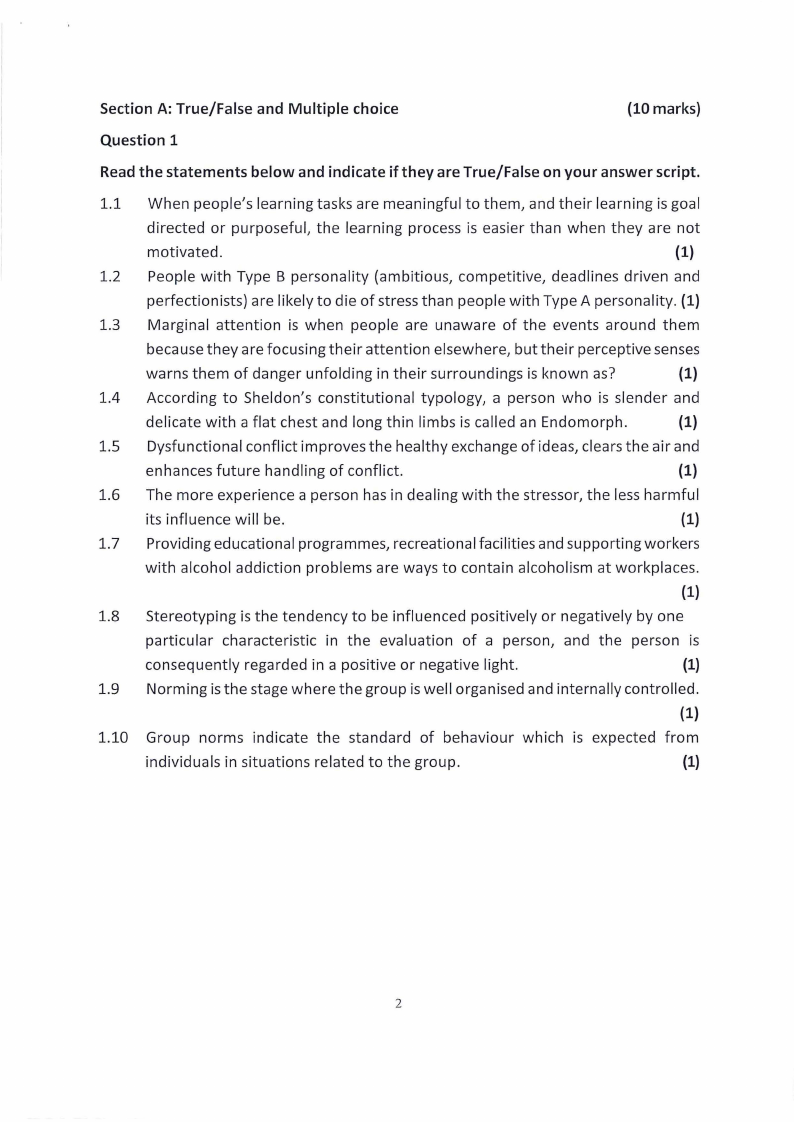
Section A: True/False and Multiple choice
(10 marks)
Question 1
Read the statements below and indicate if they are True/False on your answer script.
1.1 When people's learning tasks are meaningful to them, and their learning is goal
directed or purposeful, the learning process is easier than when they are not
motivated.
(1)
1.2 People with Type B personality (ambitious, competitive, deadlines driven and
perfectionists) are likely to die of stress than people with Type A personality. (1)
1.3 Marginal attention is when people are unaware of the events around them
because they are focusing their attention elsewhere, but their perceptive senses
warns them of danger unfolding in their surroundings is known as?
(1)
1.4 According to Sheldon's constitutional typology, a person who is slender and
delicate with a flat chest and long thin limbs is called an Endomorph.
(1)
1.5 Dysfunctional conflict improves the healthy exchange of ideas, clears the air and
enhances future handling of conflict.
(1)
1.6 The more experience a person has in dealing with the stressor, the less harmful
its influence will be.
(1)
1.7 Providing educational programmes, recreational facilities and supporting workers
with alcohol addiction problems are ways to contain alcoholism at workplaces.
(1)
1.8 Stereotyping is the tendency to be influenced positively or negatively by one
particular characteristic in the evaluation of a person, and the person is
consequently regarded in a positive or negative light.
(1)
1.9 Norming is the stage where the group is well organised and internally controlled.
(1)
1.10 Group norms indicate the standard of behaviour which is expected from
individuals in situations related to the group.
(1)
2
|
|
3 Page 3 |
▲back to top |
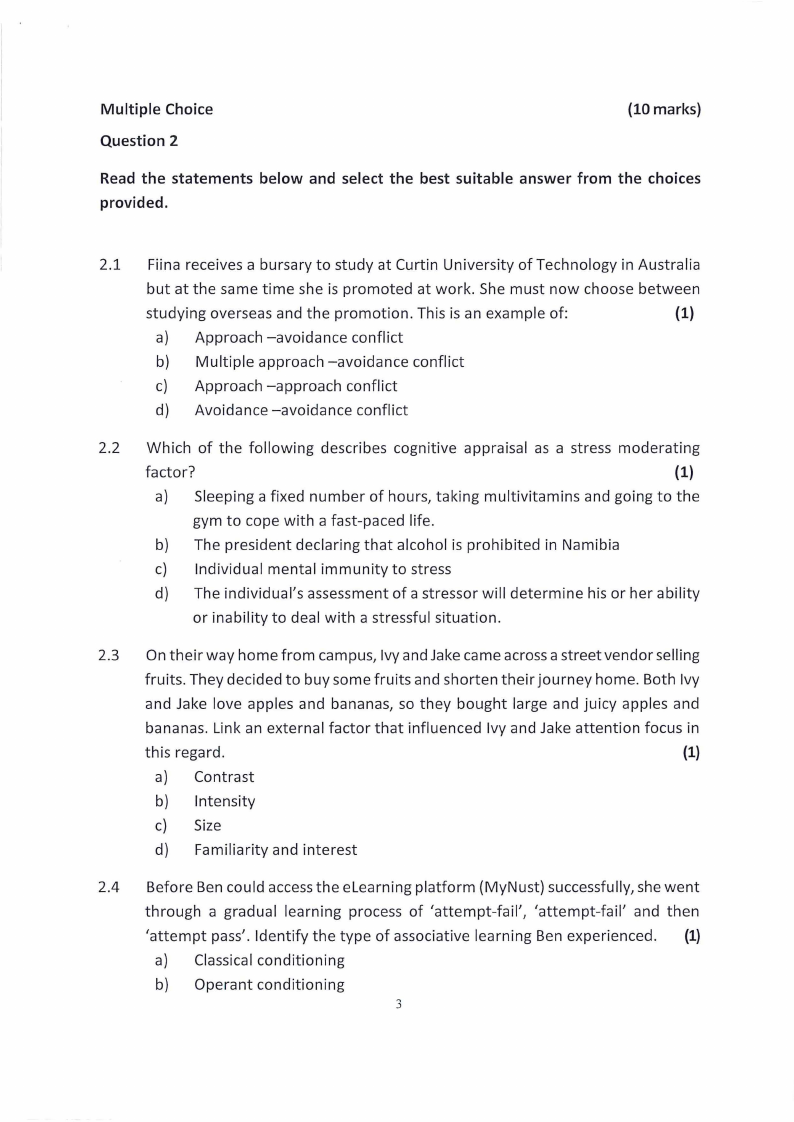
Multiple Choice
Question 2
(10 marks)
Read the statements below and select the best suitable answer from the choices
provided.
2.1 Fiina receives a bursary to study at Curtin University of Technology in Australia
but at the same time she is promoted at work. She must now choose between
studying overseas and the promotion. This is an example of:
(1)
a) Approach -avoidance conflict
b) Multiple approach -avoidance conflict
c) Approach -approach conflict
d) Avoidance -avoidance conflict
2.2 Which of the following describes cognitive appraisal as a stress moderating
factor?
(1)
a) Sleeping a fixed number of hours, taking multivitamins and going to the
gym to cope with a fast-paced life.
b) The president declaring that alcohol is prohibited in Namibia
c) Individual mental immunity to stress
d) The individual's assessment of a stressor will determine his or her ability
or inability to deal with a stressful situation.
2.3 On their way home from campus, Ivy and Jake came across a street vendor selling
fruits. They decided to buy some fruits and shorten their journey home. Both Ivy
and Jake love apples and bananas, so they bought large and juicy apples and
bananas. Link an external factor that influenced Ivy and Jake attention focus in
this regard.
(1)
a) Contrast
b) Intensity
c) Size
d) Familiarity and interest
2.4 Before Ben could access the elearning platform (MyNust) successfully, she went
through a gradual learning process of 'attempt-fail', 'attempt-fail' and then
'attempt pass'. Identify the type of associative learning Ben experienced. (1)
a) Classical conditioning
b) Operant conditioning
3
|
|
4 Page 4 |
▲back to top |
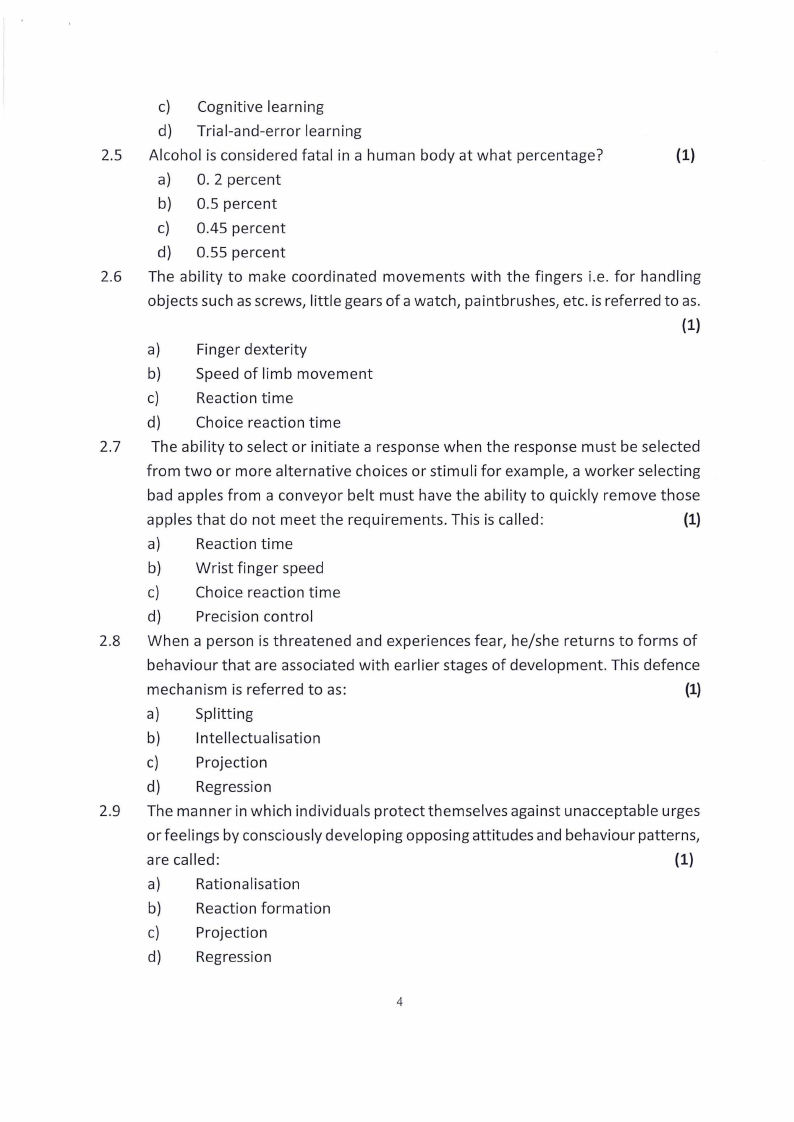
c) Cognitive learning
d) Trial-and-error learning
2.5 Alcohol is considered fatal in a human body at what percentage?
{1)
a) 0. 2 percent
b) 0.5 percent
c) 0.45 percent
d) 0.55 percent
2.6 The ability to make coordinated movements with the fingers i.e. for handling
objects such as screws, little gears of a watch, paintbrushes, etc. is referred to as.
{1)
a) Finger dexterity
b) Speed of limb movement
c) Reaction time
d} Choice reaction time
2.7 The ability to select or initiate a response when the response must be selected
from two or more alternative choices or stimuli for example, a worker selecting
bad apples from a conveyor belt must have the ability to quickly remove those
apples that do not meet the requirements. This is called:
{1)
a) Reaction time
b) Wrist finger speed
c) Choice reaction time
d) Precision control
2.8 When a person is threatened and experiences fear, he/she returns to forms of
behaviour that are associated with earlier stages of development. This defence
mechanism is referred to as:
(1)
a) Splitting
b) lntellectualisation
c) Projection
d) Regression
2.9 The manner in which individuals protect themselves against unacceptable urges
or feelings by consciously developing opposing attitudes and behaviour patterns,
are called:
{1)
a) Rationalisation
b) Reaction formation
c) Projection
d) Regression
4
|
|
5 Page 5 |
▲back to top |
2.10 This type of drug serves as a relaxant and remedy for insomnia but can be abused
to provide an intense feeling of well-being. This results in physical as well as
psychological addiction.
(1)
a) Opiates
b) Sedatives
c)
Inhalers
d) Stimulants
5
|
|
6 Page 6 |
▲back to top |
Section B: Structured questions (answer all questions)
(80 marks)
Question 2
2.1 Define the following environmental influences that can have an impact on a
person's development and give a relevant examples for each?
a) Prenatal influences
(3)
b) The birth process
(3)
c)
Postnatal influences
(3)
2.2 Discuss your personal experience with regards to Sigmund Freud's Psychoanalytic
personality structure theory?
2.2.1 Share your personal urge/desire with regards to the ID?
(3)
2.2.2 What was the interpretation and action of the ego?
(3)
2.2.3 How did the super-ego help you to resolve the issue in a morally
acceptable manner?
(3)
2.3 Discuss the three most popular methods by which employers can determine
personalities of their employees?
(9)
2.4 Identify and discuss the five (5) stages of group development that could have
been used by the NHE employees?
(10)
2.5 There are different explanations for people's need to belong to a group. Discuss
the most important reasons for it.
(12)
2.6 Describe one example of behaviour that you have learnt in your life through
observational learning, operant conditioning and trial and error learning? (6)
2.7 Define the term human ability and explain how physical, mechanical, and
psychomotor abilities positively and negatively affect recruitment and selection
in an organisation.
(8)
2.8 Discuss the three different components of an attitude and provide an example
for each of three?
(9)
6
|
|
7 Page 7 |
▲back to top |
<I
2.9 Discuss the process of attribution and the different criteria used when
attributions are made regarding someone's behaviour?
(8)
Total Marks: 100
Good luck!
7