


 |
ERP720S - ENTERPRISE RESOURCE PLANNING SYSTEMS - 2ND OPP - JULY 2025 |
|
|
1 Page 1 |
▲back to top |
nAmlBIA unlVERSITY
OF SCIEnCE Ano TECHnOLOGY
FACULTY OF COMPUTING AND INFORMATICS
DEPARTMENT OF INFORMATICS
QUALIFICATION : Bachelor of Information Technology (Business Computing)
Bachelor of Informatics
QUALIFICATION CODE: 80BSBC / O7BAIF
COURSELEVEL: NQF LEVEL7
COURSE: Enterprise Resource Planning Systems
DATE: July 2025
COURSE CODE: ERP720S
SESSION: 2
DURATION: 2 Hours
MARl<S: 100
SECOND OPPORTUNITY/SUPPLEMENTARY EXAMINATION QUESTION PAPER
EXAMINER(S):
Mr Johnson Billawer
MODERATOR (S):
Dr Victoria Hasheela
THIS EXAMINATION PAPER CONSISTSOF 5 PAGES
(INCLUDING THIS FRONT PAGE)
Instructions for the students
1. Answer ALL the questions.
2. Write clearly and neatly.
3. Number the answers clearly.
|
|
2 Page 2 |
▲back to top |
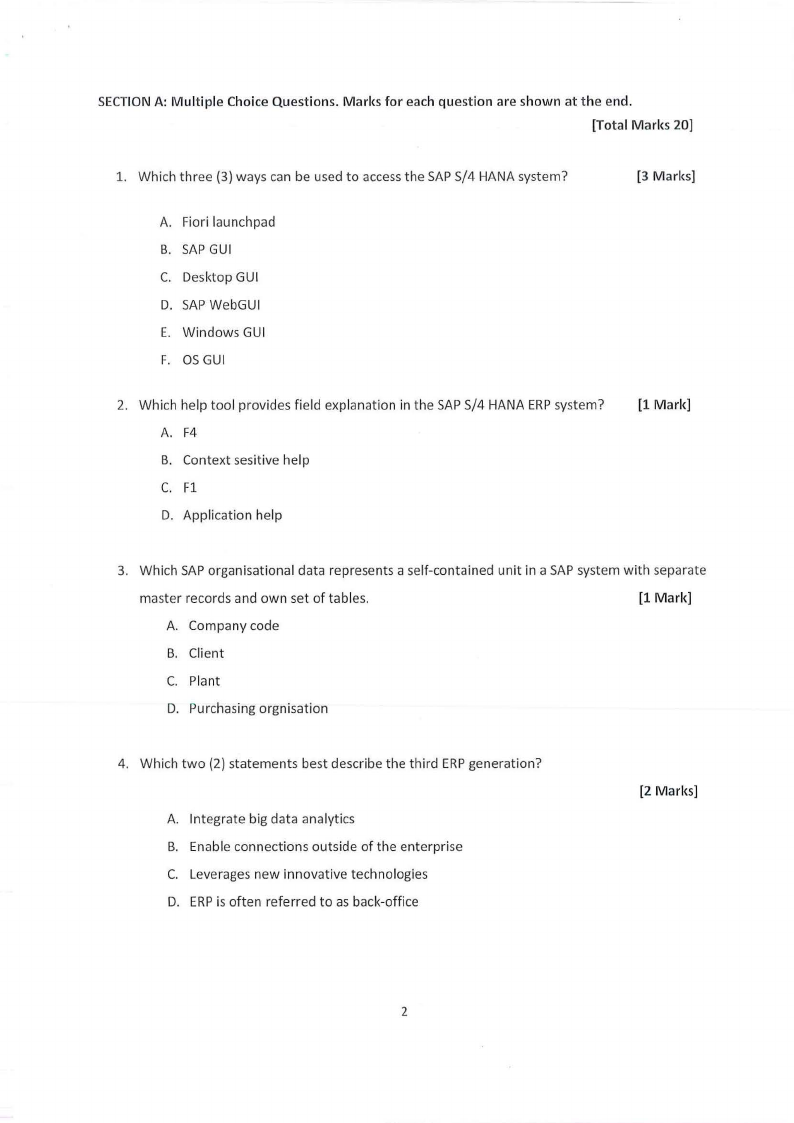
SECTIONA: Multiple Choice Questions. Marks for each question are shown at the end.
[Total Marks 20]
1. Which three (3) ways can be used to access the SAP S/4 HANA system?
[3 Marks]
A. Fiori launchpad
B. SAP GUI
C. Desktop GUI
D. SAP WebGUI
E. Windows GUI
F. OS GUI
2. Which help tool provides field explanation in the SAP S/4 HANA ERPsystem?
A. F4
B. Context sesitive help
C. Fl
D. Application help
[1 Mark]
3. Which SAP organisational data represents a self-contained unit in a SAP system with separate
master records and own set of tables.
[1 Mark]
A. Company code
B. Client
C. Plant
D. Purchasing orgnisation
4. Which two (2) statements best describe the third ERPgeneration?
A. Integrate big data analytics
B. Enable connections outside of the enterprise
C. Leverages new innovative technologies
D. ERP is often referred to as back-office
[2 Marks]
2
|
|
3 Page 3 |
▲back to top |
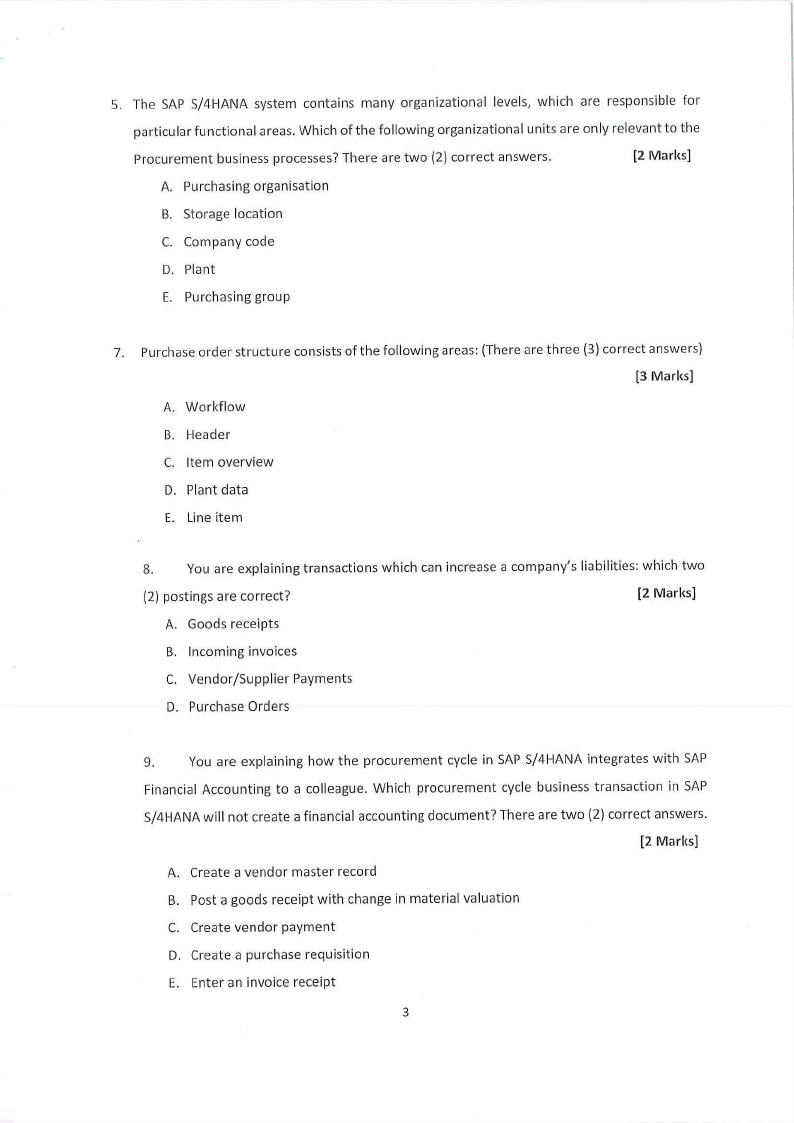
5. The SAP S/4HANA system contains many organizational levels, which are responsible for
particular functional areas. Which ofthe following organizational units are only relevant to the
Procurement business processes? There are two (2) correct answers.
[2 Marks]
A. Purchasing organisation
B. Storage location
C. Company code
D. Plant
E. Purchasing group
7. Purchase order structure consists of the following areas: (There are three (3) correct answers)
[3 Marks]
A. Workflow
B. Header
C. Item overview
D. Plant data
E. Line item
8.
You are explaining transactions which can increase a company's liabilities: which two
(2) postings are correct?
[2 Marks]
A. Goods receipts
B. Incoming invoices
C. Vendor/Supplier Payments
D. Purchase Orders
9.
You are explaining how the procurement cycle in SAP S/4HANA integrates with SAP
Financial Accounting to a colleague. Which procurement cycle business transaction in SAP
S/4HANA will not create a financial accounting document? There are two (2) correct answers.
[2 Marks]
A. Create a vendor master record
B. Post a goods receipt with change in material valuation
C. Create vendor payment
D. Create a purchase requisition
E. Enter an invoice receipt
3
|
|
4 Page 4 |
▲back to top |
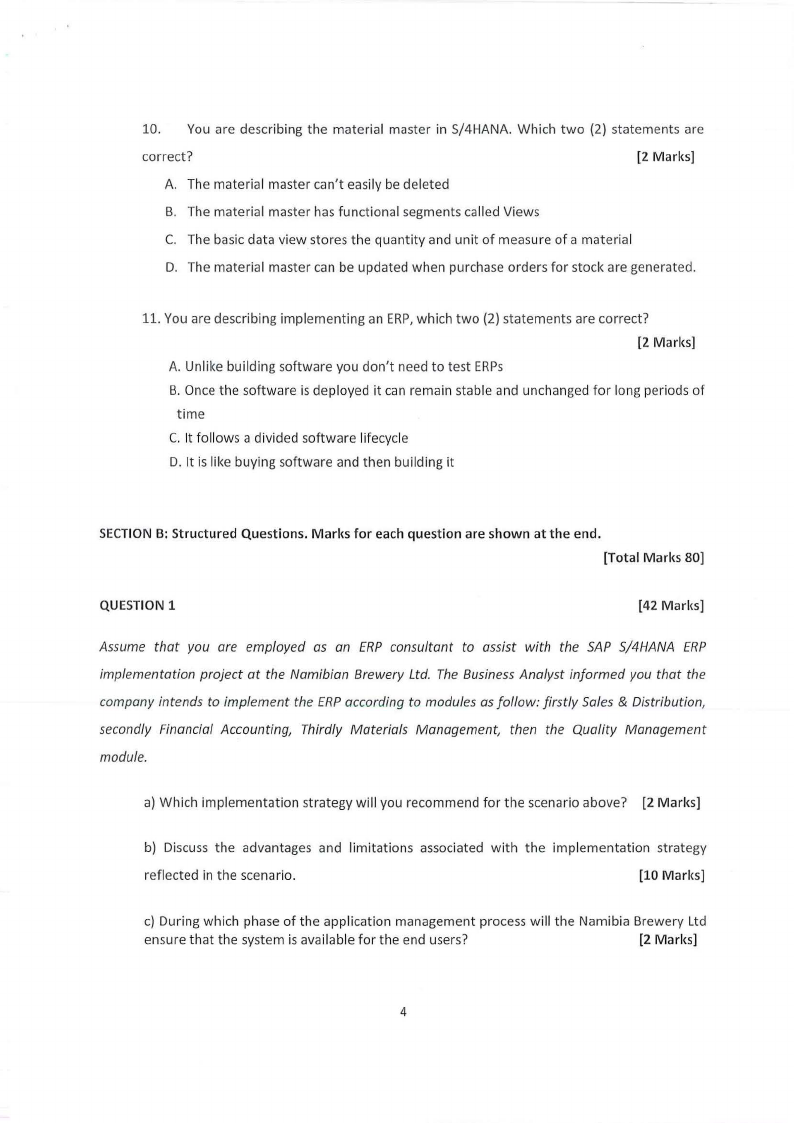
10. You are describing the material master in S/4HANA. Which two (2) statements are
correct?
(2 Marks]
A. The material master can't easily be deleted
B. The material master has functional segments called Views
C. The basic data view stores the quantity and unit of measure of a material
D. The material master can be updated when purchase orders for stock are generated.
11. You are describing implementing an ERP,which two (2) statements are correct?
(2 Marks]
A. Unlike building software you don't need to test ERPs
B. Once the software is deployed it can remain stable and unchanged for long periods of
time
C. It follows a divided software lifecycle
D. It is like buying software and then building it
SECTION B: Structured Questions. Marks for each question are shown at the end.
[Total Marks 80]
QUESTION 1
(42 Marks]
Assume that you are employed as an ERP consultant to assist with the SAP S/4HANA ERP
implementation project at the Namibian Brewery Ltd. The Business Analyst informed you that the
company intends to implement the ERPaccording to modules as follow: firstly Sales & Distribution,
secondly Financial Accounting, Thirdly Materials Management, then the Quality Management
module.
a) Which implementation strategy will you recommend for the scenario above? (2 Marks]
b) Discuss the advantages and limitations associated with the implementation strategy
reflected in the scenario.
(10 Marks]
c) During which phase of the application management process will the Namibia Brewery Ltd
ensure that the system is available for the end users?
(2 Marks)
4
|
|
5 Page 5 |
▲back to top |
d) Produce a sales order processing (order-to-cash) business blueprint for the Namibian
Brewery Ltd. Your illustration should clearly show the ERPdata levels and components that
are relevant on each level.
[12 Marks]
e) Categorise the different ERPcosts that the Namibian Brewery Ltd should consider for the
ERPimplementation project.
[16 Marks]
QUESTION 2
[10 Marks]
A) Differentiate between a thin client and a fat client.
B) Explain the divided software lifecycle of ERPsystems.
[2 Marks]
[5 Marks]
C) What are the three (3) deployment options for the SAPS/4 HANA ERPsystem? [3 Marks]
QUESTION 3
[28 Marks]
A) Discussfive (5) ERPintegration benefits levels.
[15 Marks]
B.Assume you own a groceryretail and hiredfour employees to assist you in managing the daily
activities.The business has two warehousesfor storing all the products receivedfrom suppliers.
i) Why will it be important for you to manage inventory in the shop?
[5 Marks]
ii) On a particular day the following transactions occurred in your business. Analyse each
statement below and state what type of goods movement is involved.
a) You purchased 20 products from your supplier and re-sell 15 of the products to a
customer.
[4 Marks]
b) You detected that two products are damaged, hence will not be usable in the
business.
[2 Marks]
c) You transferred some products from one warehouse to the other.
[2 Marks]
- #### THE END OF EXAM####
5