


 |
BAP511S - BUSINESS APPLICATIONS 1A - 2ND OPP - JULY 2025 |
|
|
1 Page 1 |
▲back to top |
n Am I BI A u n IVER s I TY
OF SCIEnCE Ano TECHnOLOGY
FACULTY OF COMMERCE, HUMAN SCIENCES AND EDUCATION
DEPARTMENT OF GOVERNANCE & MANAGEMENT SCIENCES
QUALIFICATION: BACHELOR OF BUSINESS AND INFORMATION ADMINISTRATION
QUALIFICATION CODE: 07BBIA
LEVEL: 5
COURSE CODE:BAP511S
COURSE NAME: BUSINESS APPLICATIONS 1A
SESSION: JULY 2025
DURATION: 2 HOURS
PAPER: PRACTICAL PAPER
MARKS: 100
EXAMINER(S)
SECOND OPPORTUNITY EXAMINATION QUESTION PAPER
MS E.VAINO
MS H.SHIVUTE
MODERATOR: MS L. TRIPODI
INSTRUCTIONS
INSTRUCTIONS
1. Answer~ questions.
2. Read all the questions carefully before answering.
3. Make sure your name and surname, question number and the
date appears in the Header and Footer.
4. Give special attention to the manuscript instructions.
THIS QUESTION PAPER CONSISTS OF 7 PAGES (Including this front page)
|
|
2 Page 2 |
▲back to top |
'
QUESTION 1
[20]
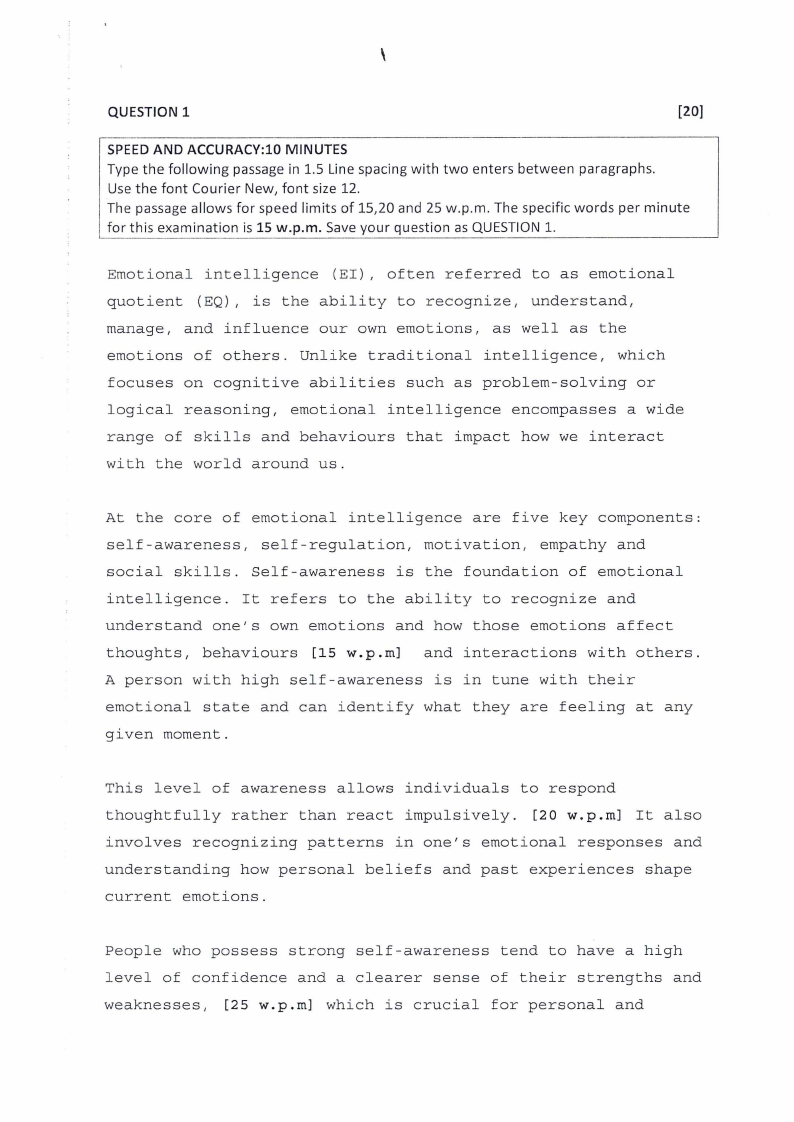
SPEED AND ACCURACY:10 MINUTES
Type the following passage in 1.5 Line spacing with two enters between paragraphs.
Use the font Courier New, font size 12.
The passage allows for speed limits of 15,20 and 25 w.p.m. The specific words per minute
for this examination is 15 w.p.m. Save your question as QUESTION 1.
Emotional intelligence
(EI), often referred to as emotional
quotient
(EQ}, is the ability to recognize,
understand,
manage, and influence our own emotions, as well as the
emotions of others. Unlike traditional
intelligence,
which
focuses on cognitive abilities
such as problem-solving
or
logical reasoning,
emotional intelligence
encompasses a wide
range of skills and behaviours
that impact how we interact
with the world around us.
At the core of emotional intelligence
are five key components:
self-awareness,
self-regulation,
motivation,
empathy and
social skills.
Self-awareness
is the foundation of emotional
intelligence.
It refers to the ability to recognize and
understand
one's own emotions and how those emotions affect
thoughts,
behaviours
[15 w.p.m] and interactions
with others.
A person with high self-awareness
is in tune with their
emotional state and can identify what they are feeling at any
given moment.
This level of awareness allows individuals
to respond
thoughtfully
rather than react impulsively.
[20 w.p.m] It also
involves recognizing
patterns in one's emotional responses and
understanding
how personal beliefs and past experiences
shape
current emotions.
People who possess strong self-awareness
level of confidence and a clearer sense
weaknesses,
[25 w.p.m] which is crucial
tend to have a high
of their strengths
and
for personal and
|
|
3 Page 3 |
▲back to top |
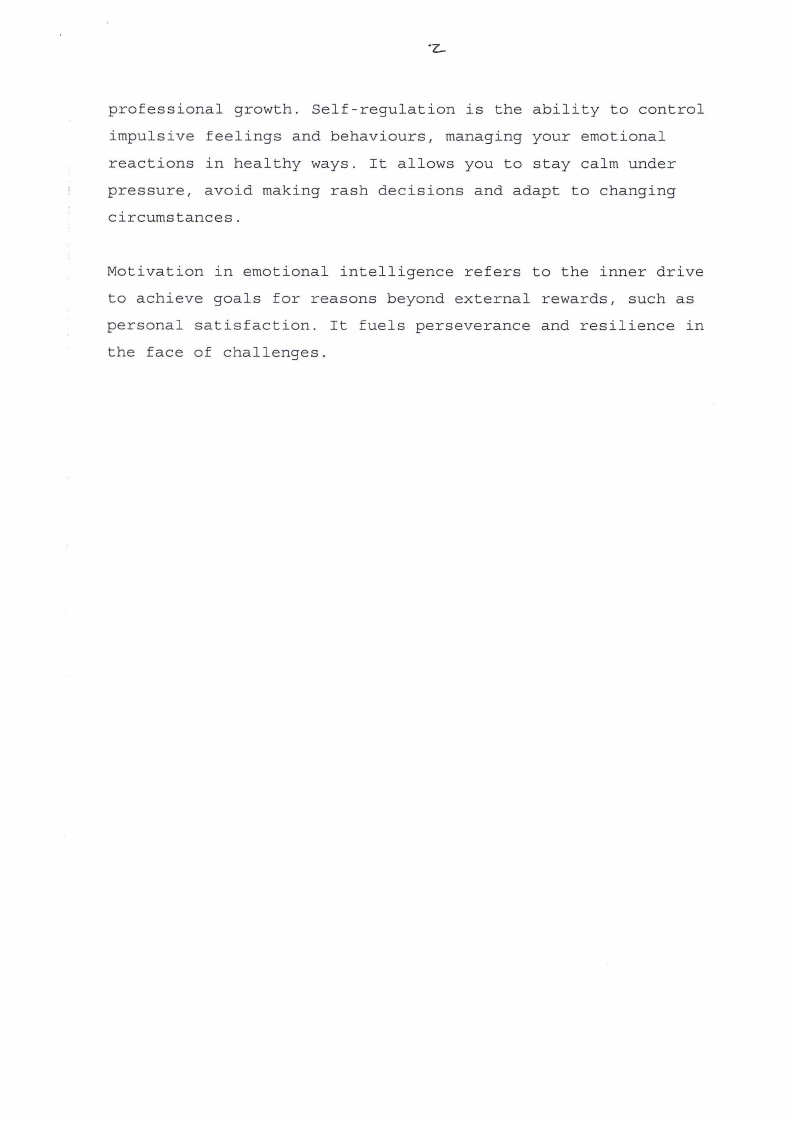
professional
growth. Self-regulation
is the ability to control
impulsive feelings and behaviours,
managing your emotional
reactions
in healthy ways. It allows you to stay calm under
pressure,
avoid making rash decisions and adapt to changing
circumstances.
Motivation in emotional intelligence
refers
to achieve goals for reasons beyond external
personal satisfaction.
It fuels perseverance
the face of challenges.
to the inner drive
rewards, such as
and resilience
in
|
|
4 Page 4 |
▲back to top |
QUESTIONS 2
[30]
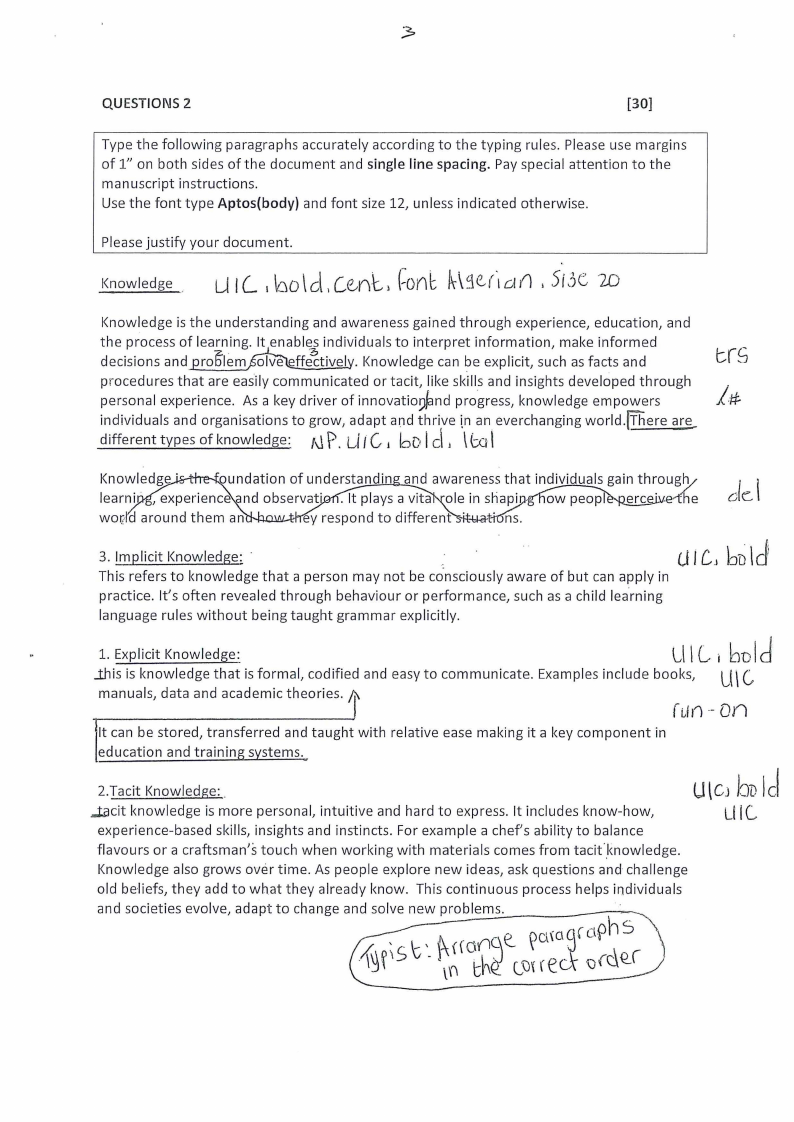
Type the following paragraphs accurately according to the typing rules. Please use margins
of 1" on both sides of the document and single line spacing. Pay special attention to the
manuscript instructions.
Use the font type Aptos(body) and font size 12, unless indicated otherwise.
Please justify your document.
Knowledge
U IL , bo \\d,Ce,nt l (=on~~\\:1e.,(1a()
'·
, 5dt. 2D
Knowledge is the understanding and awareness gained through experience, education, and
the process of learning. It enables individuals to interpret information, make informed
decisions and ro61em olve effe~tivel . Knowledge can be explicit, such as facts and
procedures that are easily communicated or tacit, like skills and insights developed through
personal experience. As a key driver of innovatio!»3nd pro.gress, knowledge empowers
individuals and organisations to grow, adapt and thrive [n an everchanging world.fi'.Eere are
Id, \\ different types of knowledge: /JP.LI/C I loo
ta I
tfS
/#:-
Knowledge·
oundation of understandin and awareness that individuals gain throug_!Y
learni , experience and observat' . It plays a vita ale in shapj_D~e-the
wo~la around them anu-....'-LlLlle,,y-t:r'lespond to different ~tefns.
/I
c e,
3. Implicit Knowledge:
.
\\d (JI Ci bu
This refers to knowledge that a person may not be co·nsciously aware of but can apply in
practice. It's often revealed through behaviour or performance, such as a child lea.ming
language rules without being taught grammar explicitly.
1. Explicit Knowledge:
..:thisis knowledge that is formal, codified and easy to communicate.
manuals, data and academic theories. frl
UIl i buld
U\\G Examples include books,
run --on
It can be stored, transferred and taught with relative ease making it a key component in
education and trainin s stems.
2.Tacit Knowledge: .
Ulcj bulei
.,J.acit knowledge is more personal, intuitive and hard to express. It includes know-how,
experience-based skills, insights and instincts. For example a chef's ability to balance
s flavours or a craftsman 1 touch when working with materials comes from tacit'_knowledge.
LIIC.
Knowledge also grows over time. As people explore new ideas, ask questions and challenge
old beliefs, they add to what they already know. This continuous process helps individuals
and societies evolve, adapt to change and solve n~e~w~p~r,.::o'..'.:b~le::.'.m~s.=-------:-T.:--;:--
, . ,_ ,
.{~~\\5 V.
Jl~\\ nfl.0tnhci\\"ol-'O-o\\{c(\\e·,ca~. f
ctf)h 5
-o((\\Q.r
,
|
|
5 Page 5 |
▲back to top |
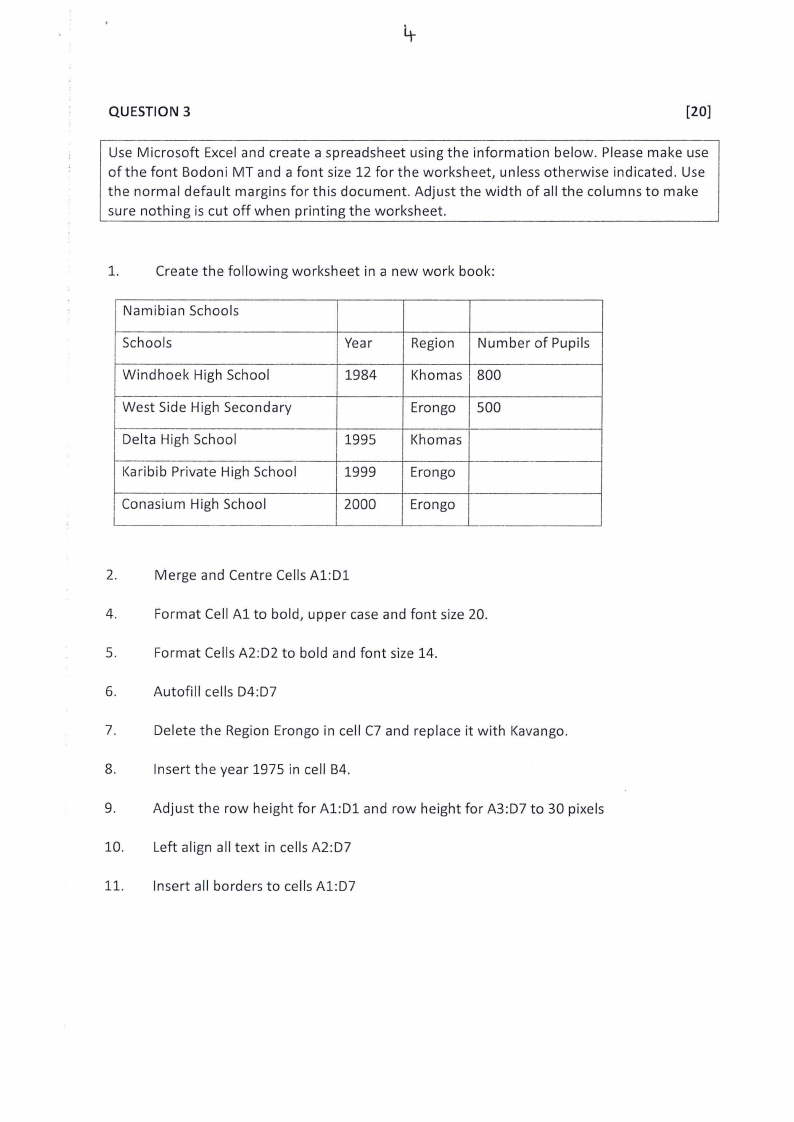
QUESTION 3
[20]
Use Microsoft Excel and create a spreadsheet using the information below. Please make use
of the font Badoni MT and a font size 12 for the worksheet, unless otherwise indicated. Use
the normal default margins for this document. Adjust the width of all the columns to make
sure nothing is cut off when printing the worksheet.
1.
Create the following worksheet in a new work book:
Namibian Schools
Schools
Windhoek High School
West Side High Secondary
Delta High School
Karibib Private High School
Conasium High School
Year
1984
1995
1999
2000
Region Number of Pupils
Kho mas 800
Erongo 500
Kho mas
Erongo
Erongo
2.
Merge and Centre Cells Al:Dl
4.
Format Cell Al to bold, upper case and font size 20.
5.
Format Cells A2:D2 to bold and font size 14.
6.
Autofill cells D4:D7
7.
Delete the Region Erongo in cell C7 and replace it with Kavango.
8.
Insert the year 1975 in cell B4.
9.
Adjust the row height for Al:Dl and row height for A3:D7 to 30 pixels
10. Left align all text in cells A2:D7
11. Insert all borders to cells Al:D7
|
|
6 Page 6 |
▲back to top |

CHART
1.
Insert a new sheet and rename it Chart. Use the information in sheet 1 A2:D7.
2.
Insert a 3-D staked 100% Column Chart and move the chart to the chart sheet.
3.
Change the chart title to Number of pupils-u/c, cent
4.
Save the Excel workbook as Question 3- your student number in the header and
· footer.
Make sure to print out both sheet in A-4 Portrait.
|
|
7 Page 7 |
▲back to top |
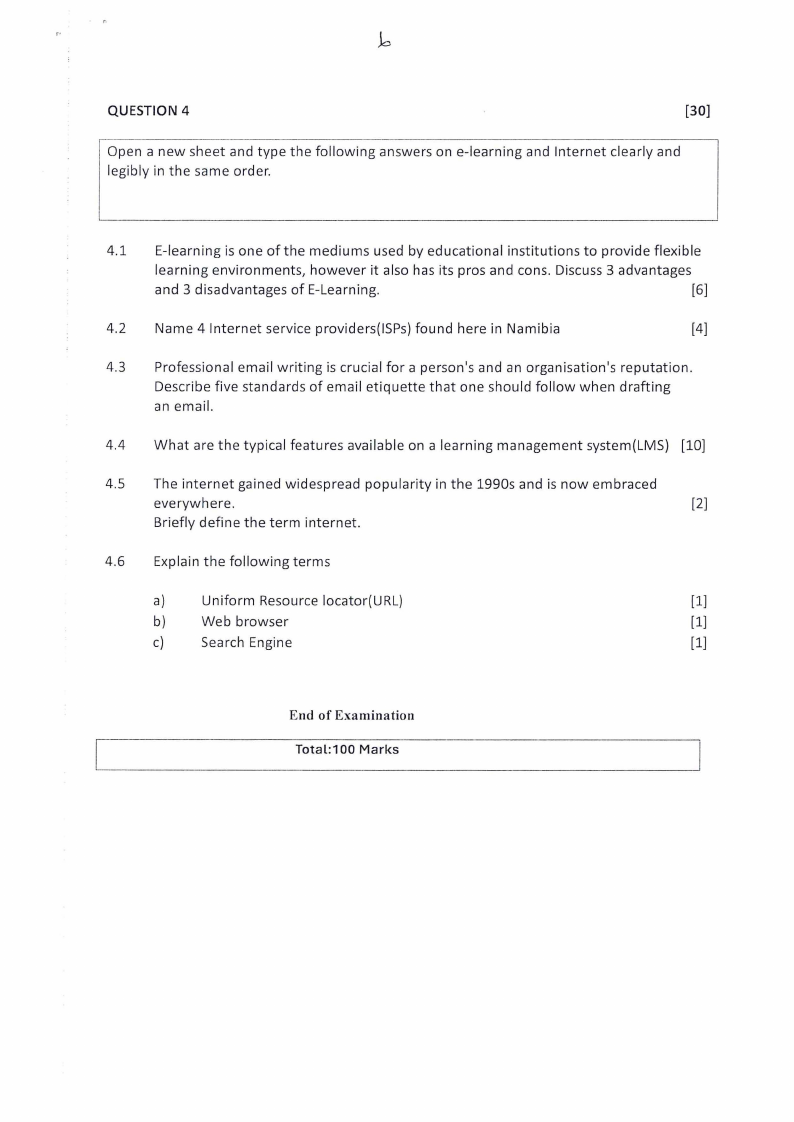
QUESTION 4
[30]
Open a new sheet and type the following answers one-learning and Internet clearly and
legibly in the same order.
4.1 E-learning is one of the mediums used by educational institutions to provide flexible
learning environments, however it also has its pros and cons. Discuss 3 advantages
and 3 disadvantages of E-Learning.
[6]
4.2 Name 4 Internet service providers(ISPs) found here in Namibia
[4]
4.3 Professional email writing is crucial for a person's and an organisation's reputation.
Describe five standards of email etiquette that one should follow when drafting
an email.
4.4 What are the typical features available on a learning management system(LMS) [10]
4.5 The internet gained widespread popularity in the 1990s and is now embraced
everywhere.
[2]
Briefly define the term internet.
4.6 Explain the following terms
a)
Uniform Resource locator(URL)
[1]
b)
Web browser
[1]
c)
Search Engine
[1]
End of Examination
Total:100 Marks