


 |
OLM621C-OPERATIONAL LOGISTICS MANAGEMENT-1ST OPP-JUNE 2025 |
|
|
1 Page 1 |
▲back to top |

nAmlBIA
UntVERSITY
OF SCIEnCEAno
TECHnOLOGY
HP-65B
HAROLDPUPKEWITZ
GraduateSchoolof Business
FACULTY OF COMMERCE; HUMAN SCIENCES AND EDUCATION
HAROLD PUPKEWITZ GRADUATE SCHOOL OF BUSINESS
QUALIFICATION: DIPLOMA IN BUSINESS PROCESS MANAGEMENT
QUALIFICATION CODE: 0GDBPM
LEVEL: 6
COURSE CODE: OLM621 C
COURSE NAME: OPERATIONAL LOGISTICS
MANAGEMENT
SESSION: JUNE 2025
DURATION: 3 HOURS
PAPER: PAPER 1
MARKS: 100
FIRST OPPORTUNITY EXAMINATION - QUESTION PAPER
EXAMINER(S)
DR GLORIA TSHOOPARA
MODERATOR:
MS HILMA NUUYANDJA
INSTRUCTIONS
1. Answer ALL the questions.
2. Write clearly and neatly.
3. Number the answers clearly.
PERMISSIBLE MATERIALS
1. Examination paper
2. Examination script
THIS QUESTION PAPER CONSISTS OF 4 PAGES (INCLUDING THIS FRONT PAGE)
1IPage
|
|
2 Page 2 |
▲back to top |
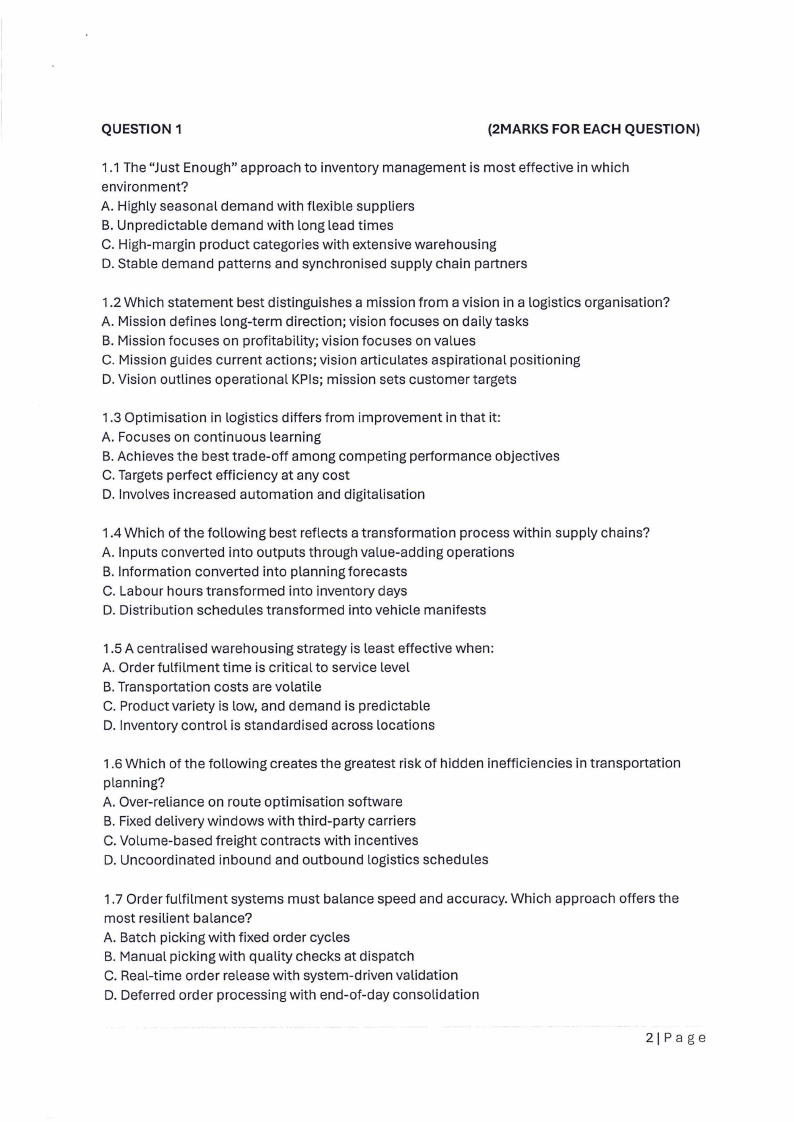
QUESTION 1
(2MARKS FOR EACH QUESTION)
1.1 The "Just Enough" approach to inventory management is most effective in which
environment?
A. Highly seasonal demand with flexible suppliers
B. Unpredictable demand with long lead times
C. High-margin product categories with extensive warehousing
D. Stable demand patterns and synchronised supply chain partners
1.2 Which statement best distinguishes a mission from a vision in a logistics organisation?
A. Mission defines long-term direction; vision focuses on daily tasks
B. Mission focuses on profitability; vision focuses on values
C. Mission guides current actions; vision articulates aspirational positioning
D. Vision outlines operational KPls; mission sets customer targets
1.3 Optimisation in logistics differs from improvement in that it:
A. Focuses on continuous learning
B. Achieves the best trade-off among competing performance objectives
C. Targets perfect efficiency at any cost
D. Involves increased automation and digitalisation
1.4 Which of the following best reflects a transformation process within supply chains?
A. Inputs converted into outputs through value-adding operations
B. Information converted into planning forecasts
C. Labour hours transformed into inventory days
D. Distribution schedules transformed into vehicle manifests
1.5 A centralised warehousing strategy is least effective when:
A. Order fulfilment time is critical to service level
B. Transportation costs are volatile
C. Product variety is low, and demand is predictable
D. Inventory control is standardised across locations
1.6 Which of the following creates the greatest risk of hidden inefficiencies in transportation
planning?
A. Over-reliance on route optimisation software
B. Fixed delivery windows with third-party carriers
C. Volume-based freight contracts with incentives
D. Uncoordinated inbound and outbound logistics schedules
1.7 Order fulfilment systems must balance speed and accuracy. Which approach offers the
most resilient balance?
A. Batch picking with fixed order cycles
B. Manual picking with quality checks at dispatch
C. Real-time order release with system-driven validation
D. Deferred order processing with end-of-day consolidation
2IPage
|
|
3 Page 3 |
▲back to top |
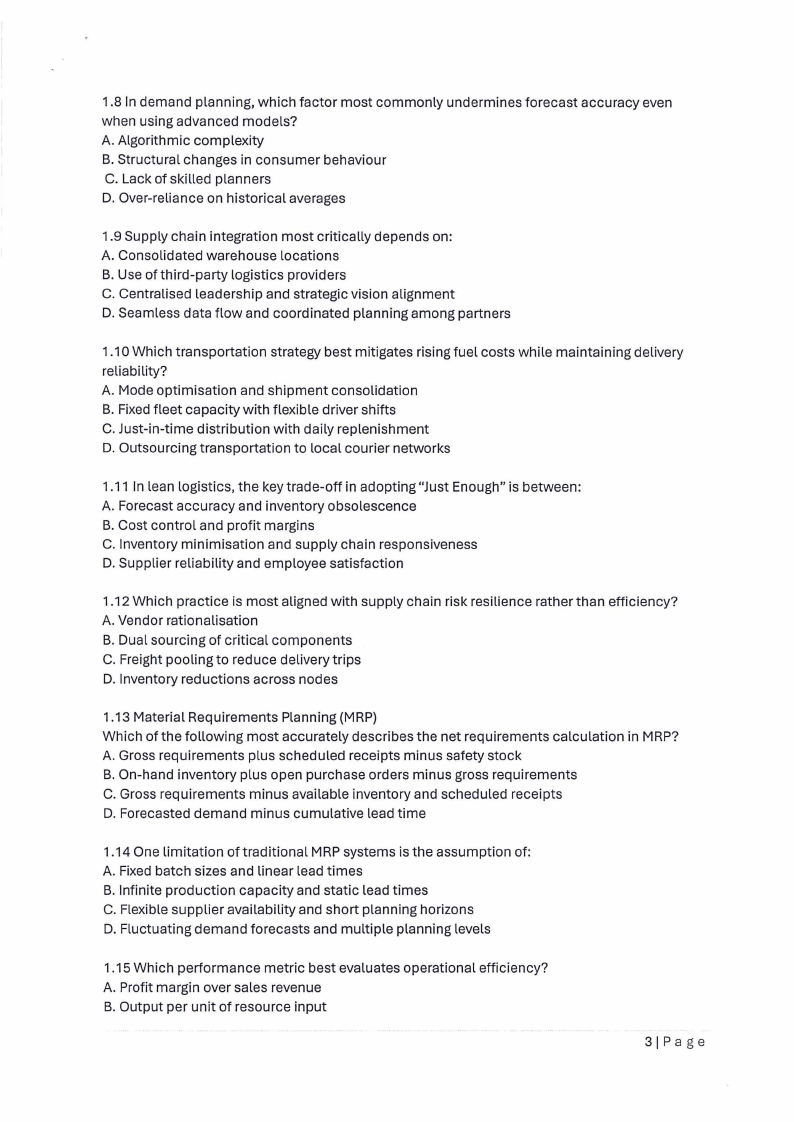
1.8 In demand planning, which factor most commonly undermines forecast accuracy even
when using advanced models?
A. Algorithmic complexity
B. Structural changes in consumer behaviour
C. Lack of skilled planners
D. Over-reliance on historical averages
1.9 Supply chain integration most critically depends on:
A. Consolidated warehouse locations
B. Use of third-party logistics providers
C. Centralised leadership and strategic vision alignment
D. Seamless data flow and coordinated planning among partners
1.1 oWhich transportation strategy best mitigates rising fuel costs while maintaining delivery
reliability?
A. Mode optimisation and shipment consolidation
B. Fixed fleet capacity with flexible driver shifts
C. Just-in-time distribution with daily replenishment
D. Outsourcing transportation to local courier networks
1.11 In lean logistics, the key trade-off in adopting "Just Enough" is between:
A. Forecast accuracy and inventory obsolescence
B. Cost control and profit margins
C. Inventory minimisation and supply chain responsiveness
D. Supplier reliability and employee satisfaction
1.12 Which practice is most aligned with supply chain risk resilience rather than efficiency?
A. Vendor rationalisation
B. Dual sourcing of critical components
C. Freight pooling to reduce delivery trips
D. Inventory reductions across nodes
1.13 Material Requirements Planning (MRP)
Which of the following most accurately describes the net requirements calculation in MRP?
A. Gross requirements plus scheduled receipts minus safety stock
B. On-hand inventory plus open purchase orders minus gross requirements
C. Gross requirements minus available inventory and scheduled receipts
D. Forecasted demand minus cumulative lead time
1.14 One limitation of traditional MRP systems is the assumption of:
A. Fixed batch sizes and linear lead times
B. Infinite production capacity and static lead times
C. Flexible supplier availability and short planning horizons
D. Fluctuating demand forecasts and multiple planning levels
1.15 Which performance metric best evaluates operational efficiency?
A. Profit margin over sales revenue
B. Output per unit of resource input
31Page
|
|
4 Page 4 |
▲back to top |
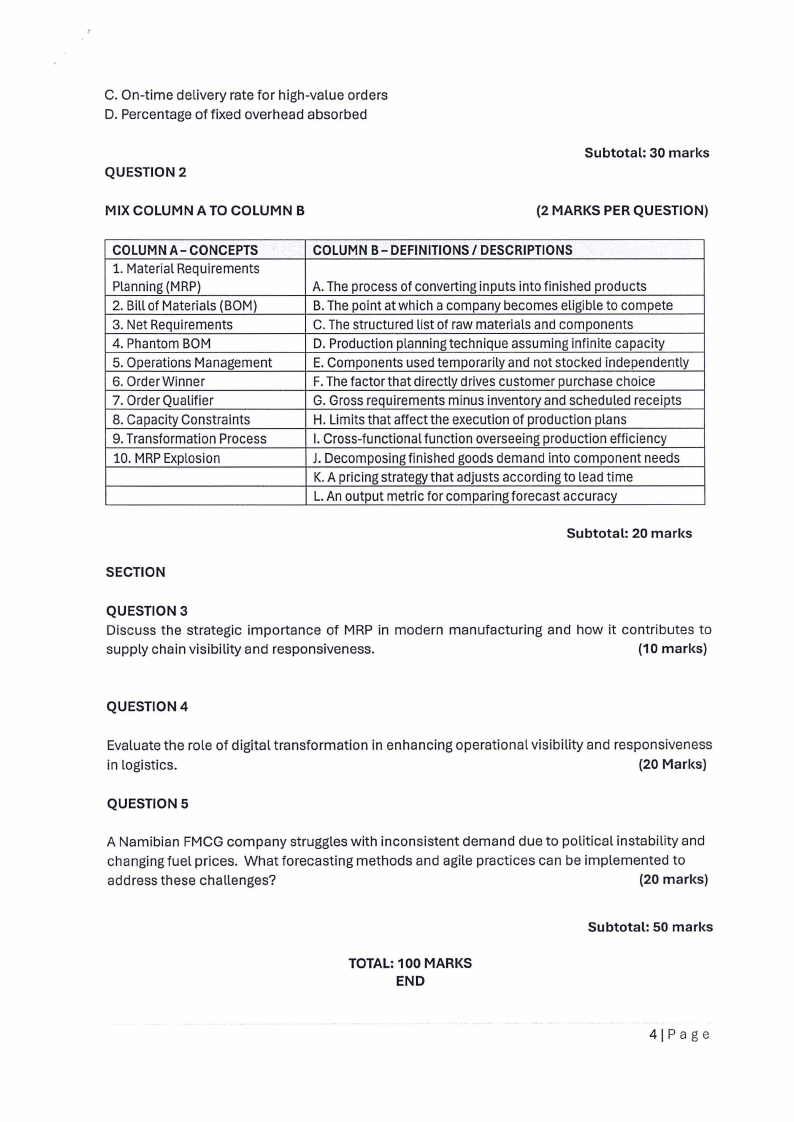
C. On-time delivery rate for high-value orders
D. Percentage of fixed overhead absorbed
QUESTION 2
Subtotal: 30 marks
MIX COLUMN A TO COLUMN B
(2 MARKS PER QUESTION)
COLUMNA- CONCEPTS
1. Material Requirements
Planning {MRP)
2. Bill of Materials {BOM)
3. Net Requirements
4. Phantom BOM
5. Operations Management
6. Order Winner
7. Order Qualifier
8. Capacity Constraints
9. Transformation Process
10. MRPExplosion
COLUMN B- DEFINITIONS/ DESCRIPTIONS
A. The process of converting inputs into finished products
B. The point at which a company becomes eligible to compete
C. The structured list of raw materials and components
D. Production planning technique assuming infinite capacity
E. Components used temporarily and not stocked independently
F. The factor that directly drives customer purchase choice
G. Gross requirements minus inventory and scheduled receipts
H. Limits that affect the execution of production plans
I. Cross-functional function overseeing production efficiency
J. Decomposing finished goods demand into component needs
K. A pricing strategy that adjusts according to lead time
L. An output metric for comparing forecast accuracy
Subtotal: 20 marks
SECTION
QUESTION 3
Discuss the strategic importance of MRP in modern manufacturing
supply chain visibility and responsiveness.
and how it contributes to
(10 marks)
QUESTION4
Evaluate the role of digital transformation in enhancing operational visibility and responsiveness
in logistics.
(20 Marks)
QUESTION 5
A Namibian FMCG company struggles with inconsistent demand due to political instability and
changing fuel prices. What forecasting methods and agile practices can be implemented to
address these challenges?
(20 marks)
TOTAL: 100 MARKS
END
Subtotal: 50 marks
41Page