


 |
BEP712S - SME PROJECTS - 1ST OPP - NOV 2025 |
|
|
1 Page 1 |
▲back to top |

nAmlBIA unlVERSITY
OF SCIEnCE Ano TECHnOLOGY
FACULTY OF COMMERCE, HUMAN SCIENCES AND EDUCATION
DEPARTMENT OF GOVERNANCE AND MANAGEMENT SCIENCES
QUALIFICATION: BACHELOR OF BUSINESS MANAGEMENT HONOURS
QUALIFICATION CODE: 07BBMA
LEVEL: 7
COURSE CODE: BEP712S
COURSE NAME: SME Projects
SESSION: NOVEMBER 2025
DURATION: 3 HOURS
PAPER: THEORY (PAPER 1)
MARKS: 100
FIRST OPPORTUNITY EXAMINATION QUESTION PAPER
EXAMINER(S) Ms. B. NDUNGAUA
Ms. V. KAIMU
Mr. V. SINALUMBU
MODERATOR MR. J. OJO
INSTRUCTIONS
1. Answer ALL the questions.
2. This paper comprises of FIVE questions.
3. Read all the questions carefully before answering.
4. Number the answers clearly
PERMISSIBLE MATERIAL
CALCULATOR
THIS QUESTION PAPER CONSISTS OF_4_ PAGES (Including this front page)
|
|
2 Page 2 |
▲back to top |
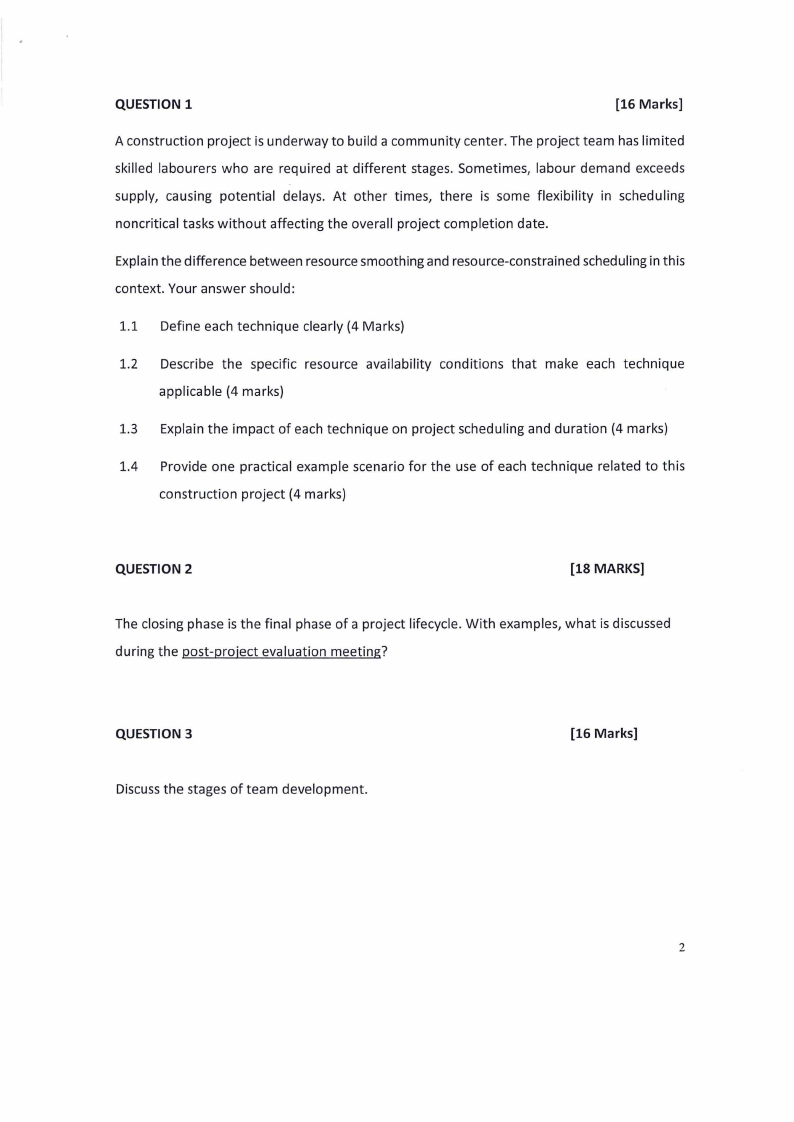
QUESTION 1
[16 Marks]
A construction project is underway to build a community center. The project team has limited
skilled labourers who are required at different stages . Sometimes, labour demand exceeds
supply, causing potential delays. At other times, there is some flexibility in scheduling
noncritical tasks without affecting the overall project completion date.
Explain the difference between resource smoothing and resource-constrained scheduling in this
context. Your answer should:
1.1 Define each technique clearly (4 Marks)
1.2 Describe the specific resource availability conditions that make each technique
applicable (4 marks)
1.3 Explain the impact of each technique on project scheduling and duration (4 marks)
1.4 Provide one practical example scenario for the use of each technique related to this
construction project (4 marks)
QUESTION 2
[18 MARKS]
The closing phase is the final phase of a project lifecycle. With examples, what is discussed
during the post-project evaluation meeting?
QUESTION 3
Discuss the stages of team development.
[16 Marks]
2
|
|
3 Page 3 |
▲back to top |
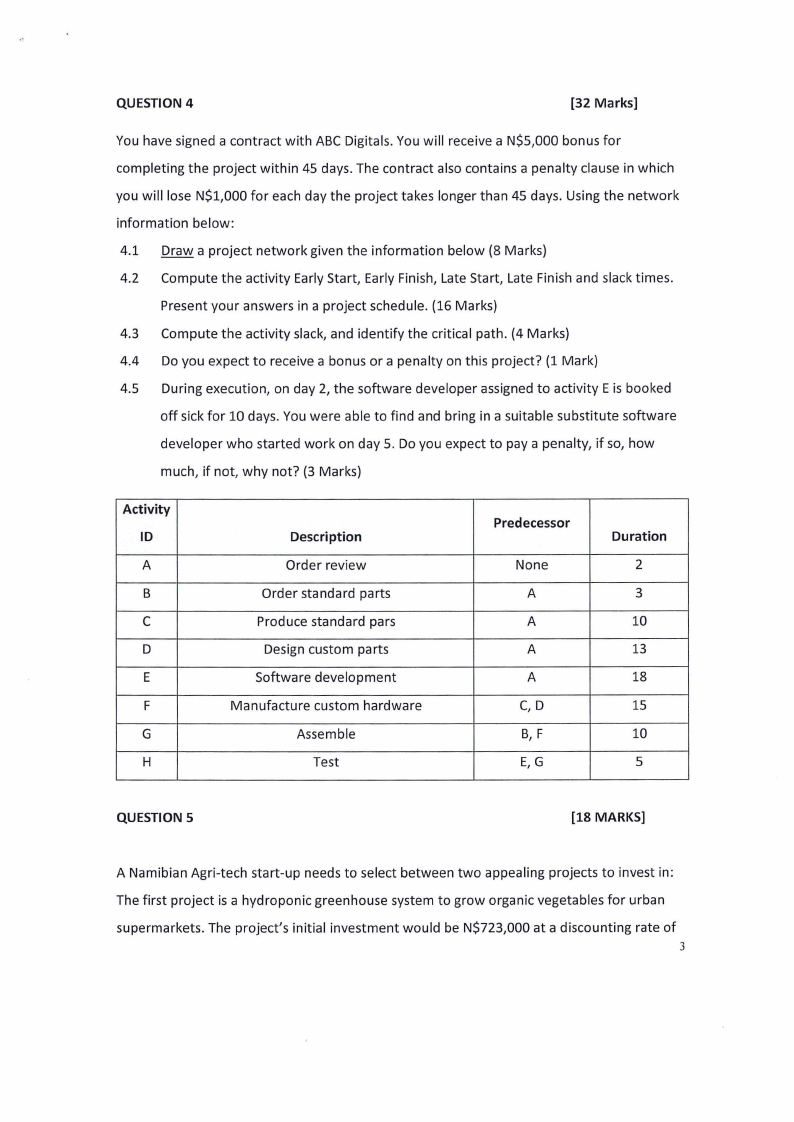
QUESTION 4
[32 Marks]
You have signed a contract with ABC Digitals. You will receive a N$5,000 bonus for
completing the project within 45 days. The contract also contains a penalty clause in which
you will lose N$1,000 for each day the project takes longer than 45 days. Using the network
information below:
4.1 Draw a project network given the information below (8 Marks)
4.2 Compute the activity Early Start, Early Finish, Late Start, Late Finish and slack times.
Present your answers in a project schedule. (16 Marks)
4.3 Compute the activity slack, and identify the critical path . (4 Marks)
4.4 Do you expect to receive a bonus or a penalty on this project? (1 Mark)
4.5 During execution, on day 2, the software developer assigned to activity E is booked
off sick for 10 days. You were able to find and bring in a suitable substitute software
developer who started work on day 5. Do you expect to pay a penalty, if so, how
much, if not, why not? (3 Marks)
Activity
ID
A
B
C
D
E
F
G
H
Description
Order review
Order standard parts
Produce standard pars
Design custom parts
Software development
Manufacture custom hardware
Assemble
Test
Predecessor
None
A
A
A
A
C,D
B, F
E, G
Duration
2
3
10
13
18
15
10
5
QUESTION 5
[18 MARKS]
A Namibian Agri-tech start-up needs to select between two appealing projects to invest in:
The first project is a hydroponic greenhouse system to grow organic vegetables for urban
supermarkets. The project's initial investment would be N$723,000 at a discounting rate of
3
|
|
4 Page 4 |
▲back to top |
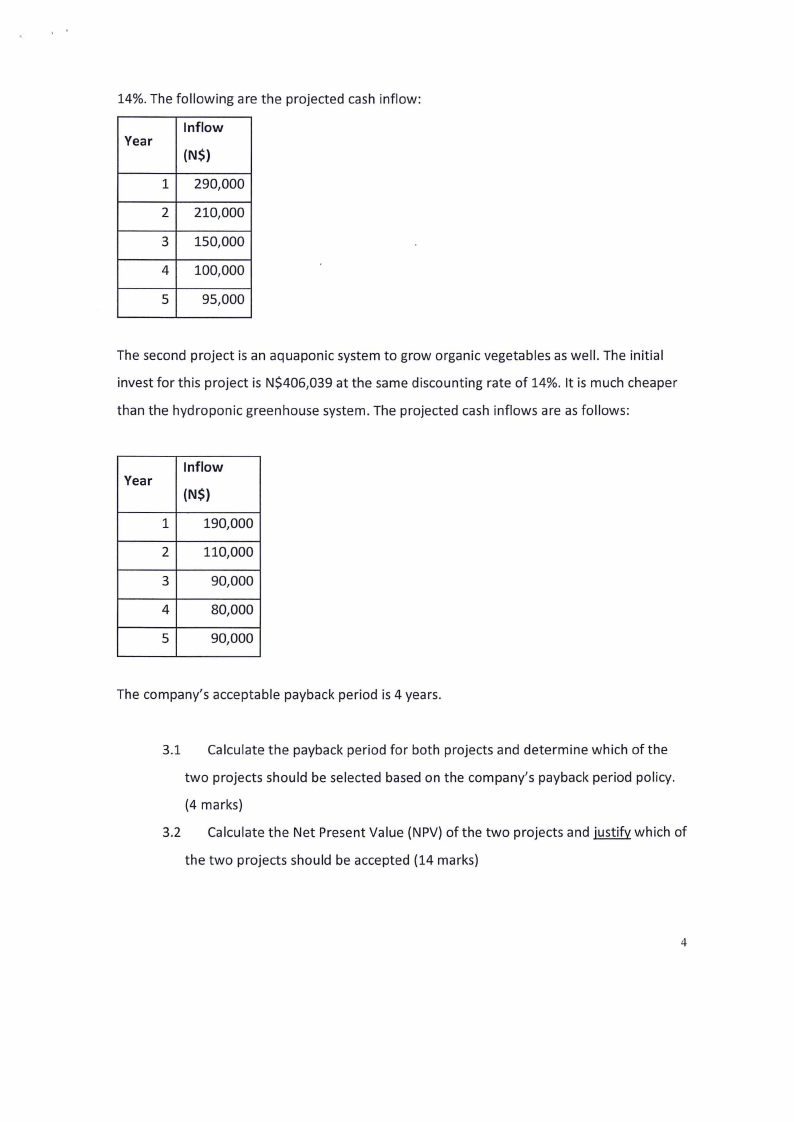
14%. The following are the projected cash inflow:
Year
Inflow
(N$)
1 290,000
2 210,000
3 150,000
4 100,000
5 95,000
The second project is an aquaponic system to grow organic vegetables as well. The initial
invest for this project is N$406,039 at the same discounting rate of 14%. It is much cheaper
than the hydroponic greenhouse system. The projected cash inflows are as follows:
Year
Inflow
(N$)
1 190,000
2 110,000
3
90,000
4
80,000
5
90,000
The company's acceptable payback period is 4 years.
3.1 Calculate the payback period for both projects and determine which of the
two projects should be selected based on the company's payback period policy.
(4 marks)
3.2 Calculate the Net Present Value (NPV) of the two projects and justify which of
the two projects should be accepted (14 marks)
4